Natural maple polyphenol found to inhibit tooth decay bacteria in new study

dentist
Credit: CC0 Public Domain

A new study in the journal Microbiology Spectrum highlights the potential of using a natural compound from maple to combat the bacteria responsible for tooth decay: Streptococcus mutans.

The compound, epicatechin gallate, is a powerful and safe alternative to traditional plaque-fighting agents. Its natural abundance, affordability and lack of toxicity make it especially promising for inclusion in oral care products such as mouthwashes, offering a safer option for young children, who often accidentally swallow mouthwash.

The new study emerged as an offshoot of research into natural compounds that inhibit biofilm formation in Listeria monocytogenes, a foodborne pathogen.

As is often the case in science, the researchers made an unexpected observation tha...

Read More

Invisible polymer film offers powerful conductivity for smart devices

Invisible material could revolutionise smart tech
Credit: La Trobe University

Scientists at La Trobe University have produced a new, powerful electricity-conducting material in research which could revolutionize smartphones and wearable technologies like medical devices.

The new technique uses hyaluronic acid, well known due to its popularity in skincare, applied directly to a gold-plated surface to create a thinner, more durable film, or polymer, used to conduct electricity in devices like biosensors.

Lead researcher Associate Professor Wren Greene said the technique could lead to major improvements in the function, cost and usability of devices like touchscreens and wearable biosensors.

“Conductive polymers as we know them were developed nearly 50 years ago and although they’re exciting, they haven’t lived up to their poten...

Read More

36 billion solar masses: Cosmic Horseshoe galaxy harbors what may be the most massive black hole ever detected

'Most massive black hole ever discovered' is detected
Another image of the Cosmic Horseshoe, but with the pair of images of a second background source highlighted. The faint central image forms close to the black hole, which is what made the new discovery possible. Credit: NASA/ESA/Tian Li(University of Portsmouth)

Astronomers have discovered potentially the most massive black hole ever detected. The cosmic behemoth is close to the theoretical upper limit of what is possible in the universe and is 10,000 times heavier than the black hole at the center of our own Milky Way galaxy.

It exists in one of the most massive galaxies ever observed—the Cosmic Horseshoe—which is so big it distorts spacetime and warps the passing light of a background galaxy into a giant horseshoe-shaped Einstein ring.

Such is the enormousness of the ultram...

Read More

Lithium loss ignites Alzheimer’s, but lithium compound can reverse disease in mice

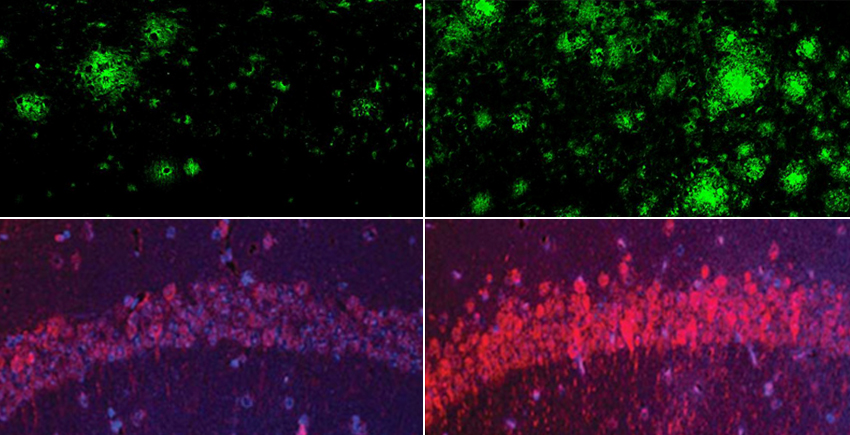
One pair of boxes shows fewer green amyloid clusters on the left and more on the right. Another pair of boxes shows a dim arc of purple and red tau on the left and a brighter arc on the right.
Top row: In a mouse model of Alzheimer’s disease, lithium deficiency (right) dramatically increased amyloid beta deposits in the brain compared with mice that had normal physiological levels of lithium (left). Bottom row: The same was true for the Alzheimer’s neurofibrillary tangle protein tau. Images: Yankner Lab

What is the earliest spark that ignites the memory-robbing march of Alzheimer’s disease? Why do some people with Alzheimer’s-like changes in the brain never go on to develop dementia? These questions have bedeviled neuroscientists for decades.

Now, a team of researchers at Harvard Medical School may have found an answer: lithium deficiency in the brain.

The work, published in Nature, shows for the first time that lithium occurs naturally in the brain, shields it from ...

Read More