






Einstein was wrong: MIT just settled a 100 year quantum debate

Figure shows a beam of red light with two atom icons in it, going through a hole. A screen depicts bending red light.
Caption:Schematic of the MIT experiment: Two single atoms floating in a vacuum chamber are illuminated by a laser beam and act as the two slits. The interference of the scattered light is recorded with a highly sensitive camera depicted as a screen. Incoherent light appears as background and implies that the photon has acted as a particle passing only through one slit.
Credits:Credit: Courtesy of the researchers

MIT physicists confirm that, like Superman, light has two identities that are impossible to see at once. Physicists at MIT recreated the double-slit experiment using individual photons and atoms held in laser light, uncovering the true limits of light’s wave–particle duality. Their results proved Einstein’s proposal wrong and confirmed a core prediction of quantum mechanics...

Read More
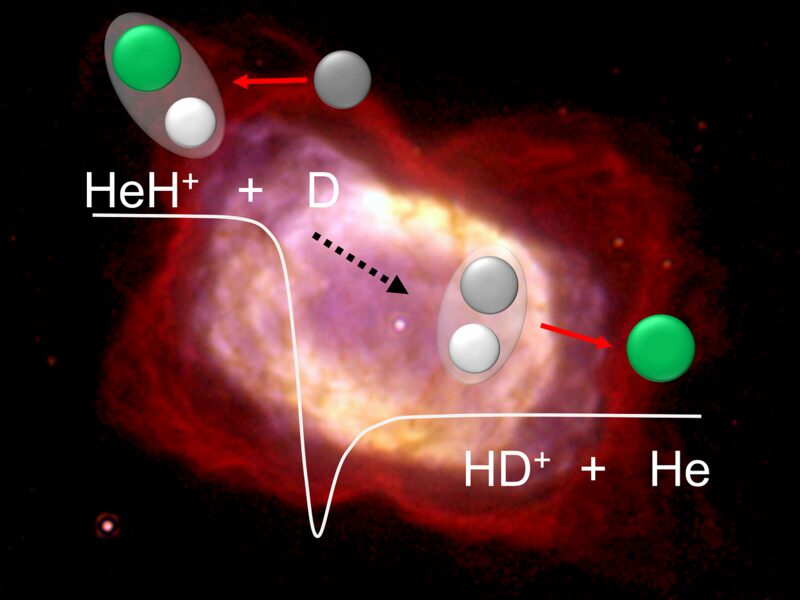
Scientists just recreated the Universe’s first molecule and solved a 13-billion-year-old puzzle

Researchers have discovered new insights into the reaction pathways of the first molecule in space. Long before stars lit up the sky, the universe was a hot, dense place where simple chemistry quietly set the stage for everything to come. Scientists have now recreated the first molecule ever to form, helium hydride, and discovered it played a much bigger role in the birth of stars than we thought. Using a special ultra-cold lab setup, they mimicked conditions from over 13 billion years ago and found that this ancient molecule helped cool the universe just enough for stars to ignite. Their findings could rewrite part of the story about how the cosmos evolved from darkness to light.

Immediately after the Big Bang, which occurred around 13...

Read More

New AI tool learns to read medical images with far less data

New AI tool learns to read medical images with far less data
GenSeg improves in-domain and out-of-domain generalization performance across a variety of segmentation tasks covering diverse diseases, organs, and imaging modalities. Credit: Nature Communications (2025). DOI: 10.1038/s41467-025-61754-6

A new artificial intelligence (AI) tool could make it much easier—and cheaper—for doctors and researchers to train medical imaging software, even when only a small number of patient scans are available.

The AI tool improves upon a process called medical image segmentation, where every pixel in an image is labeled based on what it represents—cancerous or normal tissue, for example. This process is often performed by a highly trained expert, and deep learning has shown promise in automating this labor-intensive task.

The big challenge is t...

Read More

Life’s emergence from non-living matter found more complex than previously understood

What were the chances of abiogenesis?
This illustration of early Earth includes liquid water as well as magma seeping from the planet’s core due to a large impact. Scientists at NASA are investigating the chemistry that might have existed at this time in the planet’s history. Credit: Simone Marchi

A new study published in July 2025 tackles one of science’s most profound mysteries—how did life first emerge from nonliving matter on early Earth? Using cutting edge mathematical approaches, researcher Robert G. Endres from Imperial College London has developed a framework that suggests the spontaneous origin of life faces far greater challenges than previously understood.

The study, published on the arXiv preprint server, focuses on the difficulty of assembling structured biological information under what could be reas...

Read More
