






Ghost particles may secretly decide the fate of collapsing stars

illustration of blue
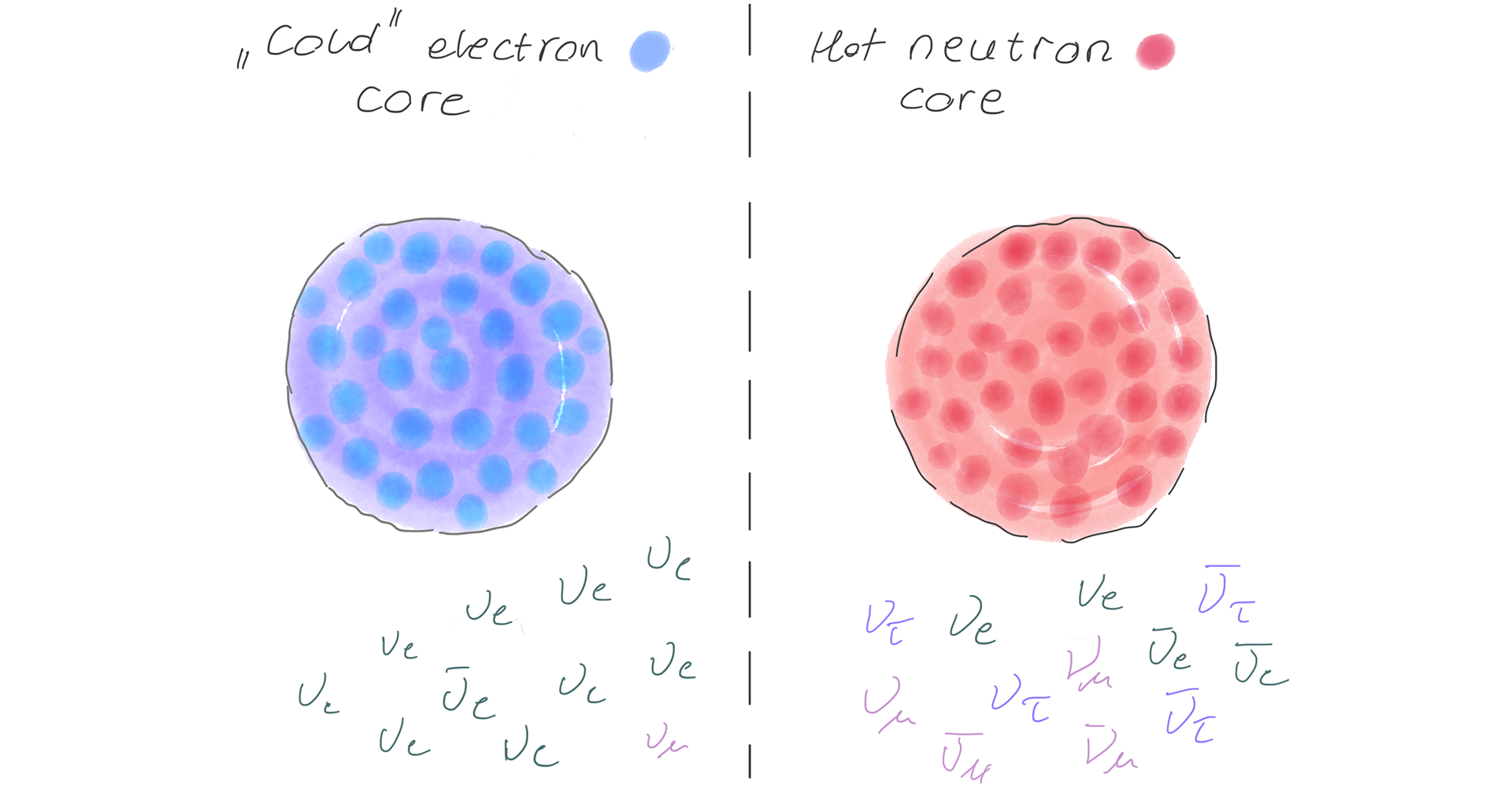
Left Panel: When neutrinos scatter with themselves via standard model interactions the collapsing core of the massive star is relatively cold, and the neutrinos are mostly all electron flavor. In this scenario we may get a supernova explosion leaving, usually, a neutron star remnant
Right Panel: If neutrinos have “secret” interactions with themselves, then electron neutrinos can be converted to all flavors. This leads to rapid heating, the “melting” of nuclei, and the rapid conversion of most protons to neutrons. We might get a black hole instead of a neutron star remnant. It is not yet clear if we get a supernova explosion.
(cr: George Fuller lab / UC San Diego)

Neutrinos are cosmic tricksters, paradoxically hardly there but lethal to stars significantly more massive than the sun...

Read More

Human CLOCK gene enhances brain connectivity and mental flexibility in mice, study finds

Human CLOCK gene enhances brain connectivity and mental flexibility in mice, study finds
Example images of excitatory neurons from the cerebral cortexes of humanized mice showing how the neurons from the humanized mice grew more dendrites. Credit: Dr. Yuxiang Liu

Clock genes are a set of genes known to contribute to the regulation of the human body’s internal 24-hour cycle, also known as the circadian rhythm. One of these genes is the so-called CLOCK gene, a protein that regulates the activity of other genes, contributing to recurrent patterns of sleep and wakefulness.

Past findings suggest that this gene is also expressed in the neocortex, a brain region that supports important cognitive abilities, including reasoning, decision-making and the processing of language. However, the gene’s possible contribution to these specific brain functions remains poorly understood.

...Read More

JWST uncovers hidden black holes devouring stars in dusty galaxies

The James Webb Space Telescope in front of a tidal disruption event, a black hole shredding a star
Caption:Astronomers at MIT, Columbia University, and elsewhere have used NASA’s James Webb Space Telescope to peer through the dust of nearby galaxies and into the aftermath of a black hole’s stellar feast. Credits:Credit: NRAO/AUI/NSF/NASA

Astronomers at MIT, Columbia University, and elsewhere have used NASA’s James Webb Space Telescope (JWST) to peer through the dust of nearby galaxies and into the aftermath of a black hole’s stellar feast.

In a study appearing today in Astrophysical Journal Letters, the researchers report that for the first time, JWST has observed several tidal disruption events—instances when a galaxy’s central black hole draws in a nearby star and whips up tidal forces that tear the star to shreds, giving off an enormous burst of energy in the process.

...Read More

Physicists discover new state of quantum matter

Professor Luis Jauregui
Professor Luis Jauregui of the UC Irvine Department of Physics & Astronomy described how the new material he and his lab developed only exists in their labs. Steve Zylius / UC Irvine

Researchers at the University of California, Irvine have discovered a new state of quantum matter. The state exists within a material that the team reports could lead to a new era of self-charging computers and ones capable of withstanding the challenges of deep space travel.

“It’s a new phase of matter, similar to how water can exist as liquid, ice or vapor,” said Luis A. Jauregui, professor of physics & astronomy at UC Irvine and corresponding author of the new paper in Physical Review Letters.

“It’s only been theoretically predicted—no one has ever measured it until now.”

This new phase is li...

Read More
