Complex organic molecules found in young star’s disk hint at cosmic origins of life

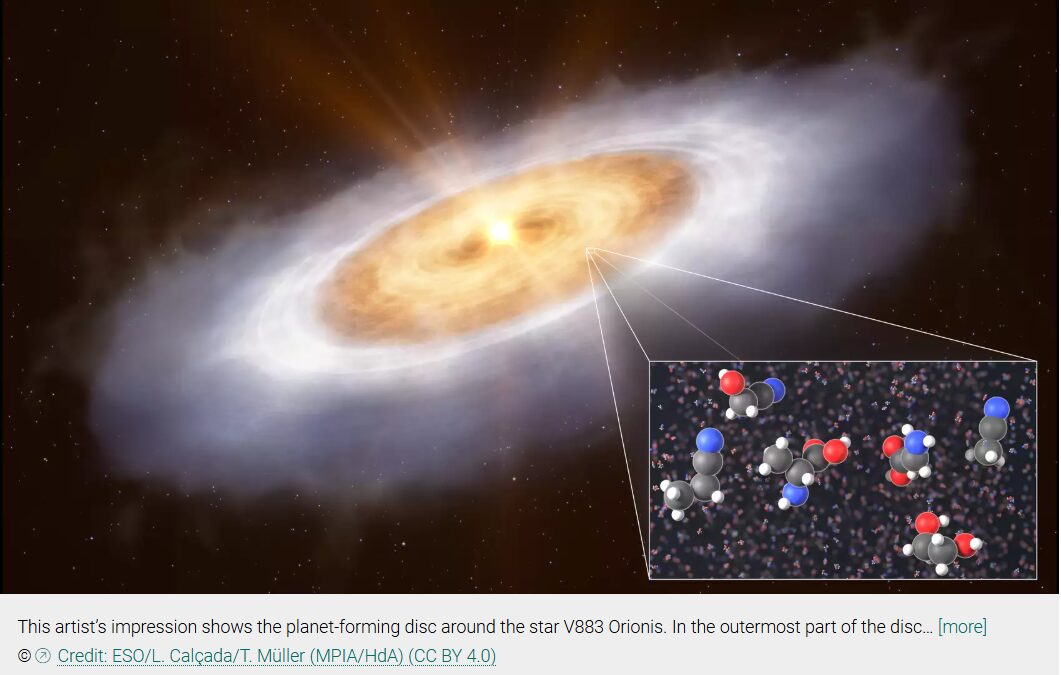
Using the Atacama Large Millimeter/submillimeter Array (ALMA), a team of astronomers led by Abubakar Fadul from the Max Planck Institute for Astronomy (MPIA) has discovered complex organic molecules—including the first tentative detection of ethylene glycol and glycolonitrile—in the protoplanetary disk of the outbursting protostar V883 Orionis.

These compounds are considered precursors to the building blocks of life. Comparing different cosmic environments reveals that the abundance and complexity of such molecules increase from star-forming regions to fully evolved planetary systems. This suggests that the seeds of life are assembled in space and are widespread.

The findings are published in the Astrophysical Journal Letters.

Astronomers have discovered complex organic m...

Read More

Newly discovered ‘sixth sense’ links gut microbes to the brain in real time

Sixth Sense' Links Gut Microbes to the Brain in Real Time - ScienceBlog.com

In a breakthrough that reimagines the way the gut and brain communicate, researchers have uncovered what they call a “neurobiotic sense,” a newly identified system that lets the brain respond in real time to signals from microbes living in our gut.

The new research, led by Duke University School of Medicine neuroscientists Diego Bohórquez, Ph.D., and M. Maya Kaelberer, Ph.D., published in Nature, centers on neuropods, tiny sensor cells lining the colon’s epithelium. These cells detect a common microbial protein and send rapid messages to the brain that help curb appetite.

But this is just the beginning...

Read More

Metasurfaces could be the next quantum information processors

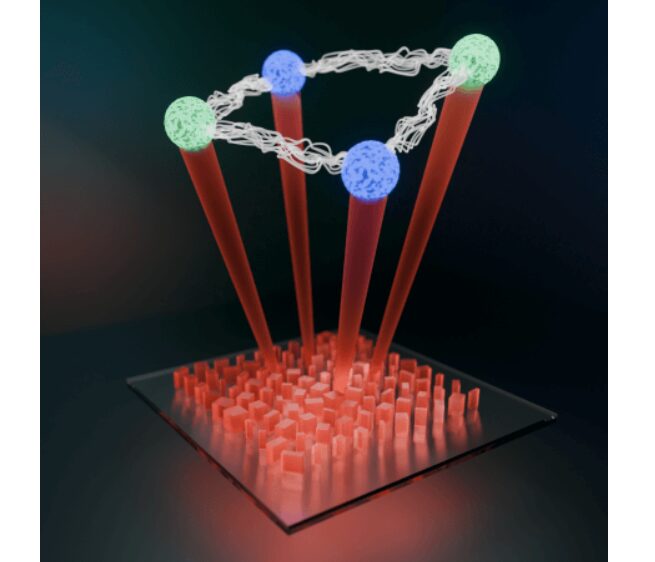
In the race toward practical quantum computers and networks, photons hold intriguing possibilities as fast carriers of information at room temperature.

Photons are typically controlled and coaxed into quantum states via waveguides on extended microchips, or through bulky devices built from lenses, mirrors, and beam splitters. The photons become entangled—enabling them to encode and process quantum information in parallel—through complex networks of these optical components. But such systems are notoriously difficult to scale up due to the large numbers and imperfections of parts required to do any meaningful computation or networking.

Could all those optical components be collapsed into a single, flat, ultra-thin array of subwavelength elements that control light in the exac...

Read More

Astronomers capture giant planet forming 440 light-years from Earth

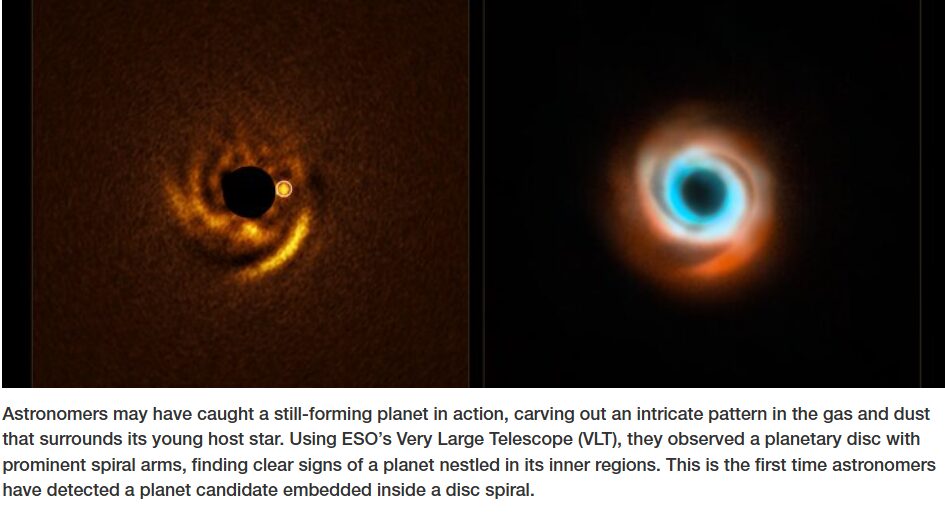
Astronomers may have caught a still-forming planet in action, carving out an intricate pattern in the gas and dust that surrounds its young host star. Using ESO’s Very Large Telescope (VLT), they observed a planetary disc with prominent spiral arms, finding clear signs of a planet nestled in its inner regions. This is the first time astronomers have detected a planet candidate embedded inside a disc spiral.

“We will never witness the formation of Earth, but here, around a young star 440 light-years away, we may be watching a planet come into existence in real time,” says Francesco Maio, a doctoral researcher at the University of Florence, Italy, and lead author of this study, published on July 21 in Astronomy & Astrophysics.

The potential planet-in-the-making was detected around...

Read More