






Antibody sIgM emerges as a key guardian of gut health and metabolism

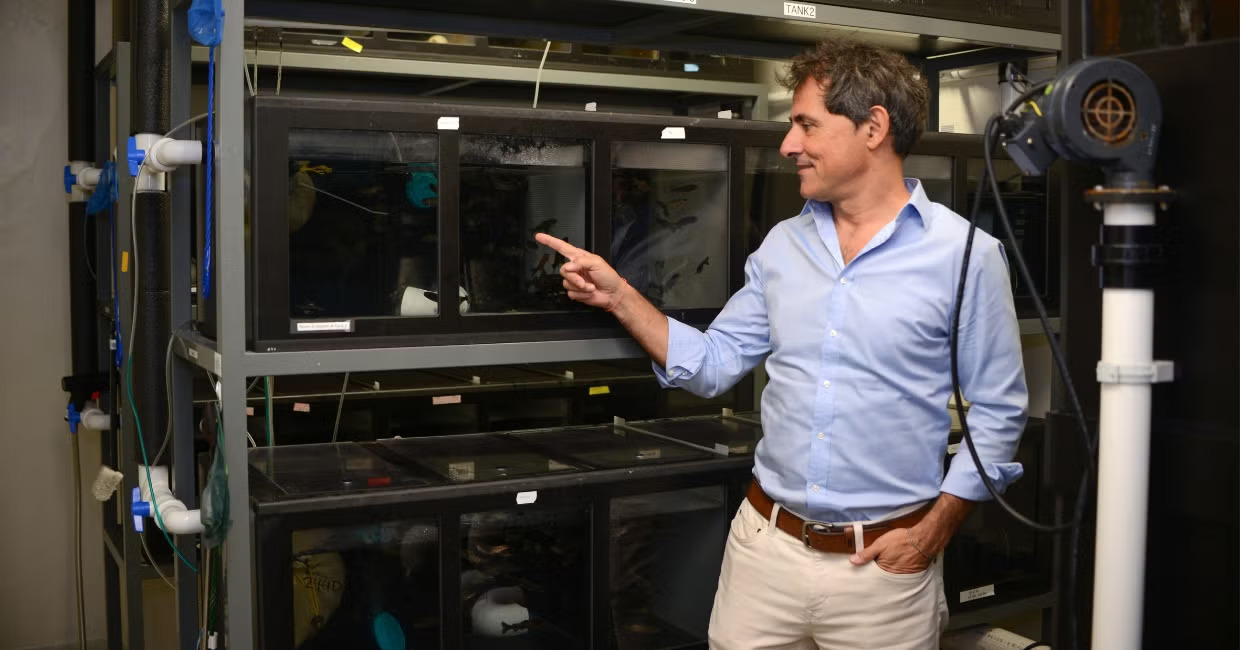
Oriol Sunyer pointing to rainbow trout, the fish species used for the reported study.
Image: Courtesy of Penn Vet

A pioneering new study published in Nature Microbiology, led by J. Oriol Sunyer, professor of immunology and pathobiology at the School of Veterinary Medicine, and a team of researchers at Penn Vet and the University of New Mexico, has uncovered a surprising new player in gut health: an antibody called secretory immunoglobulin M (sIgM).

While another antibody, secretory immunoglobulin A (sIgA), has long been known for helping balance the bacteria in our intestines, this new research shows that sIgM may be just as vital—if not more so—in protecting gut health and maintaining overall well-being.

Secretory immunoglobulins—immunoglobulins found in the mucosal surfaces ...

Read More

New Horizons conducts first-ever successful deep space stellar navigation test

First successful deep-space demonstration of stellar navigation

As NASA’s New Horizons spacecraft traveled through the Kuiper Belt at a distance of 438 million miles from Earth, an international team of astronomers used the far-flung probe to conduct an unprecedented experiment: the first-ever successful demonstration of deep space stellar navigation.

A paper describing the results was accepted for publication in The Astronomical Journal. The pre-print is available on the server arXiv.

As a proof-of-concept test, the researchers took advantage of the spacecraft’s unique vantage point as it traveled toward interstellar space to image two of our nearest stellar neighbors, Proxima Centauri, which is 4.2 light-years from Earth, and Wolf 359, which is 7.86 light-years away.

From New Horizons’ perspective, the two nearby stars shifted their app...

Read More

Mimicking the benefits of exercise with a single molecule

Mimicking the benefits of exercise with a single molecule

Capital Medical University, in collaboration with the Chinese Academy of Sciences, reports that betaine, a molecule produced in the kidney and enhanced through sustained exercise, operates as a potent inhibitor of inflammatory and aging-related pathways.

Regular physical activity boosts health across cardiovascular, metabolic, and neurological systems. Scientists have traced improvements in immune function, insulin sensitivity, clearing of senescent cells and tissue regeneration to consistent physical activity. Earlier animal studies suggested that long-term exercise can delay aging processes and reduce vulnerability to chronic disease.

Precise molecular explanations for how sustained exercise reshapes human biology remain incomplete...

Read More

Centaur: AI that thinks like us—and could help explain how we think

AI that thinks like us—and could help explain how we think
Evaluation in different held-out settings. Credit: Nature (2025). DOI: 10.1038/s41586-025-09215-4

Researchers at Helmholtz Munich have developed an artificial intelligence model that can simulate human behavior with remarkable accuracy. The language model, called Centaur, was trained on more than ten million decisions from psychological experiments—and makes decisions in ways that closely resemble those of real people. This opens new avenues for understanding human cognition and improving psychological theories.

For decades, psychology has aspired to explain the full complexity of human thought. Yet traditional models could either offer a transparent explanation of how people think—or reliably predict how they behave. Achieving both has long seemed out of reach.

The team le...

Read More
