
Global carbon emissions on track to exhaust 1.5°C budget in three years, study warns

climate
Credit: CC0 Public Domain

The central estimate of the remaining carbon budget for 1.5°C is 130 billion tons of carbon dioxide (CO2) (from the beginning of 2025). This would be exhausted in a little more than three years at current levels of CO2 emissions, according to the latest Indicators of Global Climate Change study published in the journal Earth System Science Data, and the budget for 1.6°C or 1.7°C could be exceeded within nine years.

Prof. Piers Forster, Director of the Priestley Center for Climate Futures at the University of Leeds and lead author of the study, said, “Our third annual edition of Indicators of Global Climate Change shows that both warming levels and rates of warming are unprecedented.

“Continued record-high emissions of greenhouse gases mean more of us ...

Read More
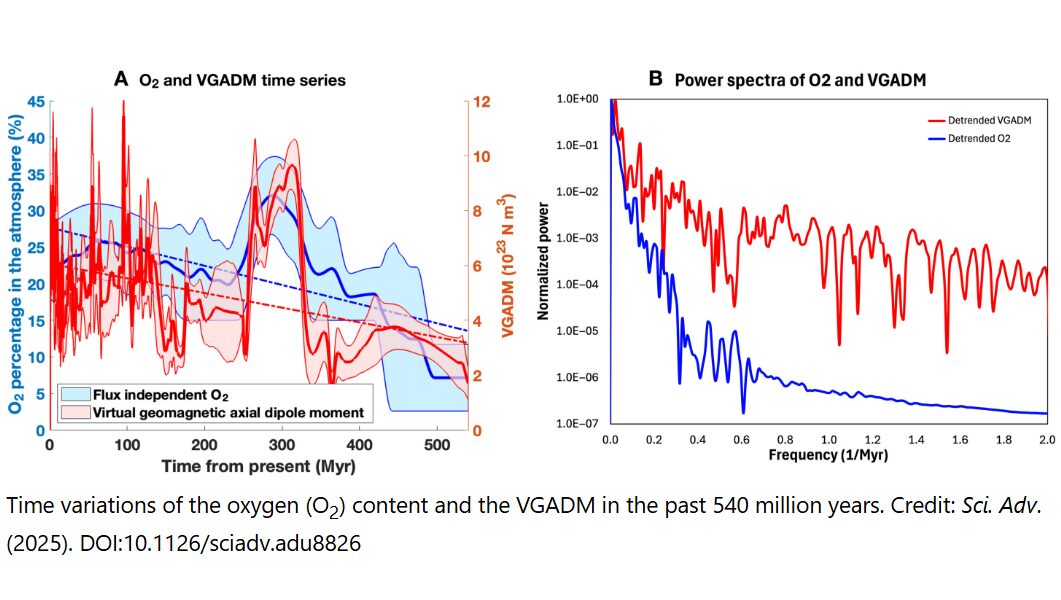
Surprising discovery shows a strong link between Earth’s magnetic field and atmospheric oxygen levels

Every breath we take in contains 21% oxygen, the gas that makes life on Earth possible. Oxygen, in its combined oxide state, has always been abundant in Earth’s crust, but elemental diatomic oxygen became part of our atmosphere around 2.4 to 2.5 billion years ago as a gift from cyanobacteria, which triggered the Great Oxidation Event and breathed life into Earth.

A joint venture between NASA Goddard Space Flight Center and the University of Leeds discovered that the Earth’s magnetic field strength and atmospheric oxygen levels over the past 540 years have seemed to spike and dip at the same time, showing a strong, statistically significant correlation between the two.

This correlation could arise from unexpected connections between geophysical processes in Earth’s deep interior,...

Read More

Passive cooling paint sweats off heat to deliver 10X cooling and 30% energy savings

New passive cooling paint sweats off heat to deliver 10X cooling and 30% energy savings
Comparison of radiative cooling paint versus integrated cooling paint for buildings. Credit: Science (2025). DOI: https://doi.org/10.1126/science.adt3372

A new cement-based paint can cool down the building by sweating off the heat. The cooling paint, named CCP-30, was designed by an international team of researchers and features a nanoparticle-modified porous structure composed of a calcium silicate hydrate (C-S-H) gel network.

This design enabled it to achieve superior cooling by combining both radiative, evaporative and reflective cooling mechanisms, which allowed it to reflect 88–92% of sunlight, emit 95% of the heat as infrared radiation, and hold about 30% of its weight in water, making it a paint ideal for keeping spaces cool throughout the day and across seasons.

As pe...

Read More

Exploring late accretion’s role in terrestrial planet evolution


Media Title
High-energy Venus Impacts

Southwest Research Institute has collaborated with Yale University to summarize the scientific community’s notable progress in advancing the understanding of the formation and evolution of the inner rocky planets, the so-called terrestrial planets. Their paper focuses on late accretion’s role in the long-term evolution of terrestrial planets, including their distinct geophysical and chemical properties as well as their potential habitability.

The Review paper is published in the journal Nature.

Solar systems form when clouds of gas and dust begin to coalesce. Gravity pulls these elements together, forming a central star, like our sun, surrounded by a flattened disk of consolidating materials...

Read More