






By measuring gases around young stars, astronomers unlock major clues to planet formation

By measuring gases around young stars, astronomers unlock major clues to planet formation
1.3 mm (Left panels) and 12CO (2-1) moment zero images (Right panels) of the AGE-PRO sample. Credit: arXiv (2025). DOI: 10.48550/arxiv.2506.10719

An international team of scientists led by astronomers from the University of Wisconsin–Madison has produced the most accurate measurement of the gases swirling around young stars and how their mass changes over time. The discovery joins many pieces of a puzzle that may reveal which kinds of planets form—rocky Earth-types, gas giants like Jupiter, or balls of ice in the Neptune mold—as star systems mature.

The researchers used an array of 66 massive radio telescopes, the Atacama Large Millimeter/submillimeter Array, perched at 16,000 feet in the Chilean Andes Mountains, to study the disks of gas spinning in the gravity of each of 3...

Read More
Tiny receiver chip uses stacked capacitors to block interference in 5G IoT devices

This compact, low-power receiver could give a boost to 5G smart devices
MIT researchers developed this compact, wireless receiver chip that uses a special filtering mechanism which consumes less than a milliwatt of static power while blocking unwanted signals that could jam an IoT device like a health wearable. Credit: Soroush Araei, Mohammad Barzgari, Haibo Yang and Negar Reiskarimian

MIT researchers have designed a compact, low-power receiver for 5G-compatible smart devices that is about 30 times more resilient to a certain type of interference than some traditional wireless receivers.

The low-cost receiver would be ideal for battery-powered internet of things (IoT) devices like environmental sensors, smart thermostats, or other devices that need to run continuously for a long time, such as health wearables, smart cameras, or industrial monitoring sen...

Read More

Astronomers have found the home address for the universe’s ‘missing’ matter

Universe’s Missing Matter Found by FRBs
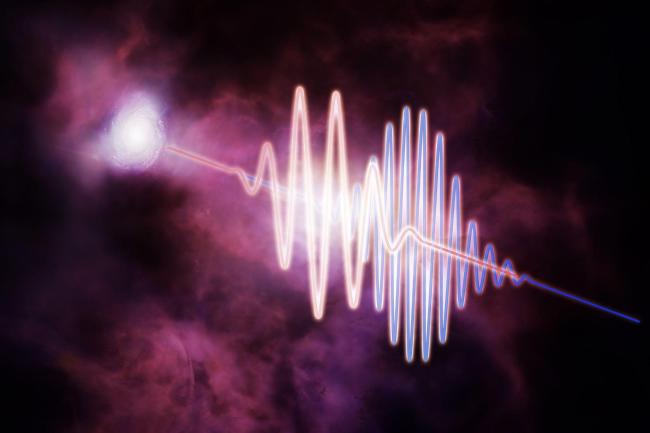
A landmark study led by the Center for Astrophysics | Harvard & Smithsonian (CfA) has pinpointed the Universe’s “missing” matter using Fast Radio Bursts (FRBs)— brief, bright radio signals from distant galaxies— as a guide. This artist’s conception depicts a bright pulse of radio waves (the FRB) on its journey through the fog between galaxies, known as the intergalactic medium. Long wavelengths, shown in red, are slowed down compared to shorter, bluer wavelengths, allowing astronomers to “weigh” the otherwise invisible ordinary matter.  
Credit: Melissa Weiss/CfA

A new landmark study has pinpointed the location of the universe’s “missing” matter, and detected the most distant fast radio burst (FRB) on record...

Read More

Biking may promote healthy brain aging

Biking might promote healthy brain aging
Want to reduce your risk of dementia and Alzheimer’s disease?

Get on your bike and ride, a new study recommends.
Biking regularly for transportation appears to lower risk of dementia by 19% and Alzheimer’s by 22%, according to results published June 9 in JAMA Network Open.

The results also suggest that cycling might even help increase the size of a brain region important for memory, researchers noted.

“Cycling is a moderate- to high-intensity workout, and also requires balance,” said Dr. Liron Sinvani, director of geriatric services at Northwell Health in Manhasset, N.Y., who reviewed the findings. “It requires more complex brain functions than walking, which is why maybe it was a better reducer of dementia risk.”

“It’s not about just doing exercise and making that part of your...

Read More
