






Photons collide in the void: Quantum simulation creates light out of nothing

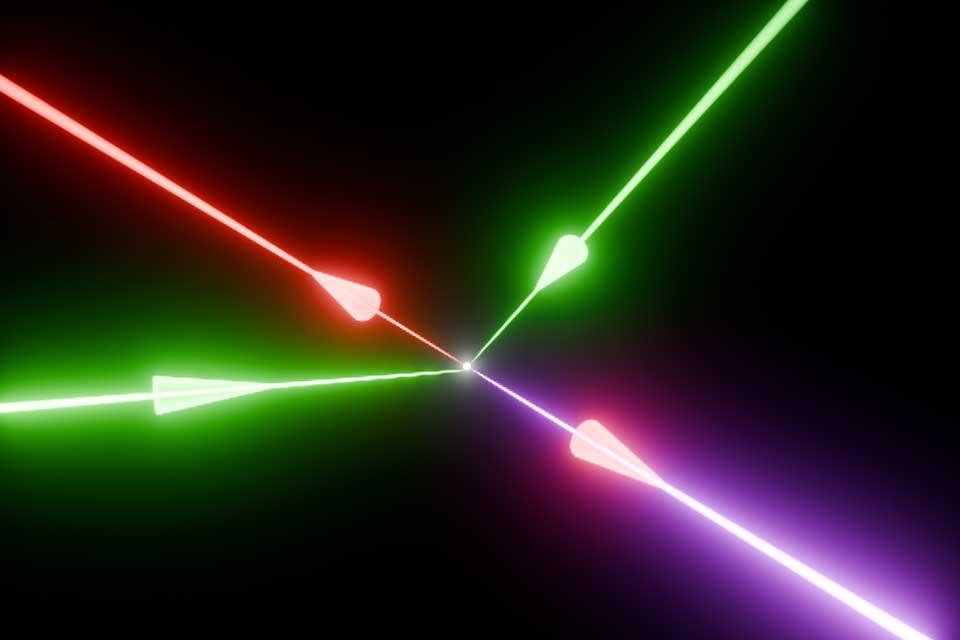
Illustration of photon-photon scattering in the laboratory. Two green petawatt lasers beams collide at the focus with a third red beam to polarise the quantum vacuum. This allows a fourth blue laser beam to be generated, with a unique direction and colour, which conserves momemtum and energy.

Using advanced computational modelling, a research team led by the University of Oxford, working in partnership with the Instituto Superior Técnico in the University of Lisbon, has achieved the first-ever real-time, three-dimensional simulations of how intense laser beams alter the ‘quantum vacuum’ — a state once assumed to be empty, but which quantum physics predicts is full of virtual electron-positron pairs.

The results have been published in Communications Physics.
Using advanced computational modelling, a research team led by the University of Oxford, working in partnership with the Instituto Superior Técnico in the University of Lisbon, has achieved the first-ever real-time, three-dimensional simulations of how intense laser beams alter the ‘quantum vacuum’ — a state once ass...
Read More

Sun unleashes monster solar storm: Rare G4 alert issued for earth

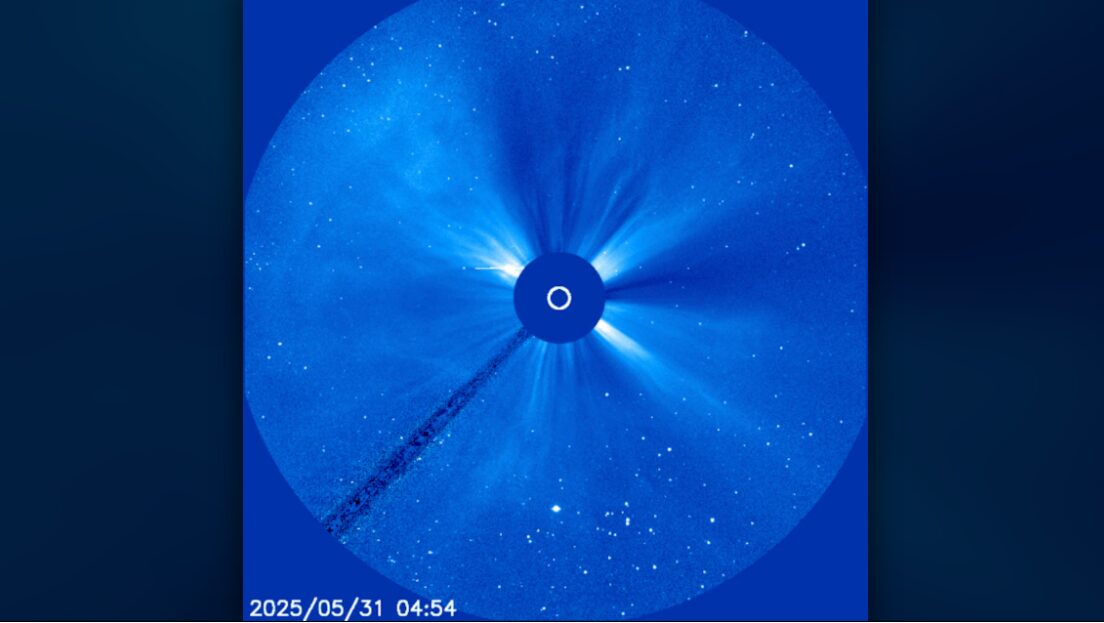
A violent solar eruption on May 31 launched a coronal mass ejection (CME) hurtling toward Earth, triggering a rare G4-level geomagnetic storm alert. Captured in real-time by U.S. Naval Research Laboratory instruments, this cosmic blast has the potential to disrupt satellites, communications, and military systems.

Local weather alerts are familiar warnings for potentially dangerous conditions, but an alert that puts all of Earth on warning is rare.

On May 31, U.S. Naval Research Laboratory’s (NRL) space-based instrumentation captured real-time observations of a powerful Coronal Mass Ejection (CME) that erupted from the Sun initiating a “severe geomagnetic storm” alert for Earth.

“Our observations demonstrated that the eruption was a so-called ‘halo CME,’ meaning it was Earth-d...

Read More

Physicists set new world record for qubit operation accuracy

Oxford physicists set new world record for qubit operation accuracy
A rendering of the Oxford University team’s ion trap chip. Credit: Dr. Jochen Wolf and Dr. Tom Harty.

Physicists at the University of Oxford have set a new global benchmark for the accuracy of controlling a single quantum bit, achieving the lowest-ever error rate for a quantum logic operation—just 0.000015%, or one error in 6.7 million operations. This record-breaking result represents nearly an order of magnitude improvement over the previous benchmark, set by the same research group a decade ago.

To put the result in perspective: a person is more likely to be struck by lightning in a given year (1 in 1.2 million) than for one of Oxford’s quantum logic gates to make a mistake.

The findings, to be published in Physical Review Letters, are a major advance towards having robust a...

Read More

Where did cosmic rays come from? Astrophysicists are closer to finding out

Where did cosmic rays come from? MSU astrophysicists are closer to finding out
X-ray image of the newly discovered pulsar wind nebular associated with an extreme Galactic cosmic ray source 1LHAASO J0343+5254u, obtained by the XMM-Newton space telescope (DiKerby, Zhang, et al., ApJ, 983, 21). Credit: XMM-Newton space telescope

New research published by Michigan State University astrophysicists could help scientists answer a century-old question: Where did galactic cosmic rays come from?

Cosmic rays—high-energy particles moving close to the speed of light—originated from somewhere in the Milky Way galaxy and beyond, but exactly where has been a mystery since they were discovered in 1912. Shuo Zhang, MSU assistant professor of physics and astronomy, and her group led two studies that shed new light on where cosmic rays might have come from...

Read More
