ALICE detects the conversion of lead into gold at the Large Hadron Collider

ALICE detects the conversion of lead into gold at the LHC
ALICE detector. Credit: CERN

In a paper published in Physical Review C, the ALICE collaboration reports measurements that quantify the transmutation of lead into gold in CERN’s Large Hadron Collider (LHC).

Transforming the base metal lead into the precious metal gold was a dream of medieval alchemists. This long-standing quest, known as chrysopoeia, may have been motivated by the observation that dull gray, relatively abundant lead is of a similar density to gold, which has long been coveted for its beautiful color and rarity. It was only much later that it became clear that lead and gold are distinct chemical elements and that chemical methods are powerless to transmute one into the other.

With the dawn of nuclear physics in the 20th century, it was discovered that heavy element...

Read More
Natural short sleepers have a genetic mutation, finds new study

Natural short sleepers have a genetic mutations finds a new study
A rare genetic mutation was identified in a human with natural short sleep traits. Credit: Ketut Subiyanto/Pexels

Not everyone needs 8 hours of sleep to function properly. Some people can feel well-rested and show no negative effects of sleep deprivation, even after just 4 hours of sleep, which is likely the result of a genetic mutation.

A recent study has reported that a mutation in salt-induced kinase 3 (hSIK3-N783Y)—a gene critical for regulating sleep duration and depth—may be the reason why some people are natural short sleepers (NSS).

The findings of this study are published in Proceedings of the National Academy of Sciences.

We might be physically inactive when sleeping, but our body is far from being idle...

Read More

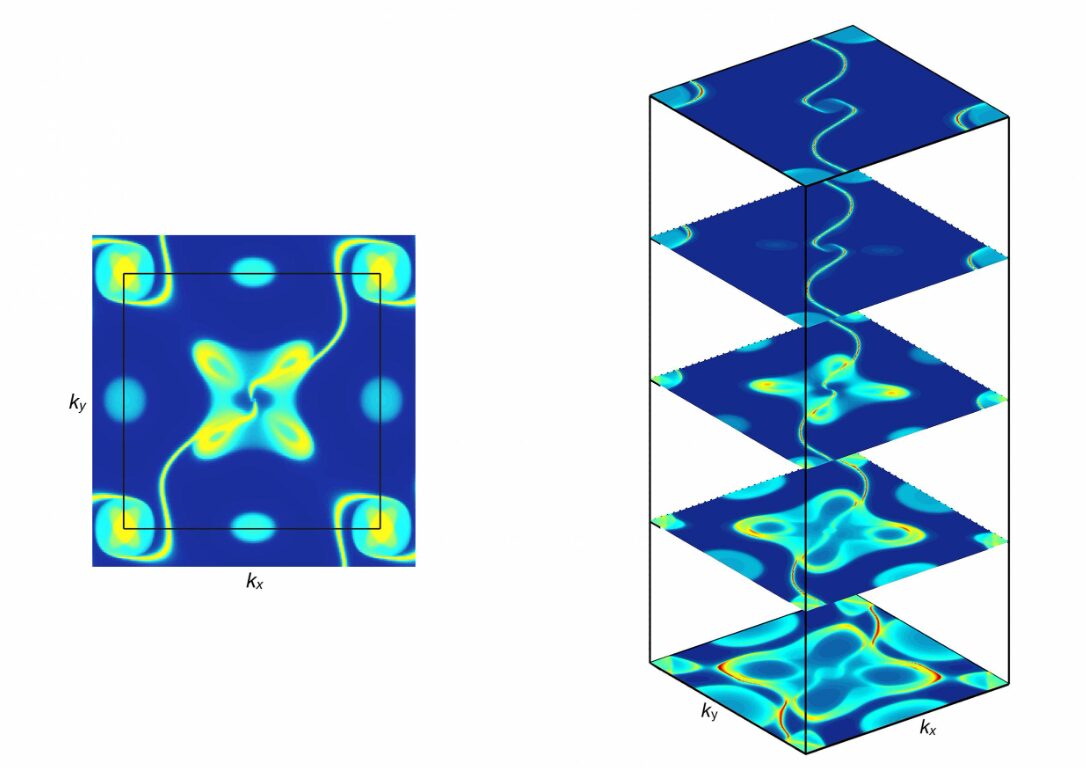
Physicists discover an unusual chiral quantum state in a topological material


Left: This image shows how the electrons are distributed on the surfaces of topological chiral crystals. The extended threads along the diagonal are the “Fermi arc” quantum states revealing the topological behavior of the electrons. The surface Fermi arc is a property that defines topological conductivity — related to the electrical conductivity of the material’s surface — which in these topological chiral crystals was about 100 times larger than that observed in previously identified topological metals. Right: These 3-D images of electron distribution within topological chiral crystals show the helicoid arc quantum state patterns.
Images by the Hasan Lab, Princeton University

Chirality—the property of an object that is distinct from its mirror image—has long captivated scie...

Read More

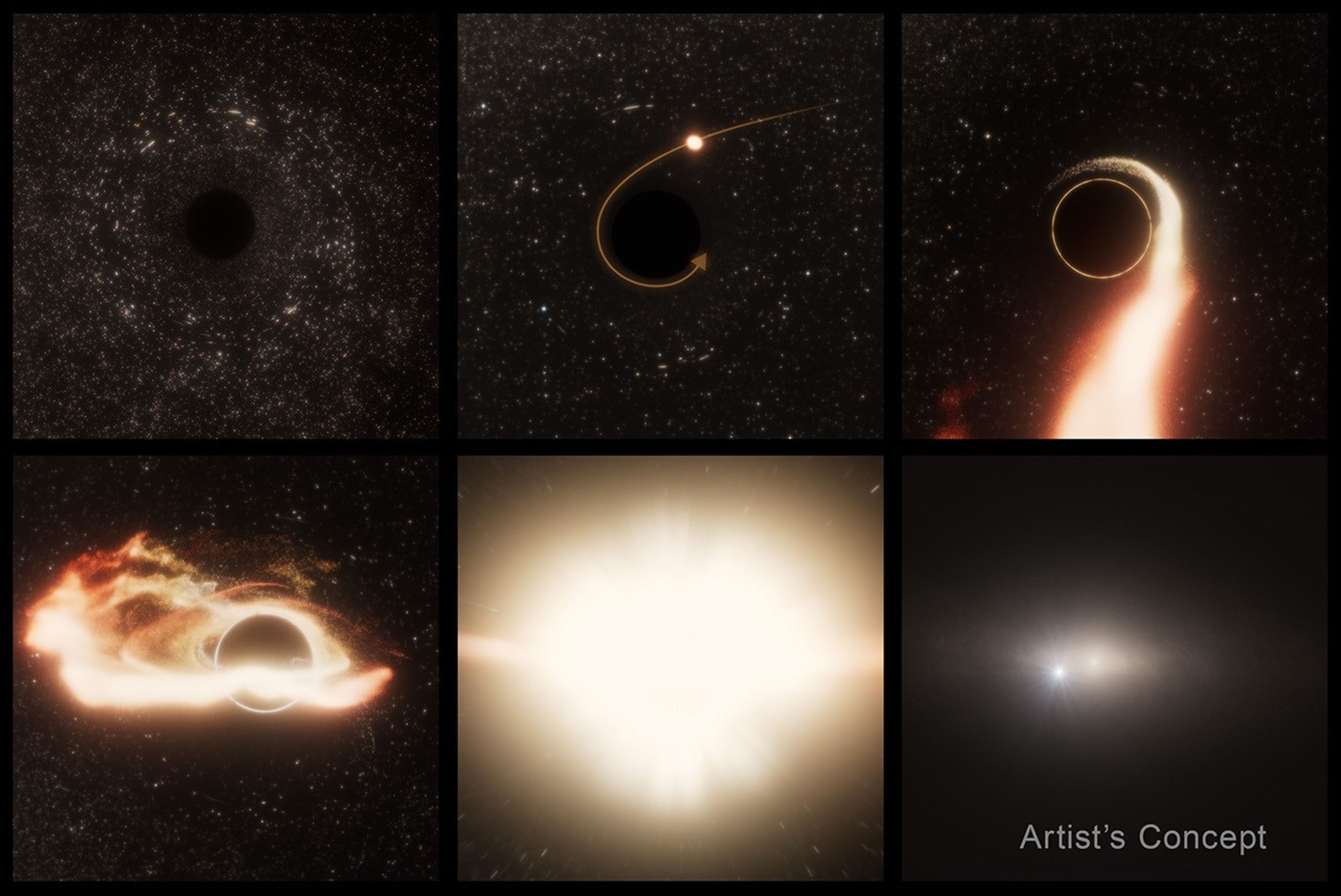
Hubble pinpoints roaming massive black hole

Six-panel illustration marked "Artist's Concept." The upper left panel shows the silhouette of supermassive black hole that is adrift inside a galaxy. The middle upper panel shows a yellow star drifting near the black hole. The three following panels show the star being shredded in bright white concentric streamers followed by a white explosion. the bottom right panel is an external view of the galaxy showing a bright white star-like object that is the site if the explosion as viewed in X-rays and visible light.
This six-panel illustration of a tidal disruption event around a supermassive black hole shows the following: 1) A supermassive black hole is adrift inside a galaxy, its presence only detectable by gravitational lensing; 2) A wayward star gets swept up in the black hole’s intense gravitational pull; 3) The star is stretched or “spaghettified” by gravitational tidal effects; 4) The star’s remnants form a disk around the black hole; 5) There is a period of black hole accretion, pouring out radiation across the electromagnetic spectrum, from X-rays to radio wavelengths; and 6) The host galaxy, seen from afar, contains a bright flash of energy that is offset from the galaxy’s nucleus, where an even more massive black hole dwells.
Artwork: NASA, ESA, STScI, Ralf Crawford (STScI)

Like a scene...

Read More