






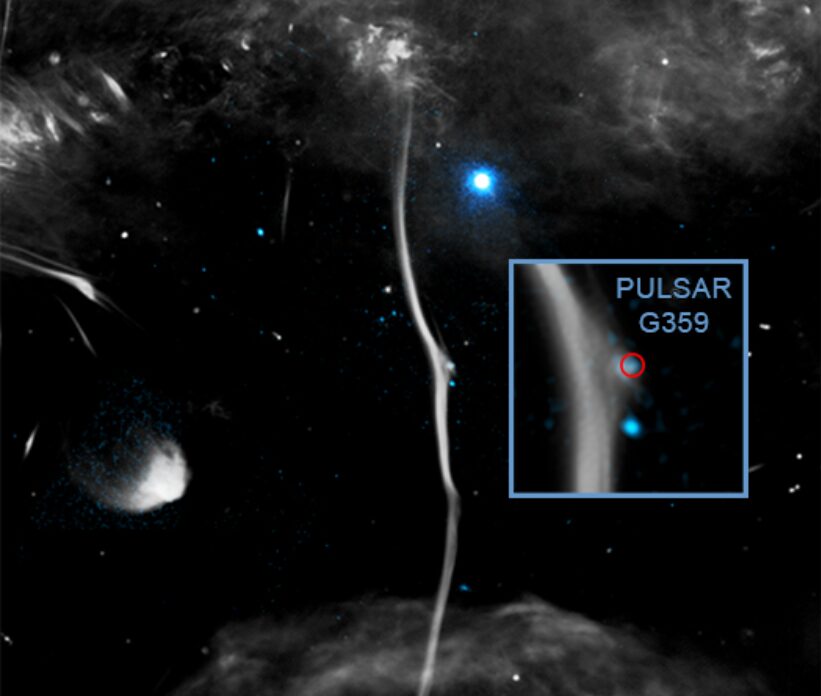
Chandra diagnoses cause of fracture in galactic ‘bone’

G359.13142-0.20005
Credit: X-ray: NASA/CXC/Northwestern Univ./F. Yusef-Zadeh et al; Radio: NRF/SARAO/MeerKat; Image Processing: NASA/CXC/SAO/N. Wolk

Astronomers have discovered a likely explanation for a fracture in a huge cosmic “bone” in the Milky Way galaxy, using NASA’s Chandra X-ray Observatory and radio telescopes.

The bone appears to have been struck by a fast-moving, rapidly spinning neutron star, or a pulsar. Neutron stars are the densest known stars and form from the collapse and explosion of massive stars. They often receive a powerful kick from these explosions, sending them away from the explosion’s location at high speeds.

Enormous structures resembling bones or snakes are found near the center of the galaxy...

Read More

Simple test could better predict your risk of heart disease

Hands covered in gloves holding a test tube with a blood sample.
Researchers from Chalmers University of Technology and Harvard University have shown comprehensively that a combination of two lipoprotein markers, measured in a simple blood test, can give more accurate information about individual risk of heart disease than the current blood cholesterol test, potentially saving lives. Photo: Marco J Haenssgen, Unsplash

For almost 60 years, measuring cholesterol levels in the blood has been the best way to identify individuals at high risk of cardiovascular disease...

Read More

Electricity-generating bacteria may power future innovations

ajo franklin and Biki Bapi Kundu

Researchers uncover a surprising survival strategy that could reshape biotech and energy systems. A team led by Rice University bioscientist Caroline Ajo-Franklin has discovered how certain bacteria breathe by generating electricity, using a natural process that pushes electrons into their surroundings instead of breathing on oxygen. The findings, published in Cell last month, could enable new developments in clean energy and industrial biotechnology.

By identifying how these bacteria expel electrons externally, the researchers offer a glimpse into a previously hidden strategy of bacterial life. This work, which merges biology with electrochemistry, lays the groundwork for future technologies that harness the unique capabilities of these microscopic organisms.

“Our research not ...

Read More

Gaia spots odd family of stars desperate to leave home

Gaia spots odd star family

The European Space Agency’s Gaia mission has spotted an unusual family of stars all strangely eager to leave home – a family we couldn’t have discovered without the star-surveying spacecraft, and one unlike all others we have spotted to date.

Stars in the Milky Way tend to form in families, with similar stars springing to life in roughly the same place at roughly the same time. These stars later head out into the wider galaxy when they’re ready to fly the nest. While smaller groups can completely dissipate, siblings from sizeable families usually move similarly and largely travel together.

We have seen many star families with Gaia...

Read More
