






Pressure-responsive, layered semiconductor shows potential for next-gen data storage

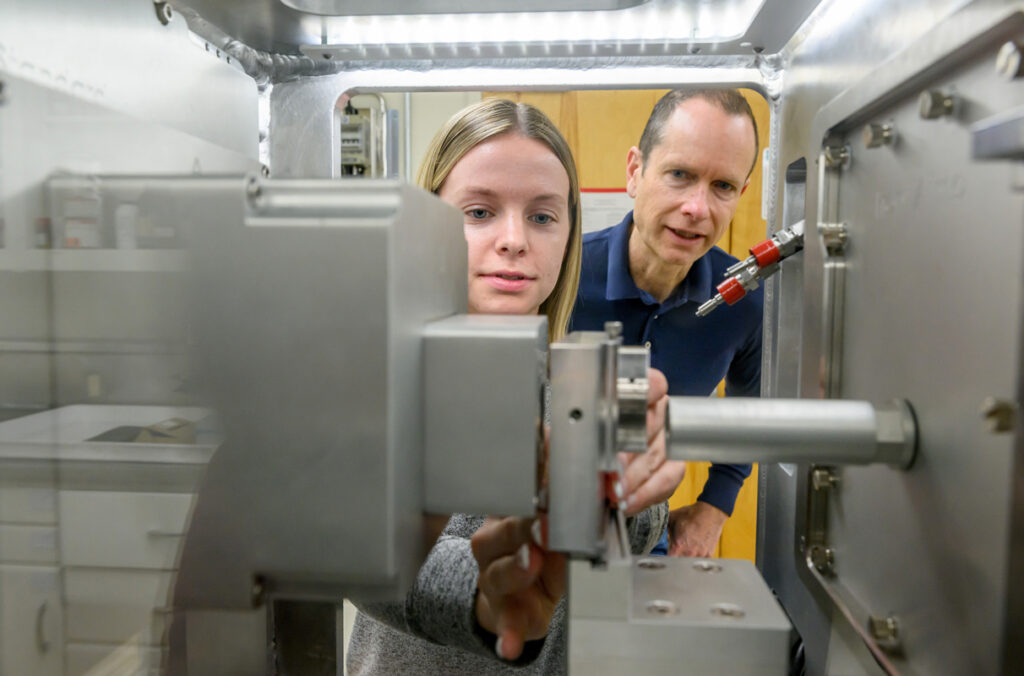
Julie Miller and Matt McCluskey using an X‑ray beamline.
Julie Miller (left) and Matt McCluskey conduct research using the X‑ray beamline at WSU’s Dodgen Research Facility. (Photo by Robert Hubner, WSU Photo Services)

A squishy, layered material that dramatically transforms under pressure could someday help computers store more data with less energy.

That’s according to a new study by researchers at Washington State University and the University of North Carolina at Charlotte that shows a hybrid zinc telluride-based material can undergo surprising structural changes when squeezed together like a molecular sandwich...

Read More

30-year mystery of dissonance in the ‘ringing’ of black holes explained

black hole
Credit: Pixabay/CC0 Public Domain

A scientist from Tokyo Metropolitan University has solved the longstanding problem of a “dissonance” in gravitational waves emitted by a black hole.

Using high precision computing and a new theoretical physics framework, it was discovered that it was caused by a resonance between a pair of distinctive “modes” i.e. different ways in which a black hole can “ring.” The phenomenon offers new insights into the nascent field of black hole spectroscopy.

The research is published in the journal Physical Review Letters.

Black holes are astrophysical objects so dense that even light cannot escape their gravitational pull...

Read More

How bacteria in our aging guts can elevate risk of leukemia and perhaps more

New findings in Nature reveal how age-related gut changes fuel the growth of pre-leukemic blood cells. Scientists at Cincinnati Children’s along with an international team of researchers have discovered a surprising new connection between gut health and blood cancer risk — one that could transform how we think about aging, inflammation, and the early stages of leukemia.

As we grow older — or in some cases, when gut health is compromised by disease — changes in the intestinal lining allow certain bacteria to leak their byproducts into the bloodstream. One such molecule, produced by specific bacteria, acts as a signal that accelerates the expansion of dormant, pre-leukemic blood cells, a critical step to developing full-blown leukemia.

The team’s findings — published April 23, 202...

Read More

The heart of world’s largest solar telescope begins to beat

The world’s largest solar telescope, the U.S. National Science Foundation (NSF) Daniel K. Inouye Solar Telescope in Hawaii, has reached an important milestone. After almost 15 years of preparation, the German instrument for the Inouye Solar Telescope, the Visible Tunable Filtergraph (VTF), has now taken its first images. The imaging spectro-polarimeter was developed and built at the Institute for Solar Physics (KIS) in Freiburg (Germany). The Max Planck Institute for Solar System Research (MPS) in Göttingen (Germany) is a partner in the project.

The data published now were obtained during the technical commissioning of the instrument...

Read More
