Google’s AI Dreamer learns how to self-improve over time by mastering Minecraft

Google's AI Dreamer learns how to self-improve over time by mastering Minecraft
Training process of Dreamer. Credit: Nature (2025). DOI: 10.1038/s41586-025-08744-2

A trio of AI researchers at Google’s Google DeepMind, working with a colleague from the University of Toronto, report that the AI algorithm Dreamer can learn to self-improve by mastering Minecraft in a short amount of time. In their study published in the journal Nature, Danijar Hafner, Jurgis Pasukonis, Timothy Lillicrap and Jimmy Ba programmed the AI app to play Minecraft without being trained and to achieve an expert level in just nine days.

Over the past several years, computer scientists have learned a lot about how deep learning can be used to train AI applications to conduct seemingly intelligent activities such as answering questions...

Read More
Astronomers discover doomed pair of spiraling stars on our cosmic doorstep

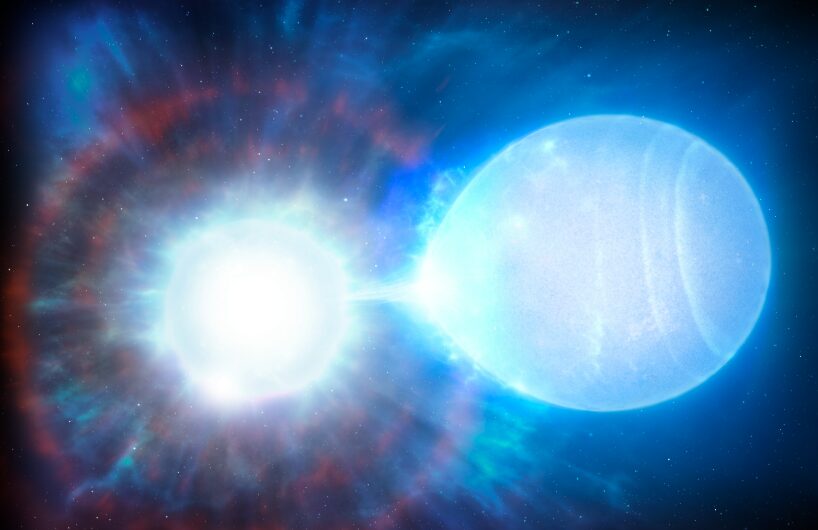
University of Warwick astronomers have discovered an extremely rare, high-mass, compact binary star system only ~150 light years away. These two stars are on a collision course to explode as a type 1a supernova, appearing 10 times brighter than the moon in the night sky.

Type 1a supernovae are a special class of cosmic explosion, famously used as “standard candles” to measure distances between Earth and their host galaxies. They occur when a white dwarf (the dense remnant core of a star) accumulates too much mass, is unable to withstand its own gravity, and explodes.

It has long been theoretically predicted that two orbiting white dwarfs are the cause of most type 1a supernova explosions...

Read More

Repurposed smartphone camera sensors create real-time, high-resolution imaging of antiproton annihilations

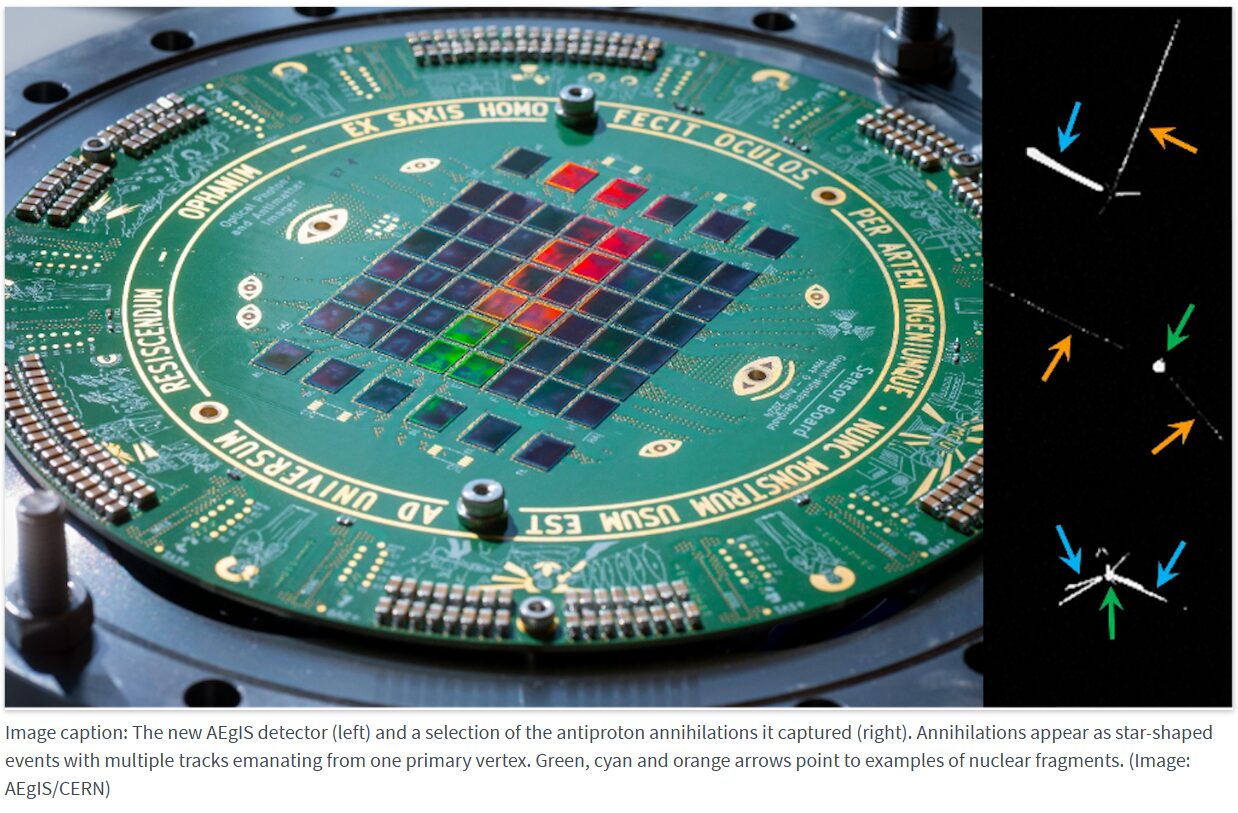
Did you know that the camera sensor in your smartphone could help unlock the secrets of antimatter? The AEgIS collaboration, led by Professor Christoph Hugenschmidt’s team from the research neutron source FRM II at the Technical University of Munich (TUM), has developed a detector using modified mobile camera sensors to image, in real time, the points where antimatter annihilates with matter.

This new device, described in a paper published in Science Advances, can pinpoint antiproton annihilations with a resolution of about 0.6 micrometers, a 35-fold improvement over previous real-time methods.

AEgIS and other experiments at CERN’s Antimatter Factory, such as ALPHA and GBAR, are on a mission to measure the free-fall of antihydrogen within Earth’s gravitational field with high pr...

Read More

Webb explores effect of strong magnetic fields on star formation

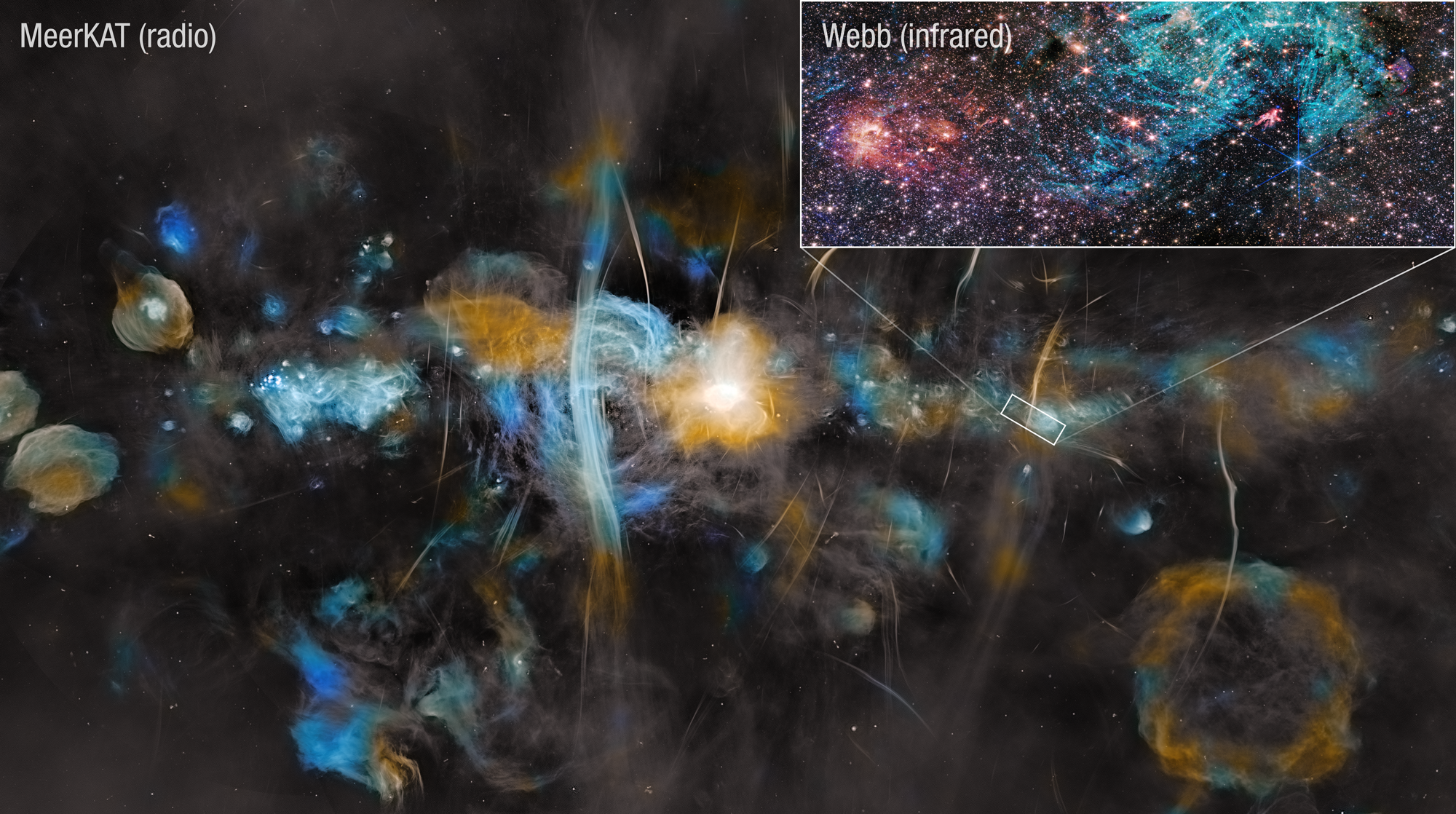
The MeerKAT radio telescope shows the plane of the Milky Way galaxy, with a graphic pullout highlighting a much smaller region on the right, captured by the James Webb Space Telescope’s near-infrared light observations. The MeerKAT image is colored in blue, cyan, and yellow, with a very bright white-yellow center that indicates the location of the Milky Way’s supermassive black hole. Painterly bubbles of various sizes, clouds, and vertical brushstroke-like streaks make up the radio image. The Webb inset shows stars and gas clouds in red, with an arching cloud of bright cyan that contains many straight, needle-like features that appear more crystalline than cloudy.
An image of the Milky Way captured by the MeerKAT (formerly the Karoo Array Telescope) radio telescope array puts the James Webb Space Telescope’s image of the Sagittarius C region in context. Like a super-long exposure photograph, MeerKAT shows the bubble-like remnants of supernovas that exploded over millennia, capturing the dynamic nature of the Milky Way’s chaotic core. At the center of the MeerKAT image the region surrounding the Milky Way’s supermassive black hole blazes bright. Huge vertical filamentary structures echo those captured on a smaller scale by Webb in Sagittarius C’s blue-green hydrogen cloud.
NASA, ESA, CSA, STScI, SARAO, Samuel Crowe (UVA), John Bally (CU), Ruben Fedriani (IAA-CSIC), Ian Heywood (Oxford)

Follow-up research on a 2023 image of the Sagittarius ...

Read More