






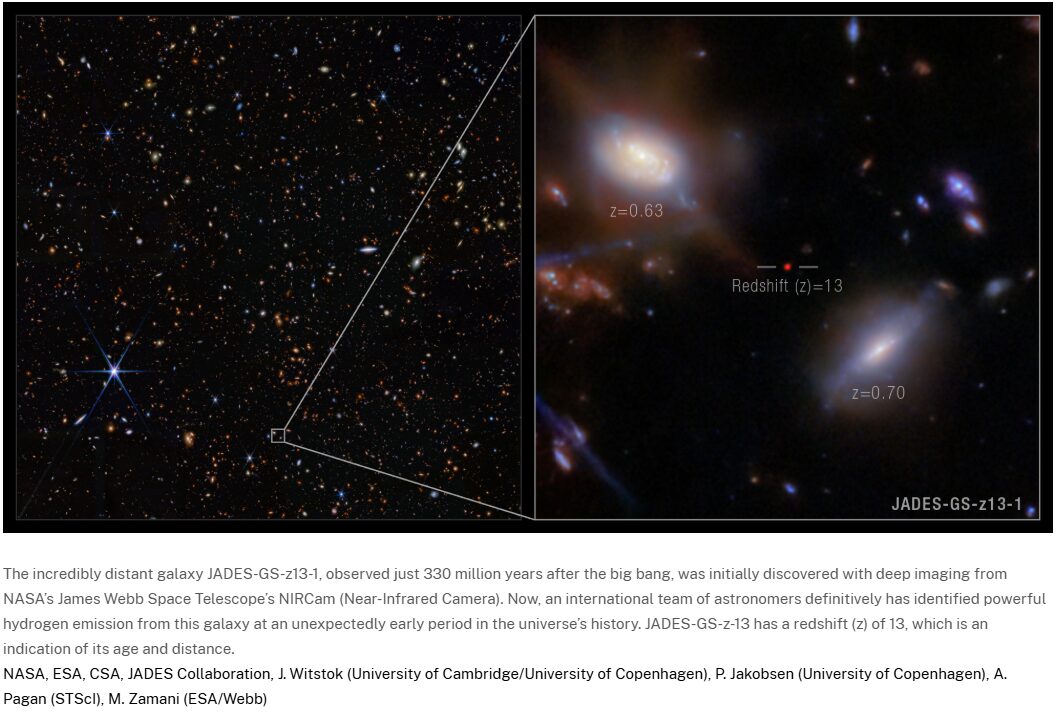
Webb telescope sees galaxy in mysteriously clearing fog of early universe

Astronomers have identified a bright hydrogen emission from a galaxy in the very early universe. The surprise finding is challenging researchers to explain how this light could have pierced the thick fog of neutral hydrogen that filled space at that time.

A key goal of the NASA/ESA/CSA James Webb Space Telescope has been to see further than ever before into the distant past of our universe, when the first galaxies were forming after the Big Bang, a period known as cosmic dawn.

Researchers studying one of those very early galaxies have now made a discovery in the spectrum of its light, that challenges our established understanding of the universe’s early history. Their results are reported in the journal Nature.

Webb discovered the incredibly distant galaxy JADES-GS-z13-1, obs...

Read More
mRNA-based COVID-19 vaccines train the ‘long-term memory’ of the immune system, study reveals

mRNA-based COVID-19 vaccines train the 'long-term memory' of the immune system
Cytokine release in macrophages following SARS-CoV-2 mRNA vaccination. Credit: Molecular Systems Biology (2025). DOI: 10.1038/s44320-025-00093-6

Researchers at the University of Cologne and University Hospital Cologne have determined that the novel mRNA-based COVID-19 vaccines not only induce acquired immune responses such as antibody production, but also cause persistent epigenetic changes in innate immune cells.

The study, “Persistent epigenetic memory of SARS-CoV-2 mRNA vaccination in monocyte-derived macrophages,” led by Professor Dr. Jan Rybniker, who heads the Division of Infectious Diseases at University Hospital Cologne and is a principal investigator at the Center for Molecular Medicine Cologne (CMMC), and Dr...

Read More

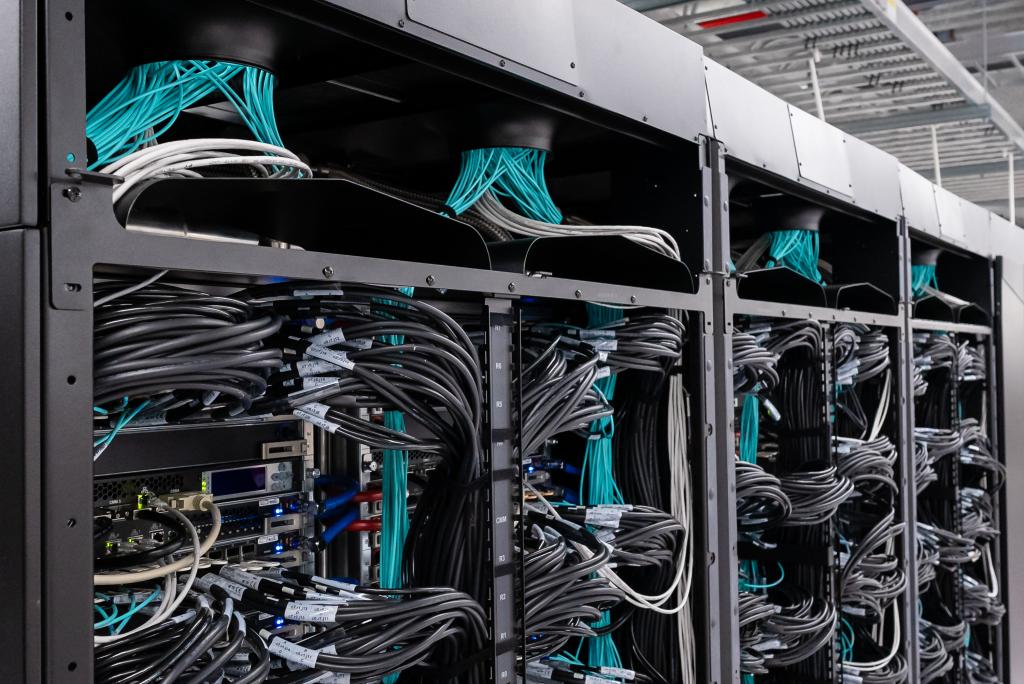
Supercomputing memory management tool makes data storage more efficient

Wall of black computer chords with blue wiring

Researchers from the Department of Energy’s Oak Ridge National Laboratory have developed a new application to increase efficiency in memory systems for high-performance computing.

Rather than allow data to bog down traditional memory systems in supercomputers and impact performance, the team from ORNL, along with researchers from the University of Tennessee, Knoxville, created a framework to manage data more efficiently with memory systems that employ more complex structures. Research papers detailing their work were recently accepted in ACM Transactions on Architecture and Code Optimization and the International Journal of High-Performance Computing Applications.

Working under the Exascale Computing Project, or ECP, a multi-year software research, development and deployment pro...

Read More

Webb captures Neptune’s auroras for first time

NASA's Webb captures Neptune's auroras for first time
Credit: Webb Space Telescope

Neptune lies in the frigid, dark, vast frontier of the outer edges of our solar system, about 3 billion miles away from the sun.

For the first time, NASA’s James Webb Space Telescope has captured bright auroral activity on Neptune. Auroras occur when energetic particles, often originating from the sun, become trapped in a planet’s magnetic field and eventually strike the upper atmosphere. The energy released during these collisions creates the signature glow.

In the past, astronomers have seen tantalizing hints of auroral activity on Neptune, for example, in the flyby of NASA’s Voyager 2 in 1989. However, imaging and confirming the auroras on Neptune has long evaded astronomers despite successful detections on Jupiter, Saturn, and Uranus...

Read More
