Study suggests one common amino acid may affect how long men live

Study suggests one common amino acid may affect how long men live

A large new study suggests that higher levels of a common amino acid called tyrosine may be linked to a shorter lifespan in men.

The research, published recently in the journal Aging, examined whether blood levels of two amino acids, phenylalanine and tyrosine, were connected to how long people live.

Amino acids are building blocks of protein. They are found in protein-rich foods such as milk, eggs and meat, and are also sold as dietary supplements.

Researchers from the University of Hong Kong and the University of Georgia analyzed health and genetic data from more than 270,000 people in the U.K. Biobank, a large long-term health study in the U.K.

At first, both amino acids appeared to be tied to a higher risk of death...

Read More

‘Solar battery’ stores sunlight for days, then releases hydrogen on demand

'Solar battery' stores sunlight for days, then releases hydrogen on demand
Catalyst solutions with luminescent ruthenium dye, which are irradiated with visible light in the reactor. Credit: Elvira Eberhardt, Ulm University

A new material can store energy from sunlight and convert it into hydrogen days later. The material, jointly developed by researchers from Ulm and Jena, can do this even in the dark. The process is reversible and can be reactivated several times using a pH switch. The results are published in the journal Nature Communications.

Green hydrogen is one of the most important pillars of the energy transition. It is produced from sunlight using photocatalytic processes. There are now a variety of technologies for converting and storing solar energy into chemical energy...

Read More

A lost moon may have created Titan and Saturn’s rings

Cassini gazes upon Titan in the distance beyond Saturn. Credit: NASA/JPL/Space Science Institute.

Titan may be the battered survivor of a colossal moon merger that reshaped Saturn’s rings and rewrote the planet’s history.

Saturn’s largest moon, Titan, may have been born in a colossal cosmic crash. New research suggests Titan formed when two older moons slammed together hundreds of millions of years ago—an event so violent it reshaped Saturn’s entire moon system and may have indirectly sparked the formation of its iconic rings. Clues come from Titan’s unusual orbit, its surprisingly smooth surface, and the strange behavior of the tumbling moon Hyperion.

New research suggests that Saturn’s brilliant rings and its largest moon, Titan, may share a violent past shaped by c...

Read More

Quantum effect could power the next generation of battery-free devices

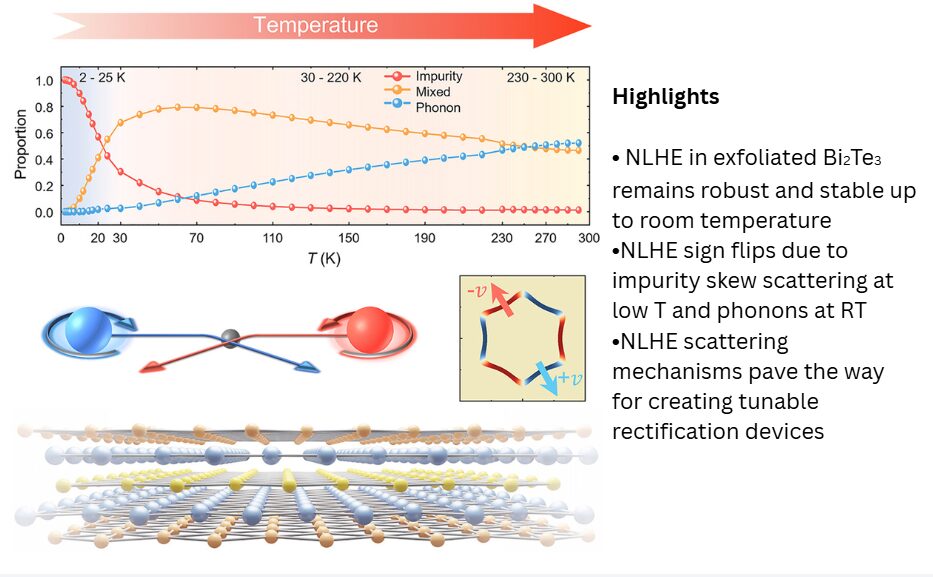
A new study has revealed how tiny imperfections and vibrations inside a promising quantum material could be used to control an unusual quantum effect, opening new possibilities for smaller, faster, and more efficient energy-harvesting devices.

The international team, led by Professor Dongchen Qi from the QUT School of Chemistry and Physics and Professor Xiao Renshaw Wang from Nanyang Technological University in Singapore, studied the mechanism governing the so-called nonlinear Hall effect (NLHE). The research is published in the journal Newton.

Unlike the classical Hall effect, this quantum version allows alternating electrical signals, like those found in wireless or ambient energy sources, to be converted directly into usable direct current without the need for traditional dio...

Read More