New holography-inspired reconfigurable surface developed for wireless communication

New holography-inspired reconfigurable surface for wireless communication
Overall schematic of holographic-inspired self-controlled RIS. Credit: https://www.nature.com/articles/s41928-025-01482-3 Credit: Zhu et al.

Reconfigurable intelligent surfaces (RIS) are engineered structures comprised of several elements known as ‘meta-atoms,’ which can reshape and control electromagnetic waves in real-time. These surfaces could contribute to the further advancement of wireless communications and localization systems, as they could be used to reliably redirect, strengthen and suppress signals.

In conventional applications of RIS for wireless communication, each meta-atom is controlled by a system known as the ‘base-station,’ which is connected to the surface via electrical cables...

Read More
Urolithin A nudges aging immune cells toward a youthful profile in 28 days

Urolithin A nudges aging immune cells toward a youthful profile in 28 days
Secondary end point—UA alters inflammatory immune response. Credit: Nature Aging (2025). DOI: 10.1038/s43587-025-00996-x

An international research team focused on aging reports that urolithin A at 1,000 mg per day shifted human immune profiles toward a more naive-like, less exhausted CD8+ state and increased fatty acid oxidation capacity, with additional functional gains.

Urolithin A is a metabolite produced by gut bacteria after breaking down ellagic acid from certain foods, such as pomegranates and walnuts. While produced naturally through microbial digestion, it is in much smaller quantities than available as a supplement or used in the study.

Aging bodies face reduced production of mature T cells, shrinking naive T cell pools and chronic low-grade inflammation...

Read More

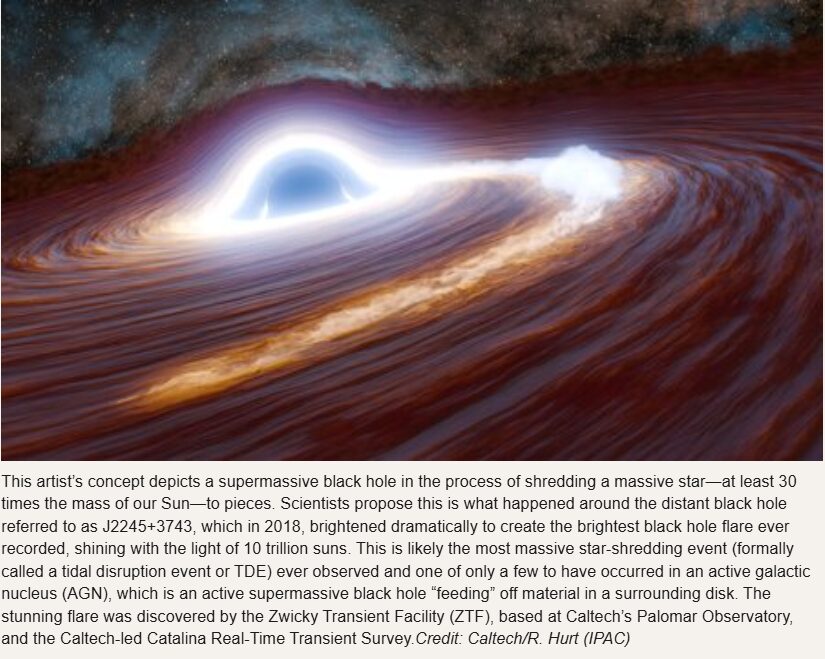
Black hole blast outshines 10 trillion Suns

A distant supermassive black hole has set a new cosmic record, unleashing the brightest flare ever seen as it devoured a gigantic star that wandered too close. A colossal black hole 10 billion light-years away has been caught devouring one of the universe’s biggest stars, unleashing a flare 30 times brighter than any seen before. The flare, detected by Caltech’s ZTF, likely marks a tidal disruption event — when a star is shredded by a black hole’s gravity.

The Universe’s most massive stars typically end their lives in spectacular explosions known as supernovae before collapsing into black holes. But one enormous star seems to have met a very different fate...

Read More

Rebalancing the Gut: How AI Solved a 25-Year Crohn’s Disease Mystery

Graphic of macrophages
Electron micrographs show how macrophages expressing girdin neutralize pathogens by fusing phagosomes (P) with the cell’s lysosomes (L) to form phagolysosomes (PL), compartments where pathogens and cellular debris are broken down (left). This process is crucial for maintaining cellular homeostasis. In the absence of girdin, this fusion fails, allowing pathogens to evade degradation and escape neutralization (right). (UC San Diego Health Sciences)

AI uncovers how a severed bond between two gut proteins sparks Crohn’s disease, and how restoring it could heal inflammation. UC San Diego researchers combined artificial intelligence with molecular biology to unravel how immune cells in the gut decide between inflammation and healing, a process gone awry in Crohn’s disease...

Read More