To raise new questions, new possibilities, to regard old problems from a new angle, requires creative imagination and marks real advance in science.
~Albert Einstein
Read More
Old Newtonian physics claimed that things have an objective reality separate from our perception of them. Quantum physics, and particularly Heisenberg's Uncertainty Principle, reveal that, as our perception of an object changes, the object itself literally changes.
~Marianne Williamson
Read More
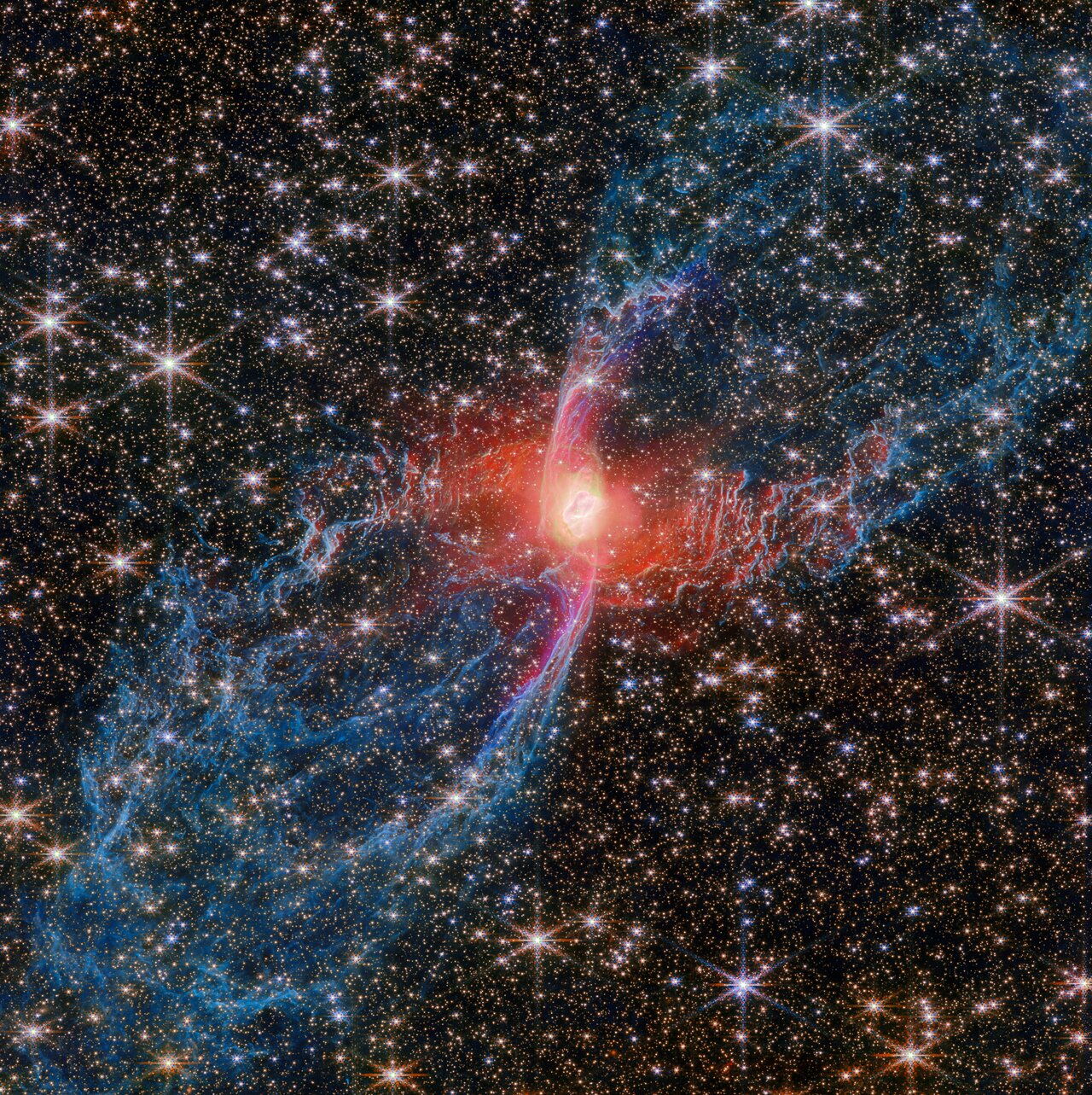
A large planetary nebula. The nebula’s central star is hidden by a blotchy pinkish cloud of dust. A strong red light radiates from this area, illuminating the nearby dust. Two large loops extend diagonally away from the center, formed of thin ridges of molecular gas, here colored blue. They stretch out to the corners of the view. A huge number of bright, whitish stars cover the background, also easily visible through the thin dust layers. Credit: European Space Agency
This new NASA/ESA/CSA James Webb Space Telescope Picture of the Month features a cosmic creepy-crawly called NGC6537—the Red Spider Nebula. Using its Near-InfraRed Camera (NIRCam), Webb has revealed never-before-seen details in this picturesque planetary nebula with a rich backdrop of thousands of stars.
Over the past decades, electronics engineers have developed a wide range of memory devices that can safely and efficiently store increasing amounts of data. However, the different types of devices developed to date come with their own trade-offs, which pose limits on their overall performance and restrict their possible applications.
Researchers at Université Grenoble Alpes (CEA-Leti, CEA List), Université de Bordeaux (CNRS) and Université Paris-Saclay (CNRS) recently developed a new memory device that combines two complementary components typically used individually, known as memristors and ferroelectric capacitors (FeCAPs)...
An artist’s conception of a pulsar/main sequence star pair, similar to the one featured in the study. Credit: ESA
The universe is a strange place. The X-ray Imaging and Spectroscopy Mission (XRISM) orbiting observatory recently highlighted this fact, when it was turned on a pulsar to document its powerful cosmic winds.
The XRISM observatory is a joint mission for NASA, the European Space Agency (ESA), and the Japan Aerospace Exploration Agency (JAXA). The mission was also a replacement for the ill-fated Hitomi X-ray observatory, which failed shortly after launch in 2016.
The discovery comes courtesy of ESA’s Resolve instrument, a soft X-ray spectrometer aboard XRISM. The study looked at neutron star GX 13+1...
Biologists have long been fascinated by the ability of salamanders to regrow entire limbs. Now Harvard researchers have solved part of the mystery of how they accomplish this feat—by activating stem cells throughout the body, not just at the injury site.
In a paper published in the journal Cell, researchers documented how this body-wide response in axolotl salamanders is triggered by the sympathetic nervous system—the iconic “fight or flight” network. The study raises the possibility that these mechanisms might one day be manipulated to regenerate human limbs and organs.
“We’ve shown the importance of the adrenaline stress signaling hormone in getting cells ready for regeneration,” said Duygu Payzin-Dogru, lead author of the new study and a postdo...













Recent Comments