To raise new questions, new possibilities, to regard old problems from a new angle, requires creative imagination and marks real advance in science.
~Albert Einstein
Read More
Old Newtonian physics claimed that things have an objective reality separate from our perception of them. Quantum physics, and particularly Heisenberg's Uncertainty Principle, reveal that, as our perception of an object changes, the object itself literally changes.
~Marianne Williamson
Read More
Parameter space showing the effect of GR on eccentricity oscillations due to an exterior planetary companion for a variety of combinations of the mass ratio m2/m1 and semi-major axis ratio a2/a1. Credit: arXiv (2025). DOI: 10.48550/arxiv.2509.26421
In the hunt for extraterrestrial life, we usually look for planets orbiting sun-like stars and icy moons. But there is another possible candidate—planets circling white dwarfs, the hot, dense remnants of dead stars.
A white dwarf is what is left when a star like our sun runs out of fuel and sheds its outer layers...
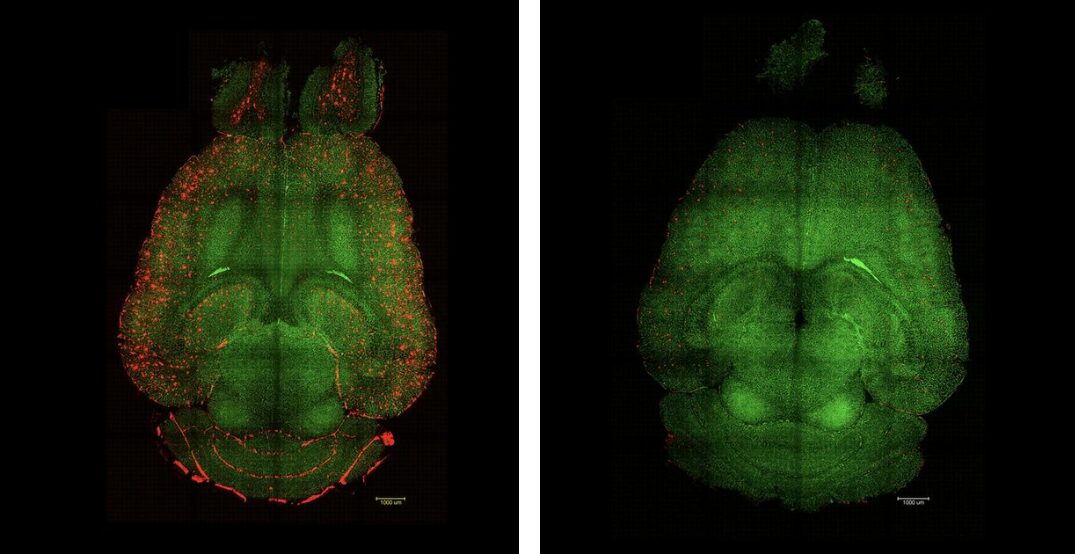
Left-hand image: Light sheet fluorescence microscope images of mouse brain 12h after NOT being treated with nanoparticles. The brains were analyzed to see the amount of Aβ plaques accumulation. Red: Aβ plaques. Green: vessels from the blood brain barrier. Right-hand image: Light sheet fluorescence microscope image of mouse brain 12h after being treated with nanoparticles. The brains were analyzed to see the amount of Aβ plaques accumulation. Red: Aβ plaques. Green: vessels from the blood brain barrier.
A research team co-led by the Institute for Bioengineering of Catalonia (IBEC) and West China Hospital Sichuan University (WCHSU), working with partners in the UK, has demonstrated a nanotechnology strategy that reverses Alzheimer’s disease in mice.
Could black holes help explain high-energy cosmic radiation?
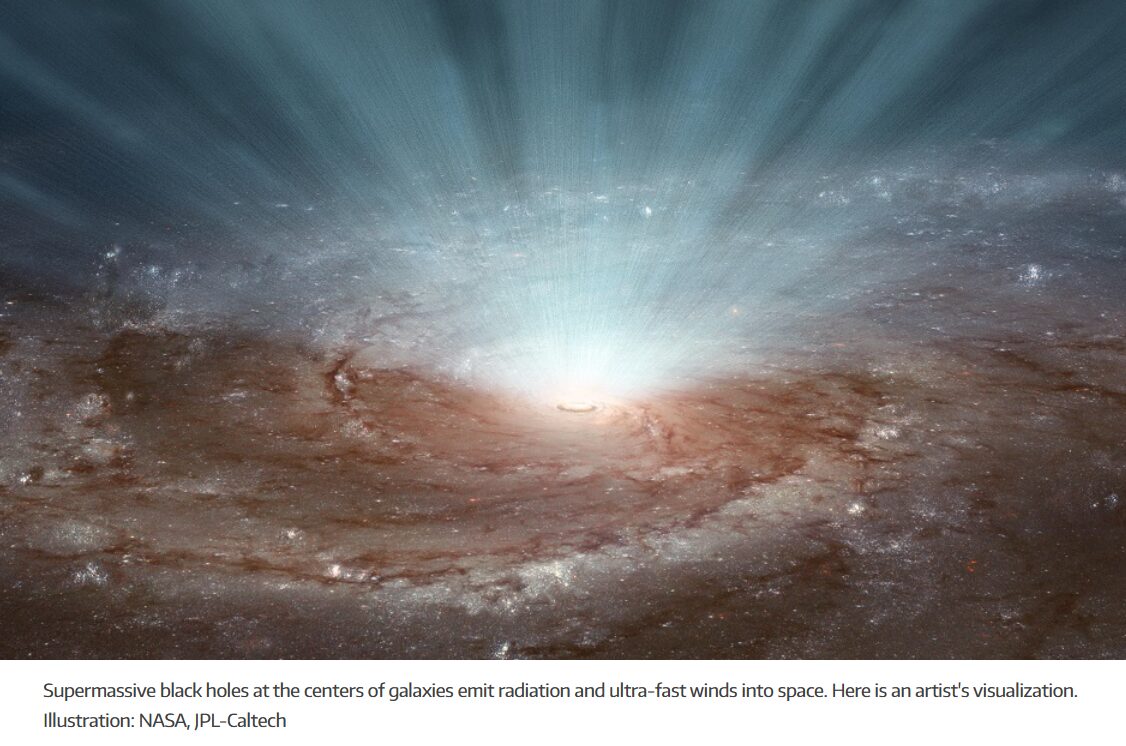
Scientists may have finally uncovered the mystery behind ultra-high-energy cosmic rays — the most powerful particles known in the universe. A team from NTNU suggests that colossal winds from supermassive black holes could be accelerating these particles to unimaginable speeds. These winds, moving at half the speed of light, might not only shape entire galaxies but also fling atomic nuclei across the cosmos with incredible energy.
The universe is full of different types of radiation and particles that can be observed here on Earth. This includes photons across the entire range of the electromagnetic spectrum, from the lowest radio frequencies all the way to the highest-energy gamma rays...
McMaster graduate student Denise Catacutan (left) and assistant professor Jon Stokes (right) have discovered a new antibiotic — and they leveraged cutting-edge AI to determine how it works.
Researchers at McMaster University and the Massachusetts Institute of Technology (MIT) have made two scientific breakthroughs at once: they not only discovered a brand-new antibiotic that targets inflammatory bowel diseases (IBD), but also successfully used a new type of AI to predict exactly how the drug works. To their knowledge, this is a global first for the AI.
Detailed in the journal Nature Microbiology, the discovery unveils a promising new treatment option for millions of people affected by Crohn’s disease and other related conditions, while also showcasing important new applications fo...













Recent Comments