






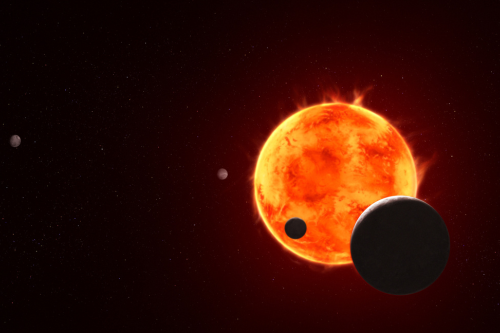
Webb spots first hints of atmosphere on a potentially habitable world

The Earth-size exoplanet TRAPPIST-1 e, depicted at the lower right, is silhouetted as it passes in front of its flaring host star in this artist’s concept of the TRAPPIST-1 system.
Image credit: NASA, ESA, CSA, J. Olmsted (STScI)

Hints of an atmosphere on TRAPPIST-1e raise hopes it could be a watery, potentially habitable world. Astronomers using the James Webb Space Telescope are unraveling the mysteries of TRAPPIST-1e, an Earth-sized exoplanet 40 light years away that could harbor liquid water. Early data suggests hints of an atmosphere, but much remains uncertain. Researchers have already ruled out a hydrogen-rich primordial atmosphere, pointing instead to the possibility of a secondary atmosphere that could sustain oceans or ice.

University of Bristol astrophysicists are helpin...

Read More

Poor sleep may accelerate brain aging

poor sleep
Credit: Unsplash/CC0 Public Domain

People who sleep poorly are more likely than others to have brains that appear older than they actually are. This is according to a comprehensive brain imaging study from Karolinska Institutet, published in the journal eBioMedicine. The paper is titled “Poor sleep health is associated with older brain age: the role of systemic inflammation.”

Increased inflammation in the body may partly explain the association.

Poor sleep has been linked to dementia, but it is unclear whether unhealthy sleep habits contribute to the development of dementia or whether they are rather early symptoms of the disease.

In a new study, researchers at Karolinska Institutet have investigated the link between sleep characteristics and how old the brain appears in relat...

Read More

Smart microfibers turn everyday objects into health care monitors and energy devices

Smart microfibres turn everyday objects into healthcare monitors and energy devices
Illustration of the microfibers in action, with uses in wearable breath and gas sensors, health monitoring, and energy conversion and electrodes. Credit: Andy Wang/University of Cambridge

New research led by the University of Cambridge, in collaboration with Hong Kong University of Science and Technology (GZ) and Queen Mary University of London, could redefine how we interact with everyday tools and devices—thanks to a novel method for printing ultra-thin conductive microfibers.

Imagine fibers thinner than a human hair (nano- to micro-scale in diameter) that can be tuned on-demand to add sensing, energy conversion and electronic connectivity capabilities to objects of different shapes and surface textures (such as glass, plastic and leather)...

Read More

Cassini proves complex chemistry in Enceladus ocean

Cassini proves complex chemistry in Enceladus ocean
The process of light, soluble and reactive organic molecules making their way onto ice grains emitted in jets of water from Saturn’s moon Enceladus, where they were detected by the Cassini spacecraft. Credit: NASA/JPL-Caltech

Scientists digging through data collected by the Cassini spacecraft have found new complex organic molecules spewing from Saturn’s moon Enceladus. This is a clear sign that complex chemical reactions are taking place within its underground ocean. Some of these reactions could be part of chains that lead to even more complex, potentially biologically relevant molecules.

Published in Nature Astronomy, this discovery further strengthens the case for a dedicated European Space Agency (ESA) mission to orbit and land on Enceladus.

In 2005, Cassini found the first ...

Read More
