To raise new questions, new possibilities, to regard old problems from a new angle, requires creative imagination and marks real advance in science.
~Albert Einstein
Read More
Old Newtonian physics claimed that things have an objective reality separate from our perception of them. Quantum physics, and particularly Heisenberg's Uncertainty Principle, reveal that, as our perception of an object changes, the object itself literally changes.
~Marianne Williamson
Read More
Visualisation of the warped disc around the young star MWC 758, with warping exaggerated by a factor four to make it visible. Both panels show properties of the disc inferred from CO emission. On the left-hand side, we see deviations in the line-of-sight velocity from the expected rotation if the disc were flat. The variations in velocity can be used to infer the warp structure. On the right-hand side we see variations in the gas temperature, from which we can see evidence of shadowing in areas of the disc. Credit: A. Winter
New ALMA observations reveal that the discs where planets form are often slightly warped, challenging long-held assumptions and offering clues about the subtle misalignments seen in our own Solar System.
Astronomers using ALMA have discovered that planet-forming...
CSD stress leads to increased numbers of LysM+ myeloid cells in vascular channels connecting skull BM to meninges. Credit: Nature Communications (2025). DOI: 10.1038/s41467-025-62840-5
Immune cells released from bone marrow in the skull in response to chronic stress and adversity could play a key role in symptoms of depression and anxiety, say researchers.
The discovery—found in a study in mice—sheds light on the role that inflammation can play in mood disorders and could help in the search for new treatments, in particular for those individuals for whom current treatments are ineffective.
Around 1 billion people will be diagnosed with a mood disorder such as depression or anxiety at some point in their life...
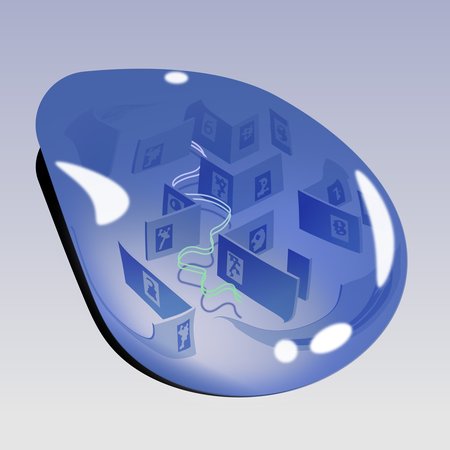
An abstract representation of DNA computation and learning in a droplet.Credit: Olivier Wyart & Ailadi Cortelletti
Neural networks are computing systems designed to mimic both the structure and function of the human brain. Caltech researchers have been developing a neural network made out of strands of DNA instead of electronic parts that carries out computation through chemical reactions rather than digital signals.
An important property of any neural network is the ability to learn by taking in information and retaining it for future decisions. Now, researchers in the laboratory of Lulu Qian, professor of bioengineering, have created a DNA-based neural network that can learn. The work represents a first step toward demonstrating more complex learning behaviors in chemical systems.
New research from the University of St Andrews has proposed that particles in solar flares are 6.5 times hotter than previously thought. The research provides an unexpected solution to a 50-year-old mystery about our nearest star.
Solar flares are sudden and huge releases of energy in the sun’s outer atmosphere that heat parts of it to greater than 10 million degrees. These dramatic events greatly increase the solar X-rays and radiation reaching Earth and are hazardous to spacecraft and astronauts, as well as affecting our planet’s upper atmosphere.
The research, published in The Astrophysical Journal Letters, looks at evidence of how flares heat solar plasma to greater than 10 million degrees. This solar plasma is made up of ions and electrons...













Recent Comments