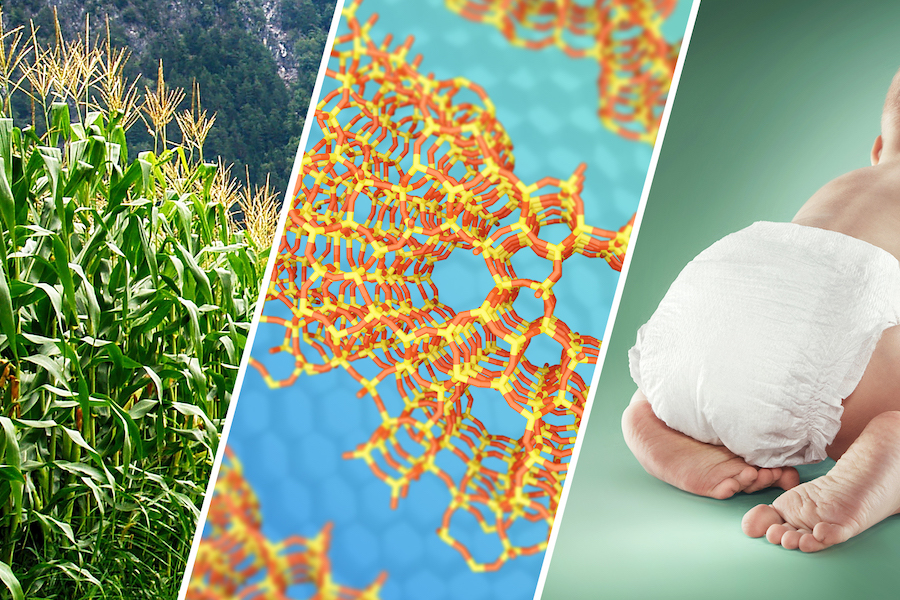
University of Minnesota researchers have invented new catalyst technology that improves the process and substantially reduces the cost of manufacturing renewable chemicals that can be used in a wide range of products including paints, coatings and diapers. Graphic credit: John Beumer, NSF Center for Sustainable Polymers, University of Minnesota
Research discovery will enable the manufacturing of biorenewable materials from trees and corn. A team led by University of Minnesota Twin Cities researchers has invented a groundbreaking new catalyst technology that converts renewable materials like trees and corn to the key chemicals, acrylic acid, and acrylates used in paints, coatings, and superabsorbent polymers...
~ also known as 2-Propenoic acid, 79-10-7, Propenoic acid, Vinylformic acid, Prop-2-enoic acid (preferred IUPAC name) etc. is an incredibly common chemical in the manufacturing industry with over 1 million tons produced per year. It is the most simple unsaturated carboxylic acid.
Chemical structure: CH2=CHCOOH, vinyl group attached to carboxylic acid terminus.
Odor: Acrid or tart
Production:
a) From propylene: CH2=CHCH3 + 3⁄2 O2 → CH2=CHCO2H + H2O
b) Oxidation of propane to acrylic acid (under research)
c) Carboxylation to acrylic acid (under supercritical CO2).
d) Environmentally-friendly option: Using fermented sugar to produce 3-hydroxypropionic acid (3HP) = acrylic acid precursor
Chemical reactions and Uses: Acrylic acid reacts with alcohol to form an es...







Recent Comments