

Additive manufacturing has revolutionized manufacturing by enabling customized, cost-effective products with minimal waste. However, with the majority of 3D printers operating on open-loop systems, they are notoriously prone to failure...
Read More


February 4, 2026,
 Physics, Technology/Electronics
Additive manufacturing has revolutionized manufacturing by enabling customized, cost-effective products with minimal waste. However, with the majority of 3D printers operating on open-loop systems, they are notoriously prone to failure...
Read More
November 25, 2025,
Physics, Technology/Electronics

Researchers at Oregon State University have developed a quick-setting, environmentally friendly alternative to concrete they hope can one day be used to rapidly 3D print homes and infrastructure.
Also known as additive manufacturing, 3D printing is already being used to help solve construction challenges such as the global housing crisis that’s emerged as Earth’s population approaches 8.5 billion.
But cement, the binding agent in concrete, accounts for about 8% of the planet’s carbon dioxide emissions, and concrete’s curing time—which can be multiple days—and required structural supports can inhibit progress on construction projects.
How ...
Read More
November 11, 2020,
Biology/Biotechnology, Health/Medical

Forget glue, screws, heat or other traditional bonding methods. A Cornell University-led collaboration has developed a 3D printing technique that creates cellular metallic materials by smashing together powder particles at supersonic speed.
This form of technology, known as “cold spray,” results in mechanically robust, porous structures that are 40% stronger than similar materials made with conventional manufacturing processes. The structures’ small size and porosity make them particularly well-suited for building biomedical components, like replacement joints.
The team’s paper, “Solid-State Additive Manufacturing of Porous Ti-6Al-4V by Supe...
Read More
July 28, 2020,
Chemistry/Nanotechnology, Physics
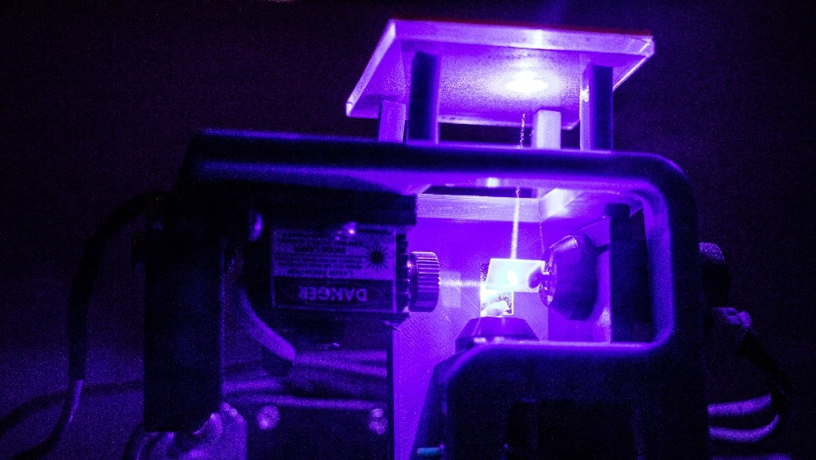
Selective laser sintering is one of the most widely used processes in additive manufacturing, but it is limited to printing with a single material at a time. Robotics engineers have now developed a new approach to overcome this limitation: By inverting the laser so that it points upwards, they’ve invented a way to enable SLS to use – at the same time – multiple materials.
Additive manufacturing – or 3D printing – uses digital manufacturing processes to fabricate components that are light, strong, and require no special tooling to produce...
Read More

Recent Comments