
AI tagged posts

Drones can now Scan Terrain and Excavations without Human Intervention

Measuring and documenting gravel and limestone quarries, cliff faces and similar natural and man-made formations is often done using drones that photograph the area. New research may make the pilots superfluous. (NB: The vertical rod on top of the drone carries a wind detector for test purposes, and it is not present on the final version of the drone.) Photo: Erdal Kayacan.

Drone pilots may become superfluous in the future. New research from Aarhus University has allowed artificial intelligence to take over control of drones scanning and measuring terrain.

A research project at Aarhus University (AU) in collaboration with the Technical University of Denmark (DTU) aims to make measuring and documenting gravel and limestone quarries much faster, cheaper and easier in the future.

Read More
Robot uses Artificial Intelligence and imaging to Draw Blood

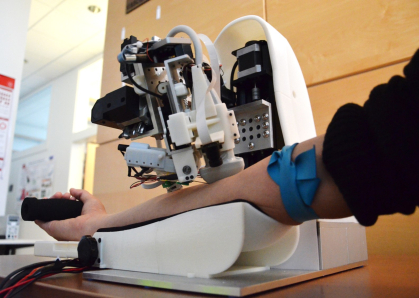
This tabletop robotic device can accurately steer needles and catheters into tiny blood vessels with minimal supervision.
This tabletop robotic device can accurately steer needles and catheters into tiny blood vessels with minimal supervision. Photo: Martin Yarmush and Alvin Chen

Engineers create device that can also insert catheters. Rutgers engineers have created a tabletop device that combines a robot, AI and near-infrared and ultrasound imaging to draw blood or insert catheters to deliver fluids and drugs.

Their most recent research results, published in the journal Nature Machine Intelligence, suggest that autonomous systems like the image-guided robotic device could outperform people on some complex medical tasks.

Medical robots could reduce injuries and improve the efficiency and outcomes of procedures, as well as carry out tasks with minimal supervision when resources are limited...

Read More

‘Multitasking’ AI Tool to Extract Cancer Data in record time

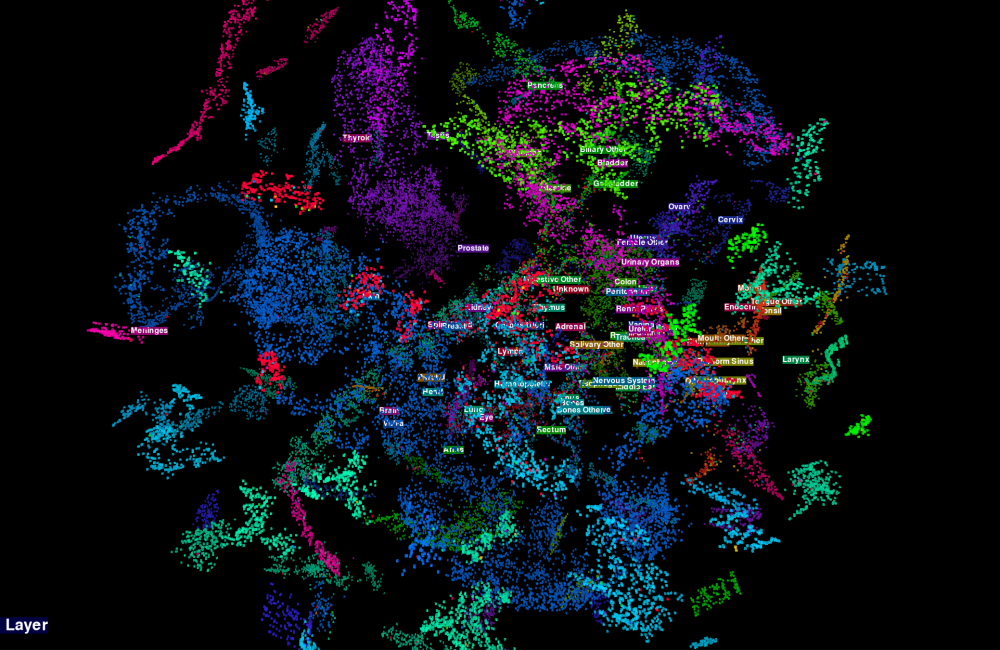
The image visualizes how the team’s multitask convolutional neural network classifies primary cancer sites. Image credit: Hong-Jun Yoon/ORNL

To better leverage cancer data for research, scientists are developing an artificial intelligence (AI)-based natural language processing tool to improve information extraction from textual pathology reports. In a first for cancer pathology reports, the team developed a multitask convolutional neural network (CNN) – a deep learning model that learns to perform tasks, such as identifying key words in a body of text, by processing language as a two-dimensional numerical dataset.

As the second-leading cause of death in the United States, cancer is a public health crisis that afflicts nearly one in two people during their lifetime...

Read More

Molecular Eraser enables better Data Storage and Computers for AI

Abstract Image
Detecting and Directing Single Molecule Binding Events on H-Si(100) with Application to Ultradense Data Storage

Scientists have added a crucial tool to the atomic-scale manufacturing toolkit with major implications for today’s data driven—carbon intensive—world, according to new research from the University of Alberta in Canada.

“Computers today are contributing one gigatonne of carbon emissions to the atmosphere, and we can eliminate that by enhancing the most power-hungry parts of conventional computers with our atomic-scale circuitry,” said Robert Wolkow, professor in the University of Alberta’s Department of Physics a Principal Research Officer at the National Research Council of Canada’s Nanotechnology Research Centre, and chief technical officer of Quantum Silicon Inc, a...

Read More
