AI tagged posts

ChartNet trains AI to read charts, boosting smaller models past commercial rivals

To accelerate and refine decision-making in a fast-paced, global marketplace, enterprises may deploy generative artificial intelligence models to help summarize and interpret the charts that often fill market summaries and financial reports.

But even the latest vision-language models sometimes struggle with this task, since it requires a model to integrate visual, numerical, and linguistic understanding. A company that invests in a state-of-the-art model might still receive inaccurate or incomplete information.

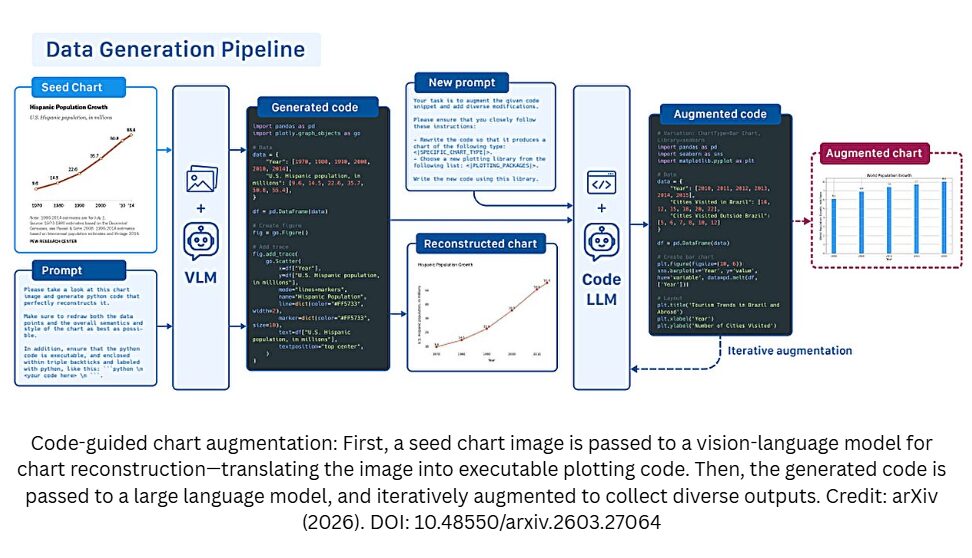
To fill this performance gap, researchers from MIT and the MIT-IBM Computing Research Lab developed a multifaceted resource for AI users that is specifically designed to teach vision-language models (VLMs) how to effectively interpret charts.

They used a novel data gen...

Read More

AI repurposes routine chest X-rays to catch silent bone loss before fracture

AI repurposes routine chest X-rays to catch silent bone loss before fracture
Credit: Shu-Han Chen / St. Paul’s Hospital / National Taiwan University

Osteoporosis is a silent disease where bone loss develops gradually before fractures occur. Current clinical screening recommendations mainly focus on older women and selected high-risk groups, leaving some men, younger adults, and individuals with normal body weight completely outside routine screening pathways.

To close this care gap, researchers from St. Paul’s Hospital and National Taiwan University have demonstrated how AI can leverage routine chest X-rays to detect asymptomatic bone loss, closing critical gaps in screening healthy Asian populations. Their paper is published in the journal npj Digital Medicine.

Strikingly, the study found that more than half of the confirmed abnormal bone-density cases...

Read More

AI has crossed a threshold. What Claude Mythos means for the future of cybersecurity

Frontier AI Sandbox
Credit: Image generated by the editorial team using AI for illustrative purposes.

The limit of what artificial intelligence can achieve, known as frontier AI, has crossed another threshold. AI can now plan and execute sophisticated cyber operations with minimal guidance at speeds far beyond human capability.

That, at least, is the evidence from an independent test of Claude Mythos Preview, the latest and most advanced model in the Claude family of AI systems, developed by US tech firm Anthropic. Similar to ChatGPT, these can understand and generate human-like text, analyze information, and solve complex problems.

The finance sector is alarmed. It relies on highly interconnected digital systems that are especially attractive targets for sophisticated cyber-attacks...

Read More

The AI that taught itself: How AI can learn what it never knew

Illustration: Midjourney

For years, the guiding assumption of artificial intelligence has been simple: an AI is only as good as the data it has seen. Feed it more, train it longer, and it performs better. Feed it less, and it stumbles. A new study from the USC Viterbi School of Engineering was accepted at the IEEE SoutheastCon 2026, taking place March 12–15. It suggests something far more surprising: with the right method in place, an AI model can dramatically improve its performance in territory it was barely trained on, pushing well past what its training data alone would ever allow.

The method was developed by Minda Li, a USC Viterbi undergraduate who has been pursuing research since her freshman year, working alongside her advisor Bhaskar Krishnamachari, a Faculty Fellow and S...

Read More