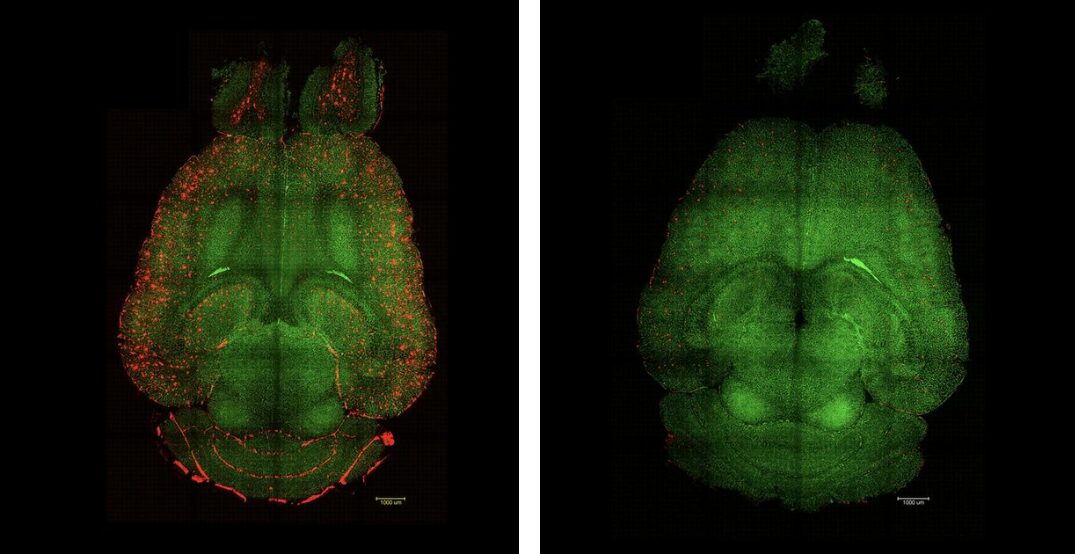
Left-hand image: Light sheet fluorescence microscope images of mouse brain 12h after NOT being treated with nanoparticles. The brains were analyzed to see the amount of Aβ plaques accumulation. Red: Aβ plaques. Green: vessels from the blood brain barrier. Right-hand image: Light sheet fluorescence microscope image of mouse brain 12h after being treated with nanoparticles. The brains were analyzed to see the amount of Aβ plaques accumulation. Red: Aβ plaques. Green: vessels from the blood brain barrier.
A research team co-led by the Institute for Bioengineering of Catalonia (IBEC) and West China Hospital Sichuan University (WCHSU), working with partners in the UK, has demonstrated a nanotechnology strategy that reverses Alzheimer’s disease in mice.
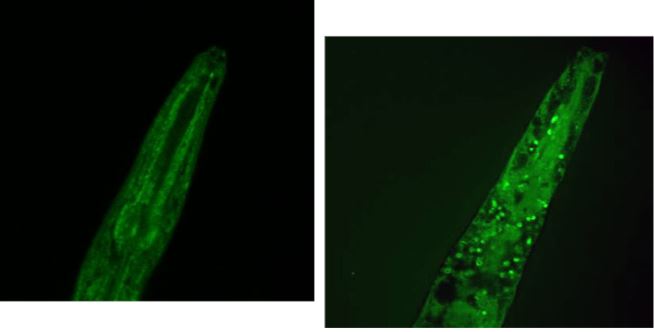
Alzheimer’s disease model of the worm C. elegans treated with the plant-derived compound fenchol (Left) and with a DMSO placebo (Right). Fenchol reduced accumulation of amyloid-β (green dots) in the organism’s head, compared to the placebo. | Images courtesy of Hariom Yadav, PhD, of the University of South Florida, first appeared as Fig. 4d in Frontiers in Aging Neuroscience, DIO: 10.3389/fnagi.2021.735933
Fenchol, a natural compound abundant in some plants including basil, can help protect the brain against Alzheimer’s disease pathology, a preclinical study led by University of South Florida Health (USF Health) researchers suggests.






Recent Comments