
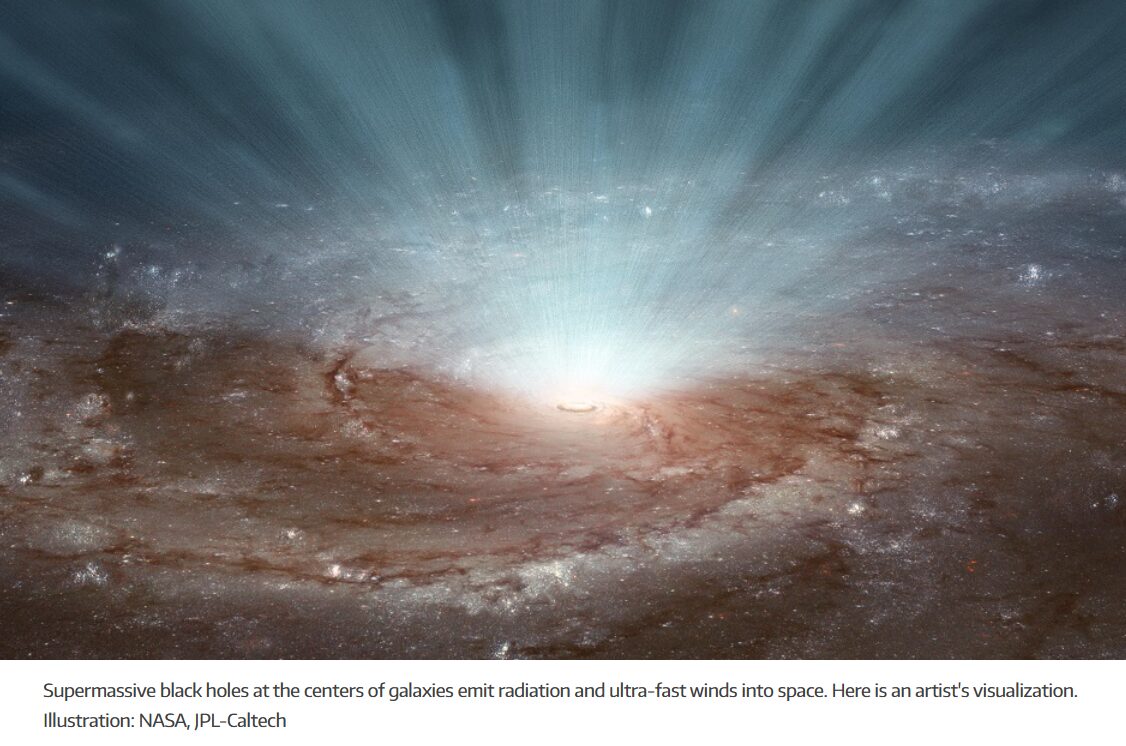
black hole tagged posts

Black holes might hold the key to a 60-year cosmic mystery

Could black holes help explain high-energy cosmic radiation?

Scientists may have finally uncovered the mystery behind ultra-high-energy cosmic rays — the most powerful particles known in the universe. A team from NTNU suggests that colossal winds from supermassive black holes could be accelerating these particles to unimaginable speeds. These winds, moving at half the speed of light, might not only shape entire galaxies but also fling atomic nuclei across the cosmos with incredible energy.

The universe is full of different types of radiation and particles that can be observed here on Earth. This includes photons across the entire range of the electromagnetic spectrum, from the lowest radio frequencies all the way to the highest-energy gamma rays...

Read More
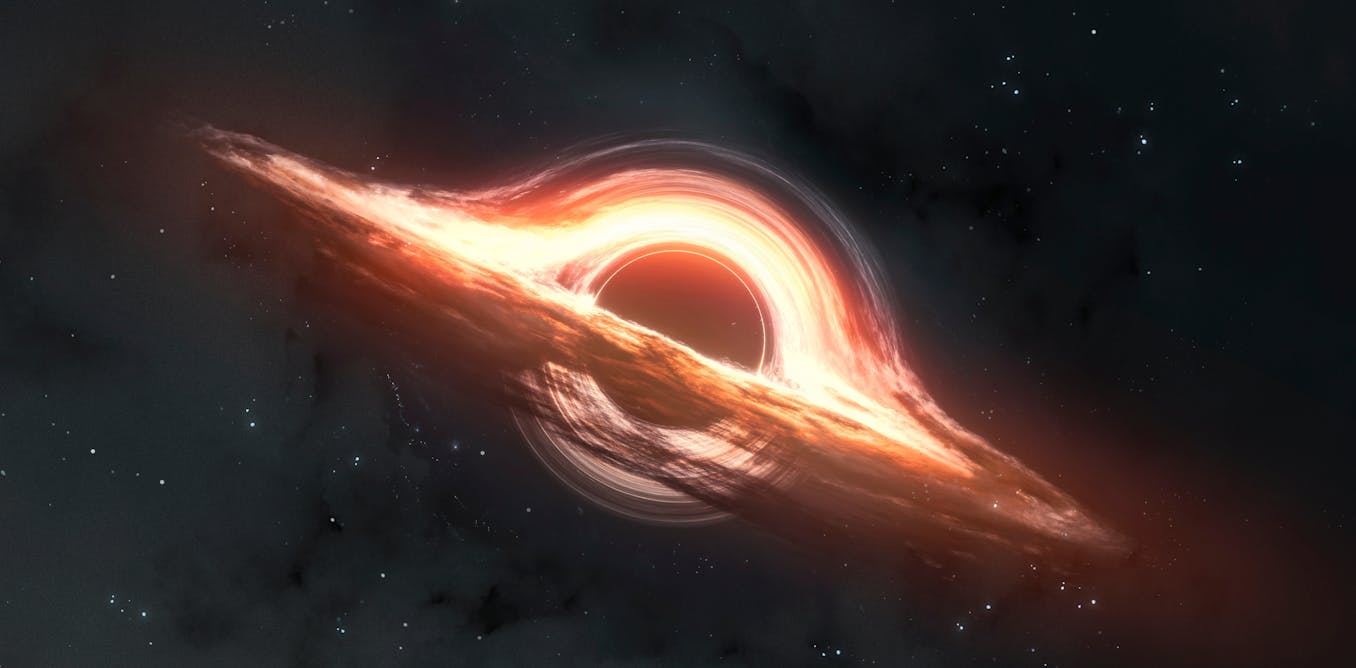
Chandra finds black hole that’s growing at 2.4 times the Eddington limit

An artist's concept of a supermassive black hole, a surrounding disk of material falling towards the black hole and a jet containing particles moving away at close to the speed of light. This black hole represents a recently-discovered quasar powered by a black hole. New Chandra observations indicate that the black hole is growing at a rate that exceeds the usual limit for black holes, called the Eddington Limit. Credit: NASA/CXC/SAO/M. Weiss
An artist’s concept of a supermassive black hole, a surrounding disk of material falling towards the black hole and a jet containing particles moving away at close to the speed of light. This black hole represents a recently-discovered quasar powered by a black hole. New Chandra observations indicate that the black hole is growing at a rate that exceeds the usual limit for black holes, called the Eddington Limit. Credit: NASA/CXC/SAO/M. Weiss
X-ray: NASA/CXC/INAF-Brera/L. Ighina et al.; Illustration: NASA/CXC/SAO/M. Weiss; Image Processing: NASA/CXC/SAO/N. Wolk

A black hole is growing at one of the fastest rates ever recorded, according to a team of astronomers...

Read More

What if the Big Bang wasn’t the beginning? Research suggests it may have taken place inside a black hole

The Big Bang is often described as the explosive birth of the universe—a singular moment when space, time and matter sprang into existence. But what if this was not the beginning at all? What if our universe emerged from something else—something more familiar and radical at the same time?

In a new paper, published in Physical Review D, my colleagues and I propose a striking alternative. Our calculations suggest the Big Bang was not the start of everything, but rather the outcome of a gravitational crunch or collapse that formed a very massive black hole—followed by a bounce inside it.

This idea, which we call the black hole universe, offers a radically different view of cosmic origins, yet it is grounded entirely in known physics and observations.

Today’s standard cosmo...

Read More

Professor Proposes how a Black Hole in Orbit Around a Planet could be a Sign of an Advanced Civilization

New study proposes how a black hole in orbit around a planet could be a sign of an advanced civilization
Ray traced shadow of a spinning and charged black hole. Credit: Simon Tyran, CC BY-SA 4.0

In 1971, English mathematical physicist and Nobel-prize winner Roger Penrose proposed how energy could be extracted from a rotating black hole. He argued that this could be done by building a harness around the black hole’s accretion disk, where infalling matter is accelerated to close to the speed of light, triggering the release of energy in multiple wavelengths.

Since then, multiple researchers have suggested that advanced civilizations could use this method (the Penrose Process) to power their civilization and that this represents a technosignature we should be on the lookout for.

Examples include John M...

Read More
