black holes tagged posts

Black Holes could come in ‘Perfect Pairs’ in an ever Expanding Universe

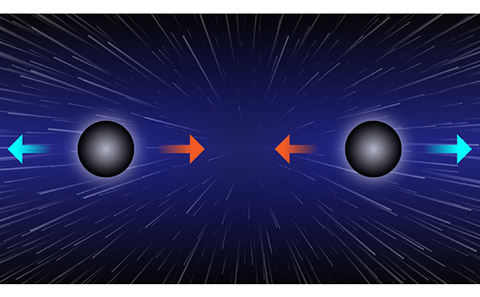
Graphic explaining forces holding two black holes at a distance.
Two black holes at fixed distance. Credit: APS/Alan Stonebraker

Researchers from the University of Southampton, together with colleagues from the universities of Cambridge and Barcelona, have shown it’s theoretically possible for black holes to exist in perfectly balanced pairs — held in equilibrium by a cosmological force — mimicking a single black hole.

Black holes are massive astronomical objects that have such a strong gravitational pull that nothing, not even light, can escape. They are incredibly dense. A black hole could pack the mass of the Earth into a space the size of a pea.

Conventional theories about black holes, based on Einstein’s theory of General Relativity, typically explain how static or spinning black holes can exist on their own, isolated in space...

Read More
VERA Unveils Surroundings of Rapidly Growing Black Holes

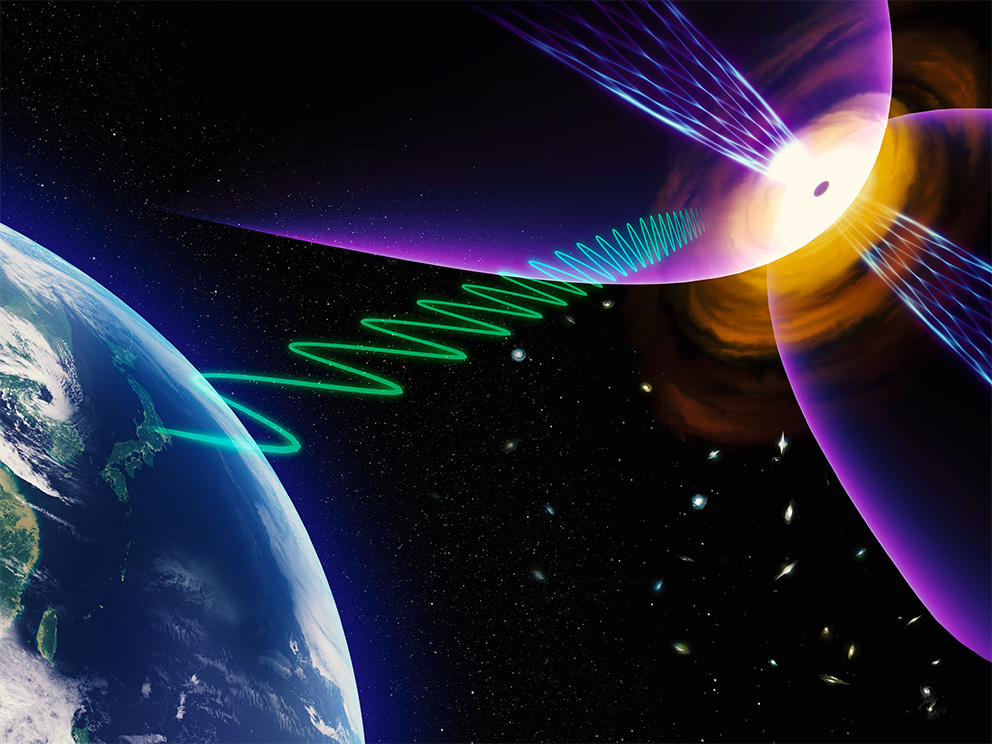
Jets ejected from a rapidly growing supermassive black hole with surrounding outflows. The polarization plane of a radio wave emitted from the vicinity of a black hole rotates as it passes through the surrounding magnetized gas. (Credit: NAOJ) 

An international team of astronomers used the state-of-the-art capability of VERA, a Japanese network of radio telescopes operated by NAOJ, to uncover valuable clues about how rapidly growing “young” supermassive black holes form, grow, and possibly evolve into more powerful quasars.

It is now widely accepted that nearly every active galaxy harbors a supermassive black hole at its core, with masses ranging from millions to billions of times that of the Sun...

Read More

Eventually Everything Will Evaporate, Not Only Black Holes

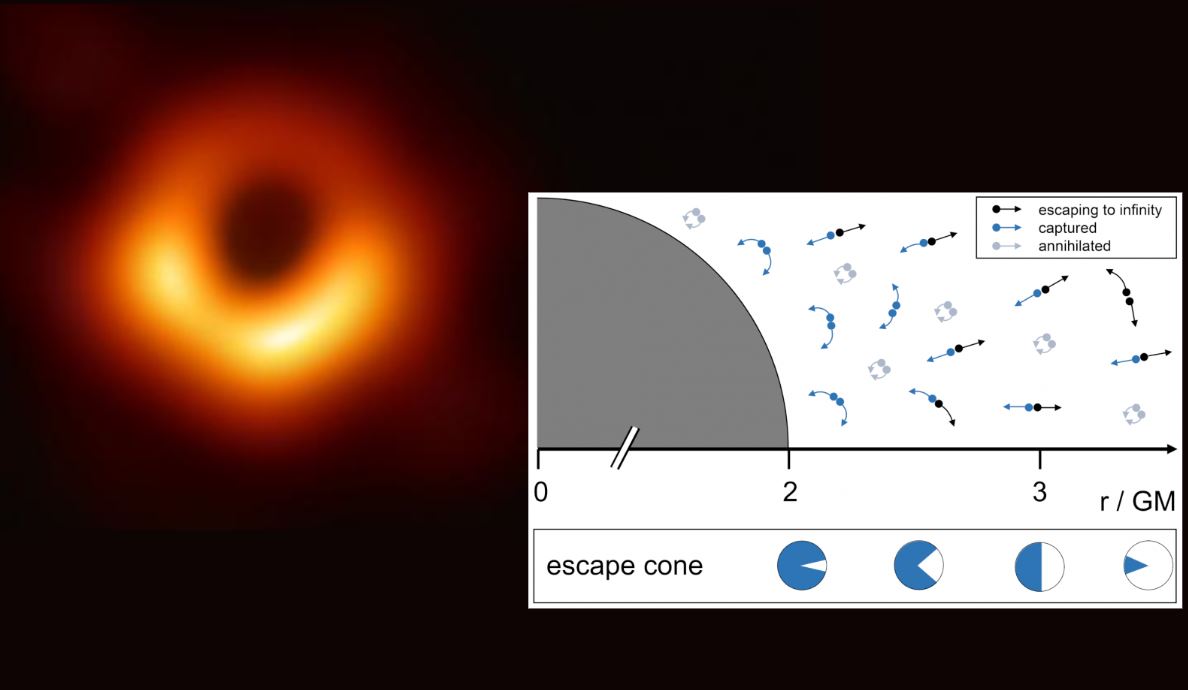
New theoretical research by Michael Wondrak, Walter van Suijlekom and Heino Falcke of Radboud University has shown that Stephen Hawking was right about black holes, although not completely. Due to Hawking radiation, black holes will eventually evaporate, but the event horizon is not as crucial as had been believed. Gravity and the curvature of spacetime cause this radiation too. This means that all large objects in the universe, like the remnants of stars, will eventually evaporate.

Using a clever combination of quantum physics and Einstein’s theory of gravity, Stephen Hawking argued that the spontaneous creation and annihilation of pairs of particles must occur near the event horizon (the point beyond which there is no escape from the gravitational force of a black hole)...

Read More

This Star might be Orbiting a Strange ‘Boson Star’

This star might be orbiting a strange
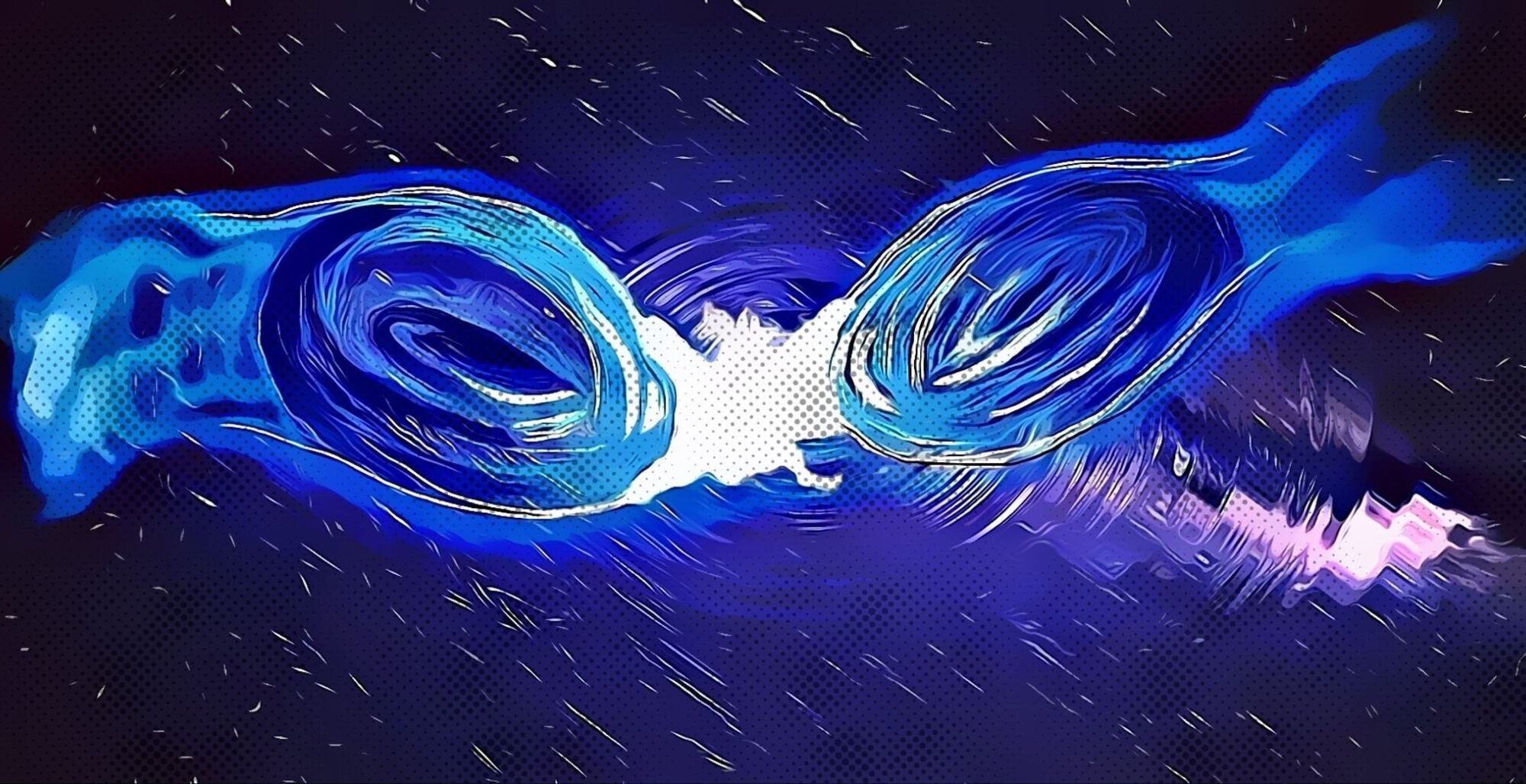
Illustration of a merger of two boson stars. Credit: Nicolás Sanchis-Gual and Rocío García Souto

A team of astronomers has claimed that observations of a sun-like star orbiting a small black hole might actually be the indication of something far more exotic—the existence of a boson star, a star composed entirely of dark matter.

The Gaia survey, led by the European Space Agency, provided detailed maps of more than a billion stars in the Milky Way galaxy. While almost all of those stars behaved as expected, there were some surprises. For example, one star in particular was seen orbiting a dark companion.

The star itself was fairly typical, weighing in at 0.93 solar masses and with roughly the same chemical abundance as our own sun...

Read More