
bosons tagged posts

Observing one-dimensional anyons: Exotic quasiparticles in the coldest corners of the universe

Illustration with balls and arrows and a ring
Researchers inject an impurity into a one-dimensional ultracold gas, thereby generating a quasiparticle with exotic properties.

Scientists led by Hanns-Christoph Nägerl have observed anyons — quasiparticles that differ from the familiar fermions and bosons — in a one-dimensional quantum system for the first time. The results, published in Nature, may contribute to a better understanding of quantum matter and its potential applications.

Nature categorizes particles into two fundamental types: fermions and bosons. While matter-building particles such as quarks and electrons belong to the fermion family, bosons typically serve as force carriers — examples include photons, which mediate electromagnetic interactions, and gluons, which govern nuclear forces...

Read More
Discovery of New Class of Particles could take Quantum Mechanics One Step Further

Discovery of new of particles could take quantum mechanics one step further
Excitonic pairing and fractional quantum Hall effect in quantum Hall bilayer. Credit: Naiyuan J. Zhang et al,

Amid the many mysteries of quantum physics, subatomic particles don’t always follow the rules of the physical world. They can exist in two places at once, pass through solid barriers and even communicate across vast distances instantaneously. These behaviors may seem impossible, but in the quantum realm, scientists are exploring an array of properties once thought impossible.

In a new study, physicists at Brown University have now observed a novel class of quantum particles called fractional excitons, which behave in unexpected ways and could significantly expand scientists’ understanding of the quantum realm.

“Our findings point toward an entirely new class of quantum pa...

Read More

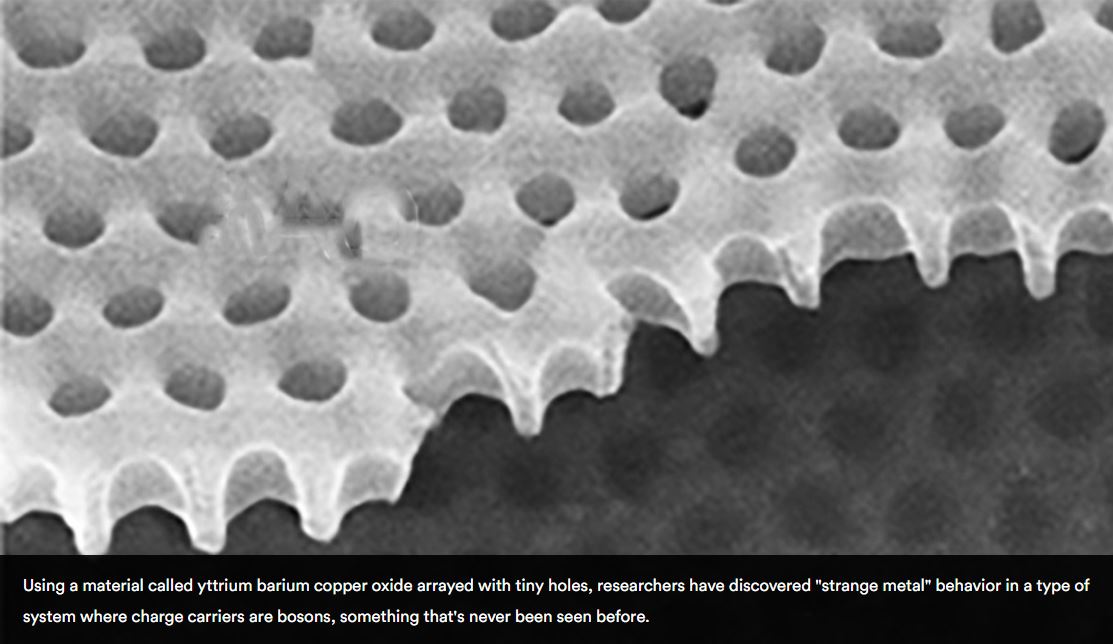
Newly Discovered Type of ‘Strange Metal’ could lead to Deep Insights

A new discovery could help scientists to understand ‘strange metals,’ a class of materials that are related to high-temperature superconductors and share fundamental quantum attributes with black holes.

Scientists understand quite well how temperature affects electrical conductance in most everyday metals like copper or silver. But in recent years, researchers have turned their attention to a class of materials that do not seem to follow the traditional electrical rules. Understanding these so-called “strange metals” could provide fundamental insights into the quantum world, and potentially help scientists understand strange phenomena like high-temperature superconductivity.

Now, a research team co-led by a Brown University physicist has added a new discovery to the strange meta...

Read More
