
Cassini spacecraft tagged posts

Cassini Gets Up Close and Personal With Saturn’s ‘Wavemaker’ Moon Daphnis

Cassini Gets Up Close and Personal With Saturn's 'Wavemaker' Moon Daphnis

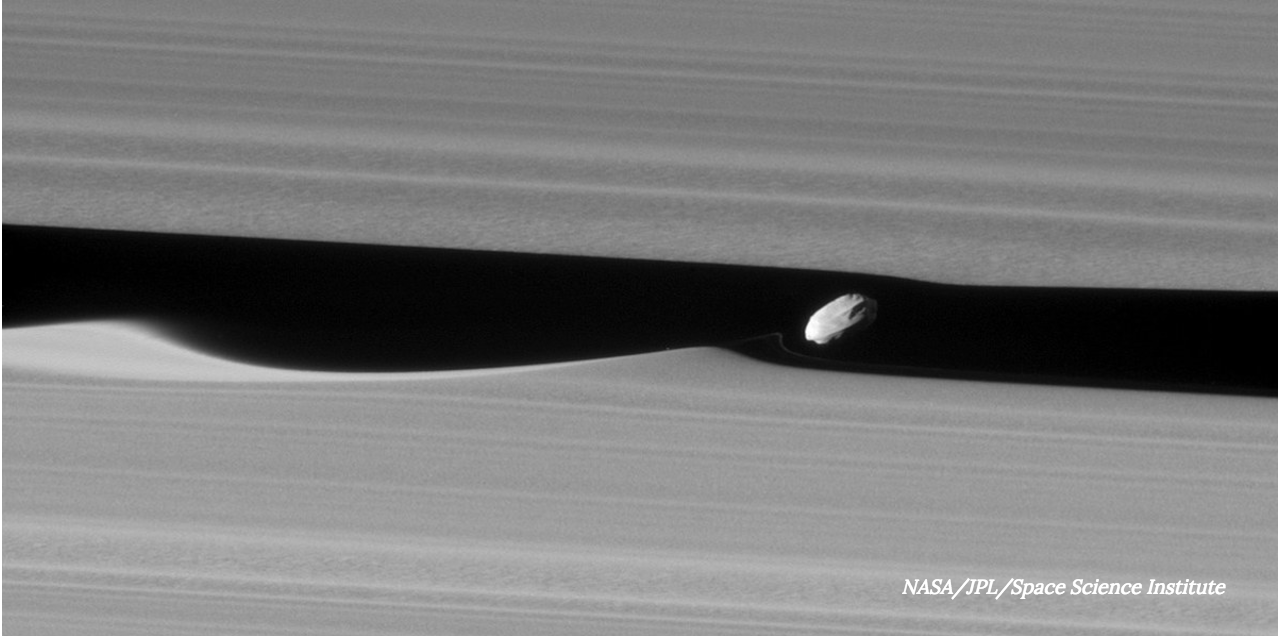
As this almost surreal observation of Saturn’s tiny moon Daphnis shows, we’re finally getting a really good look at the small-scale processes that are at work in Saturn’s rings Credit: NASA/JPL/Space Science Institute

The wavemaker moon, Daphnis, is featured in this view, taken as NASA’s Cassini spacecraft made one of its ring-grazing passes over the outer edges of Saturn’s rings on Jan. 16, 2017. This is the closest view of the small moon obtained yet. Daphnis (5 miles) orbits within the 26-mile wide Keeler Gap. Cassini’s viewing angle causes the gap to appear narrower than it actually is, due to foreshortening.

The little moon’s gravity raises waves in the edges of the gap in both the horizontal and vertical directions...

Read More

Using Cassini spacecraft, possible Positions of a Ninth planet in the Solar System have been specified

Location of a possible ninth planet. Analysis of radio data from the Cassini spacecraft defines forbidden areas (in red) where the perturbations created by the planet are inconsistent with observations, and a likely area (green) where the addition of the planet improves the model prediction, reducing the differences between the calculations and Cassini data. The position of minimum residues is the most likely location for a planet at P9. Scales are in astronomical units (AU). Credit: Image courtesy of CNRS

Location of a possible ninth planet. Analysis of radio data from the Cassini spacecraft defines forbidden areas (in red) where the perturbations created by the planet are inconsistent with observations, and a likely area (green) where the addition of the planet improves the model prediction, reducing the differences between the calculations and Cassini data. The position of minimum residues is the most likely location for a planet at P9. Scales are in astronomical units (AU). Credit: Image courtesy of CNRS

The Kuiper Belt Objects, small bodies similar to Pluto beyond Neptune, have a particular distribution that is difficult to explain by pure chance...

Read More
