
CHARA Array tagged posts

Close-up images show how stars explode in real time

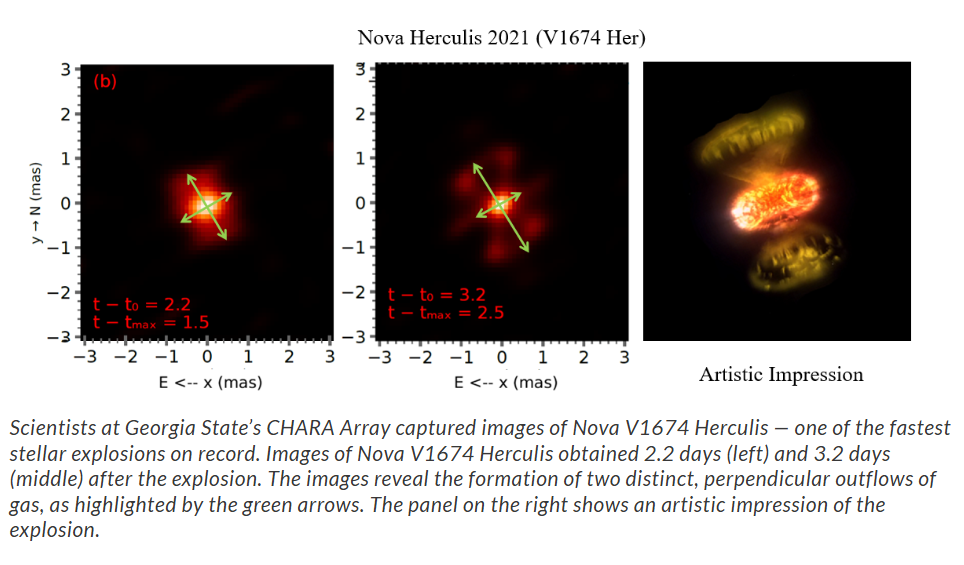
Astronomers have captured images of two stellar explosions—known as novae—within days of their eruption and in unprecedented detail. The breakthrough provides direct evidence that these explosions are more complex than previously thought, with multiple outflows of material and, in some cases, dramatic delays in the ejection process.

The international study, published in the journal Nature Astronomy, used a cutting-edge technique called interferometry at the Center for High Angular Resolution Astronomy (CHARA Array) in California. This approach allowed scientists to combine the light from multiple telescopes, achieving the sharp resolution needed to directly image the rapidly evolving explosions.

“The images give us a close-up view of how material is ejected away from the sta...

Read More

Elusive, Dusty Inner Region of Distant Galaxy

The long-sought after innermost dusty ring was detected with the highest spatial resolution in the infrared wavelengths ever used. An international team of scientists has achieved the milestone of directly observing the long-sought, innermost dusty ring around a supermassive black hole, at a right angle to its emerging jet. Such a structure was thought to exist in the nucleus of galaxies but had been difficult to observe directly because intervening material obscured our line of sight.

Now the inner disk is detected using the highest spatial resolution in the infrared wavelengths ever done for an extragalactic object. The new discovery was just published in The Astrophysical Journal.

“This is a very exciting step forward to view the inner region of a distant galaxy with such fin...

Read More
