
DART tagged posts

Hit the wrong spot and an asteroid returns on a collision course

Asteroid deflection could save Earth, or accidentally doom it, depending on where we aim the impact.

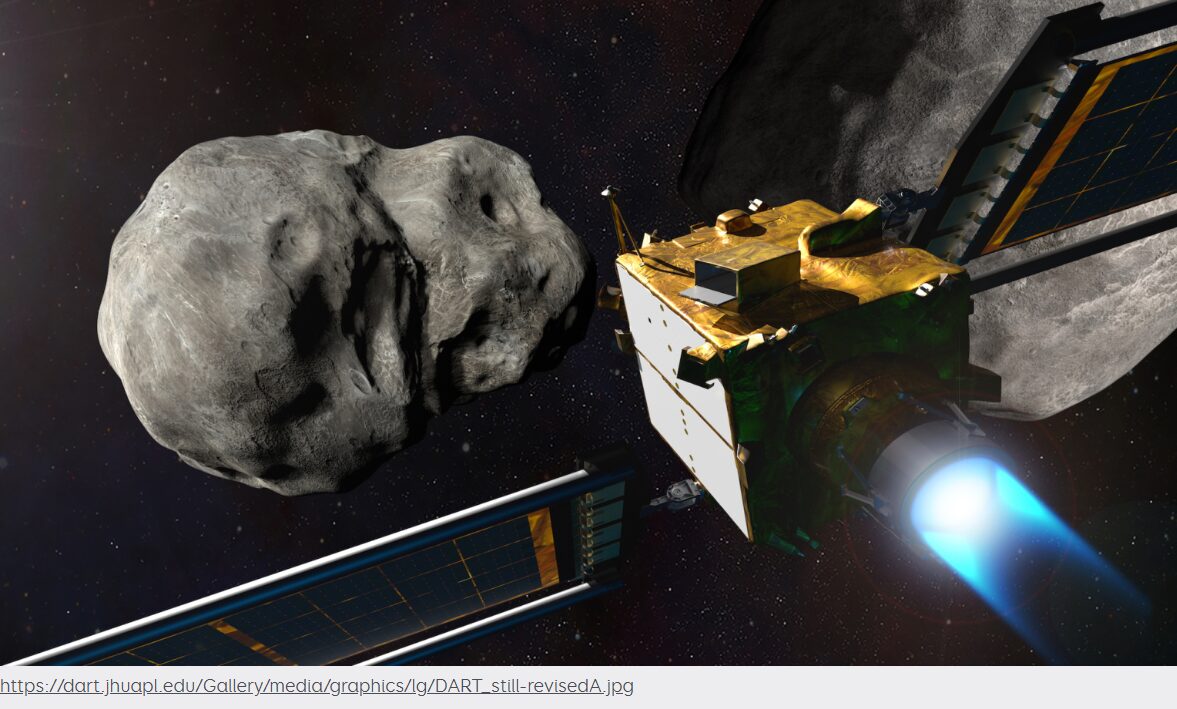
Scientists caution that asteroid deflection must be precise, as striking the wrong spot risks sending it through a gravitational keyhole that sets up a future collision with Earth. Using lessons from NASA’s DART mission, researchers are developing probability maps to guide safer impact strategies.

Selecting the right spot to smash a spacecraft into the surface of a hazardous asteroid to deflect it must be done with great care, according to new research presented at the EPSC-DPS2025 Joint Meeting this week in Helsinki...

Read More
Late-time Small-body Asteroid Disruptions can Protect the Earth

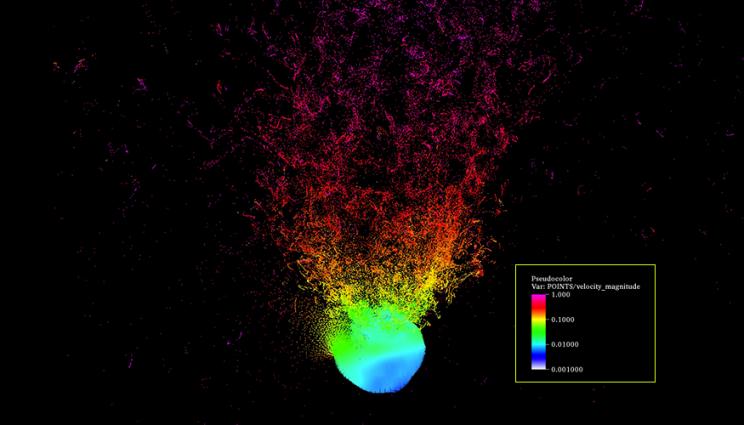
The hydro simulation in Spheral that provided the basis for the analysis: 1 Megaton at a few meters standoff distance from a 100-meter diameter asteroid (with Bennu shape). Colors denote velocities. The legend is cm/us, which is equivalent to 10 km/s

If an asteroid is determined to be on an Earth-impacting trajectory, scientists typically want to stage a deflection, where the asteroid is gently nudged by a relatively small change in velocity, while keeping the bulk of the asteroid together.

A kinetic impactor or a standoff nuclear explosion can achieve a deflection. However, if the warning time is too short to stage a successful deflection, another option is to couple a lot of energy to the asteroid and break it up into many well-dispersed fragments...

Read More
