
DES tagged posts

Universe may end in a “big crunch,” new dark energy data suggests

Universe May End in a Big Crunch
The universe may not fade away endlessly — it could snap back and collapse in a cosmic “big crunch” 20 billion years from now. Credit: Shutterstock

New data from major dark-energy observatories suggest the universe may not expand forever after all. A Cornell physicist calculates that the cosmos is heading toward a dramatic reversal: after reaching its maximum size in about 11 billion years, it could begin collapsing, ultimately ending in a “big crunch” roughly 20 billion years from now.

A Cornell physicist has calculated that the universe may be nearing the halfway point of a total lifespan of about 33 billion years...

Read More
New evidence suggests Einstein’s cosmic constant may be wrong

Dark energy may be evolving—hinting that the universe’s ultimate destiny could be far stranger than we ever imagined. Astronomers are rethinking one of cosmology’s biggest mysteries: dark energy. New findings show that evolving dark energy models, tied to ultra-light axion particles, may better fit the universe’s expansion history than Einstein’s constant model. The results suggest dark energy’s density could be slowly declining, altering the fate of the cosmos and fueling excitement that we may be witnessing the universe’s next great revelation.

Dark energy, the mysterious force thought to drive the universe’s accelerating expansion, remains one of the deepest puzzles in modern physics...

Read More

Footprints of Galactic Immigration uncovered in Andromeda Galaxy

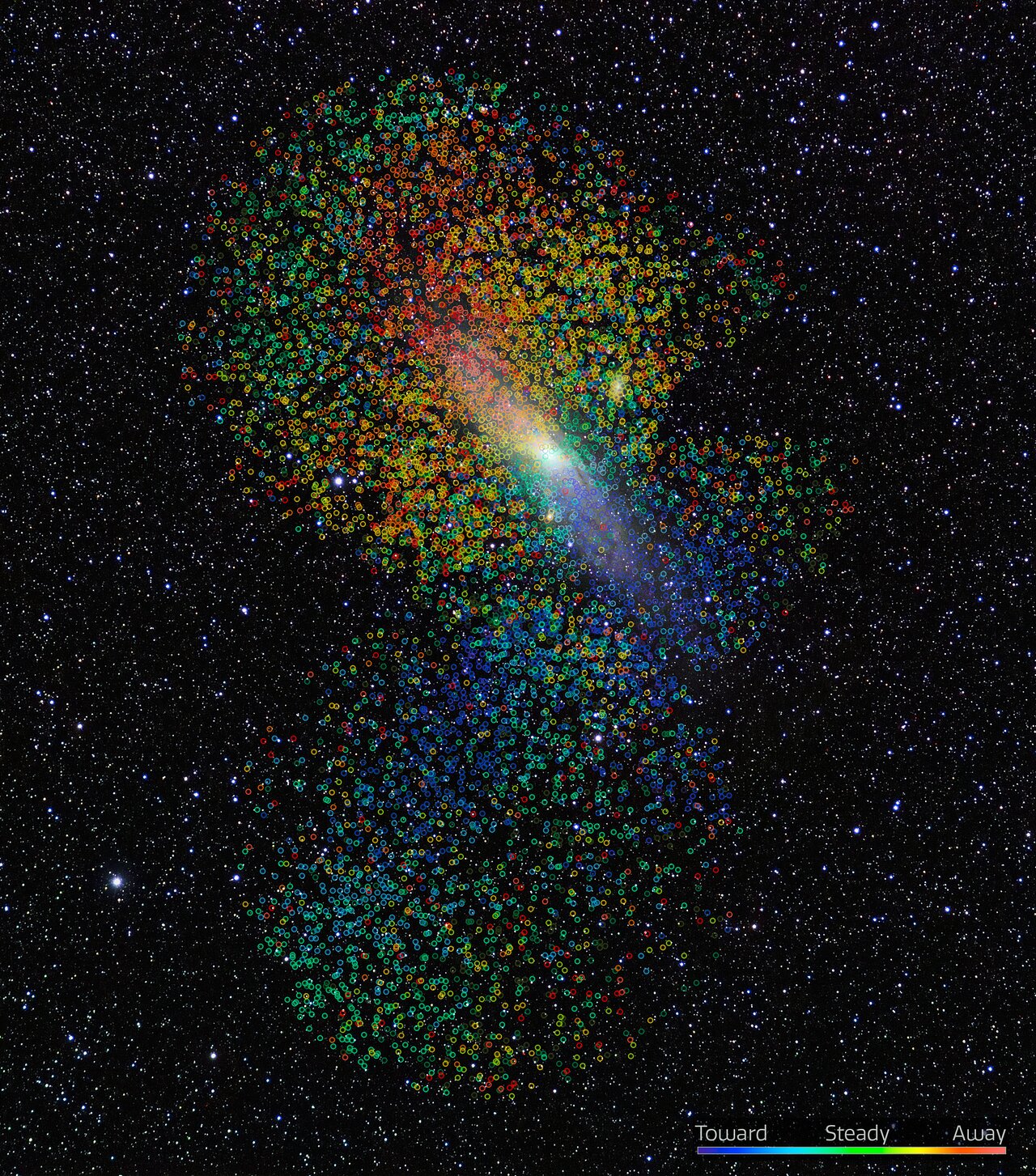
A team of researchers led by astronomers at NSF’s NOIRLab has uncovered striking new evidence for a mass migration of stars into the Andromeda Galaxy. Intricate patterns in the motions of stars reveal an immigration history very similar to that of the Milky Way. The new results were obtained with the DOE’s Dark Energy Spectroscopic Instrument on the Nicholas U. Mayall 4-meter Telescope at Kitt Peak National Observatory, a Program of NSF’s NOIRLab.

The Dark Energy Spectroscopic Instrument reveals compelling evidence of a mass migration of stars into Andromeda Galaxy. Intricate patterns in the motions of stars reveal an immigration history very similar to that of the Milky Way.

Over the course of billions of years, galaxies grow and evolve by forging new stars and merging with o...

Read More

Astronomers Reveal Secrets of Most Distant Supernova ever Detected

Top: Area of sky before the supernova was detected. Bottom: The supernova is detected. Credit: M Smith and DES collaboration

Top: Area of sky before the supernova was detected. Bottom: The supernova is detected.
Credit: M Smith and DES collaboration

An international team led by the University of Southampton has confirmed the discovery of the most distant supernova ever detected – a huge cosmic explosion that took place 10.5 billion years ago, or 3/4 the age of the Universe itself. The exploding star, DES16C2nm, was detected by the Dark Energy Survey (DES), an international collaboration to map several hundred million galaxies in order to find out more about dark energy – the mysterious force believed to be causing the accelerated expansion of the Universe.

As detailed in a new study published in The Astrophysical Journal, light from the event has taken 10...

Read More
