
Distant Galaxies tagged posts

Gas location drives star formation in distant galaxies

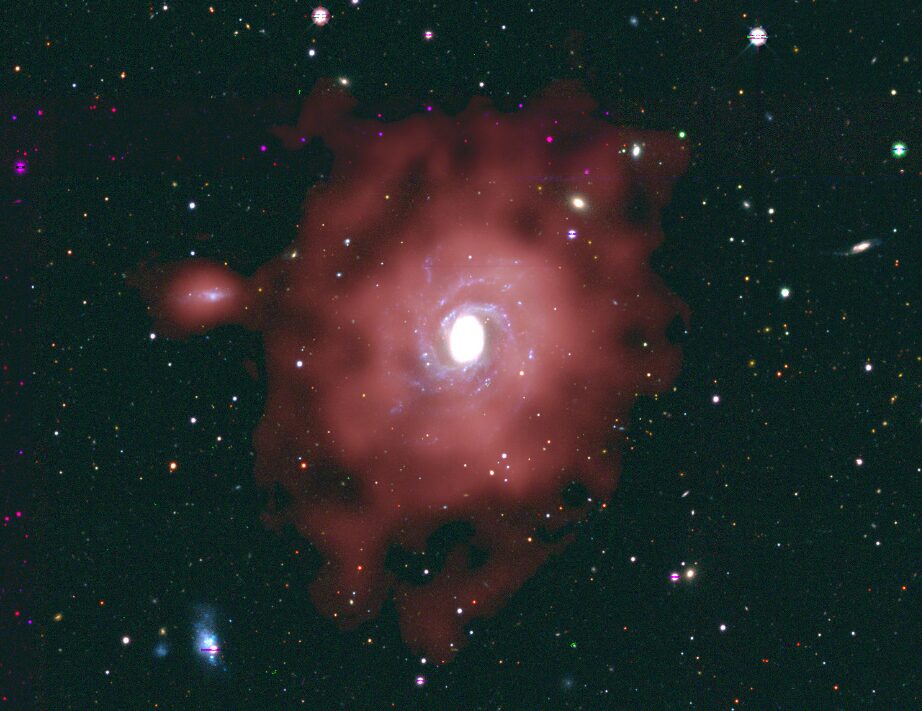
The red shade shows the atomic hydrogen gas content of the galaxy overlaid on the optical image. Credit: Legacy Surveys / D. Lang (Perimeter Institute)/ T. Westmeier – ICRAR

In the intriguing realm of star-forming galaxies, the key factor isn’t the total amount of gas but rather its strategic distribution within the galaxy.

Researchers at the International Centre for Radio Astronomy Research (ICRAR) made the discovery about galaxies by studying the gas distribution that helps create stars.

Using CSIRO’s ASKAP radio telescope located at Inyarrimanha Ilgari Bundara, the CSIRO Murchison Radio-astronomy Observatory, researchers explored the gas distribution in about 1,000 galaxies as part of the WALLABY survey.

Lead author Seona Lee, a PhD student at The University of Western Au...

Read More
New discovery about Distant Galaxies: Stars are more Massive than we thought

New discovery about distant galaxies: Stars are heavier than we thought
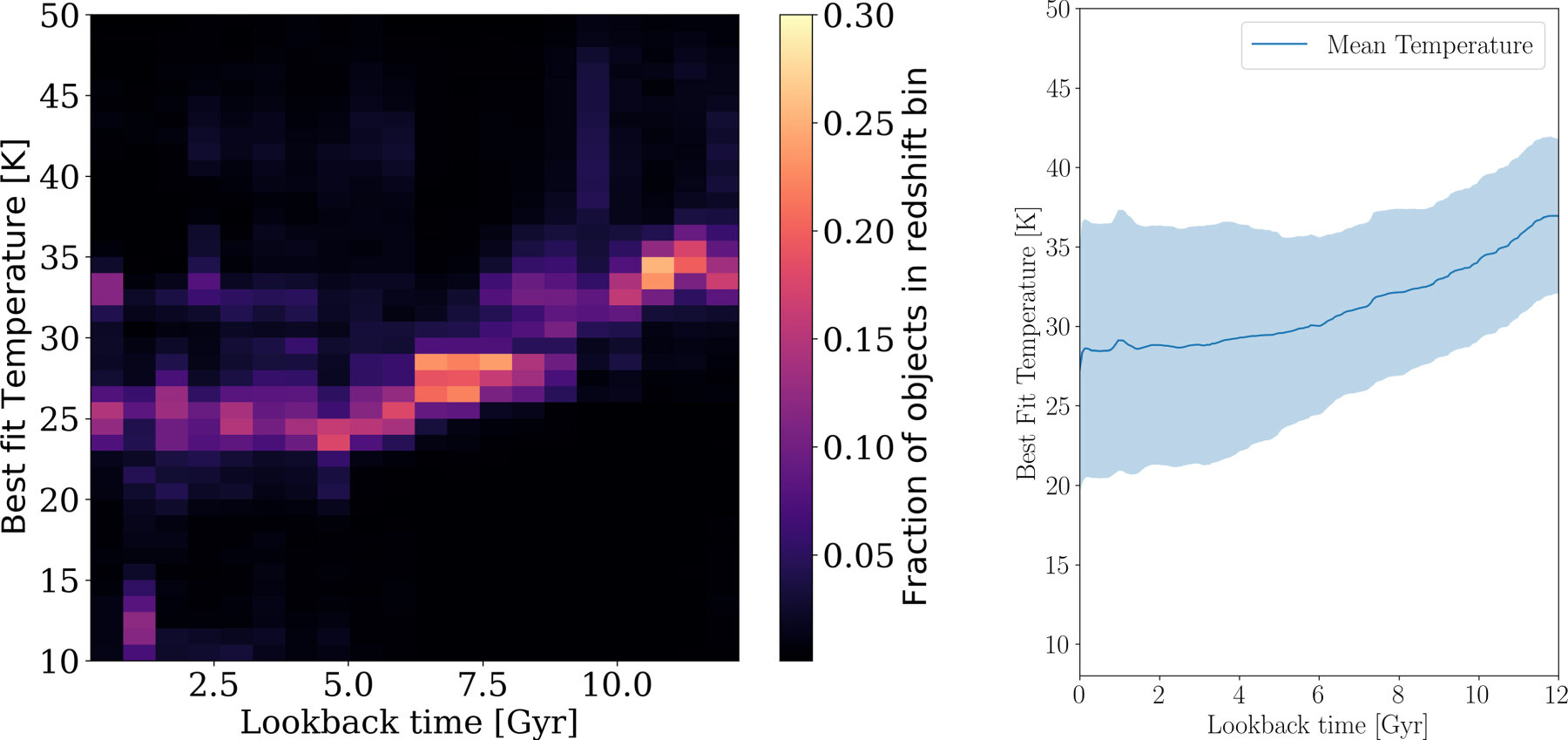
Left: best-fit temperature from 10 to 50 K vs. lookback time from a sample of 139,535 COSMOS2015 galaxies with S/N 10 in the V band (Laigle et al. 2016). At each redshift, the distribution is individually normalized in order to emphasize the temperature distribution at all redshifts. With increased redshift, fewer galaxies are fit at lower temperatures. Right: boxcar-smoothed mean with standard deviation of best-fit gas temperature at different lookback times (with mean determined from objects in 2 Gyr width age bins and not including galaxies fit at the bounds of temperature range). The mean temperature increases from ∼28 to ∼36 K from present to 12 Gyr, while the spread decreases. Credit: The European Physical Journal E (2022). DOI: 10.1140/epje/s10189-022-00183-5

A team o...

Read More
