
Earth-like planets tagged posts

New census of sun’s neighbors reveals best potential real estate for life

A new study led by a Georgia State University astronomy graduate student is a major step forward in the search for stars that could host Earth-like planets that may prove to be good havens for life to develop. Sebastián Carrazco-Gaxiola shared the results at the January 2026 meeting of the American Astronomical Society in Phoenix, Ariz.

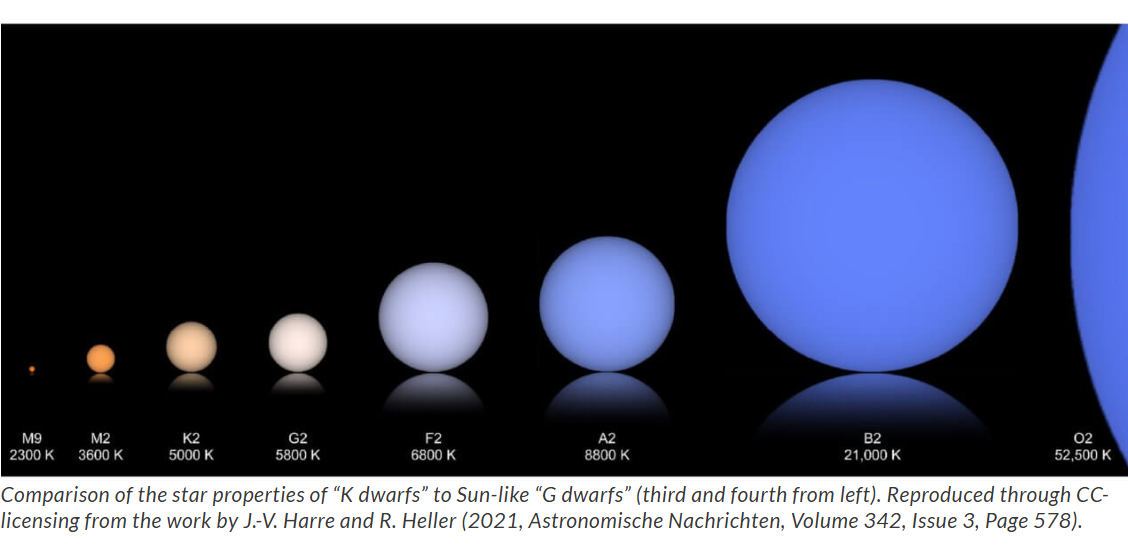
“This survey marks the first comprehensive look at thousands of the sun’s lower-mass cousins,” Carrazco-Gaxiola said. “These stars, known as ‘K dwarfs,’ are commonly found throughout space, and they provide a long-term, stable environment for their planetary companions.”

Survey details and observational methods
Carrazco-Gaxiola’s survey focuses on over 2,000 stars that are closer than 130 light-years from Earth...

Read More

Supernova immersion model suggests Earth-like planets are more common in the universe

New supernova theory suggests Earth-like planets are more common in the Universe
Schematic picture of the system assumed in this study. Credit: Science Advances (2025). DOI: 10.1126/sciadv.adx7892

Rocky planets like our Earth may be far more common than previously thought, according to new research published in the journal Science Advances. It suggests that when our solar system formed, a nearby supernova (the massive explosion of a star near the end of its life) bathed it in cosmic rays containing the radioactive ingredients to make rocky, dry worlds. This mechanism could be ubiquitous across the galaxy.

Earth-like planets are thought to form from planetesimals (objects made of rock and ice) that were dried out early in the solar system’s history...

Read More

Super-Earths and mini-Neptunes: More Earth-like planets may exist

illustration of planets

A new study presents a compelling new model for the formation of super-Earths and mini-Neptunes – planets that are 1 to 4 times the size of Earth and among the most common in our galaxy. Using advanced simulations, the researchers propose that these planets emerge from distinct rings of planetesimals, providing fresh insight into planetary evolution beyond our solar system.

A new study by Rice University researchers Sho Shibata and Andre Izidoro presents a compelling new model for the formation of super-Earths and mini-Neptunes — planets that are 1 to 4 times the size of Earth and among the most common in our galaxy...

Read More

Astronomers discover Dark past of Planet-eating ‘Death Star’ Solar Twin could hold clues to Planetary Formation

HIP68468, a twin star to the sun about 300 light-years away, may have swallowed one or more of its planets, based on lithium and refractory elements recently discovered near its surface. Credit: Illustration by Gabi Perez / Instituto de Astrofísica de Canarias

HIP68468, a twin star to the sun about 300 light-years away, may have swallowed one or more of its planets, based on lithium and refractory elements recently discovered near its surface. Credit: Illustration by Gabi Perez / Instituto de Astrofísica de Canarias

An international team has made the rare discovery of a planetary system with a host star similar to Earth’s sun. Especially intriguing is the star’s unusual composition, which indicates it ingested some of its planets. “It doesn’t mean that the sun will ‘eat’ the Earth any time soon,” said Jacob Bean, assistant professor of astronomy and astrophysics at UChicago. “But our discovery provides an indication that violent histories may be common for planetary systems, including our own.”

Unlike the artificial planet-destroying Death Star...

Read More
