
electromagnetic spectrum tagged posts

Quasars don’t last long—so how do they get so massive?

artist-quasar.jpeg
Artist’s illustration of a quasar. (Credit : NASA)

Quasars represent some of the most luminous and energetic phenomena in the universe. These distant powerhouses are driven by supermassive black holes—colossal gravitational engines with masses millions to billions of times that of our sun—which actively devour surrounding matter at incredible rates.

As gas, dust, and stellar material spiral inward through an accretion disk superheated to millions of degrees, this matter releases tremendous energy across the electromagnetic spectrum before crossing the event horizon. The resulting emissions can outshine entire galaxies despite originating from a region no larger than our solar system.

The discovery of billion-solar-mass black holes in distant quasars challenges conventional gr...

Read More
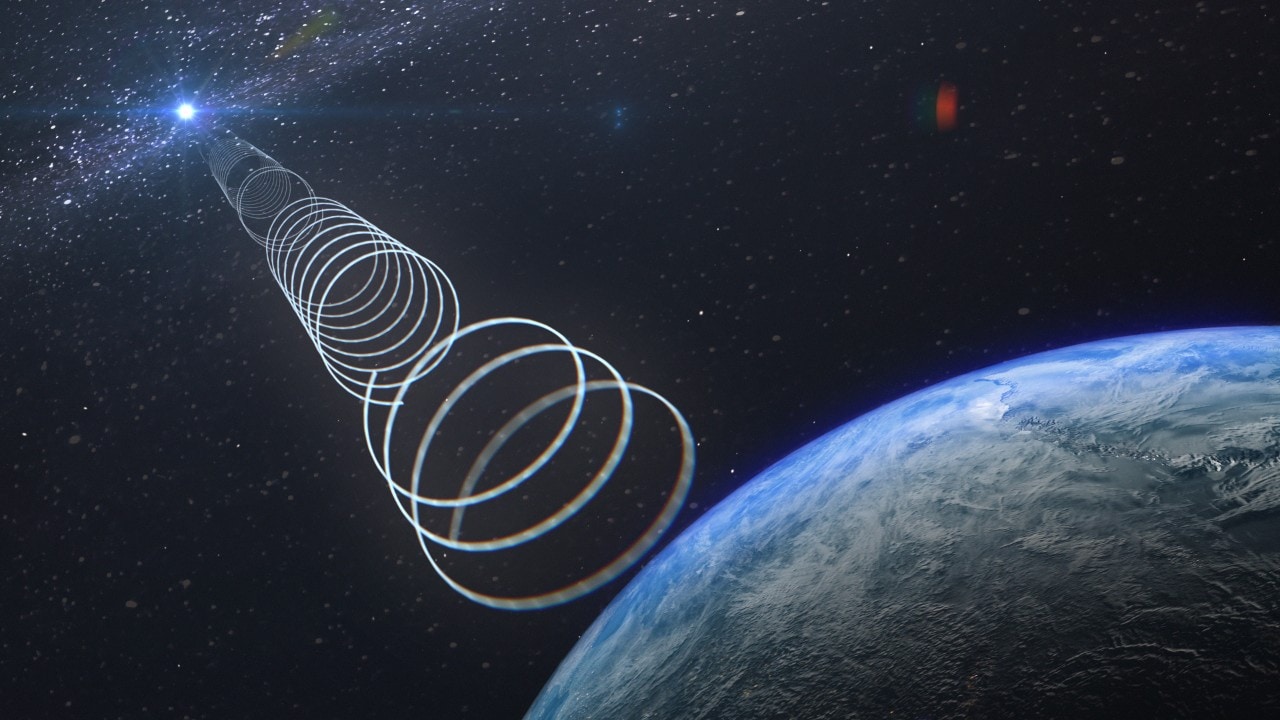
Strange Radio Waves emerge from the direction of the Galactic Center

Artist's impression of ASKAP J173608.2-321635 by Sebastian Zentilomo
Artist’s impression of ASKAP J173608.2-321635 by Sebastian Zentilomo

A variable signal aligned to the heart of the Milky Way is tantalising scientists. Astronomers have discovered unusual signals coming from the direction of the Milky Way’s centre. The radio waves fit no currently understood pattern of variable radio source and could suggest a new class of stellar object.

“The strangest property of this new signal is that it is has a very high polarisation. This means its light oscillates in only one direction, but that direction rotates with time,” said Ziteng Wang, lead author of the new study and a PhD student in the School of Physics at the University of Sydney.

“The brightness of the object also varies dramatically, by a factor of 100, and the signal switches on and off appa...

Read More
