
extraterrestrial life tagged posts

Planets of Binary Stars as possible homes for Alien Life

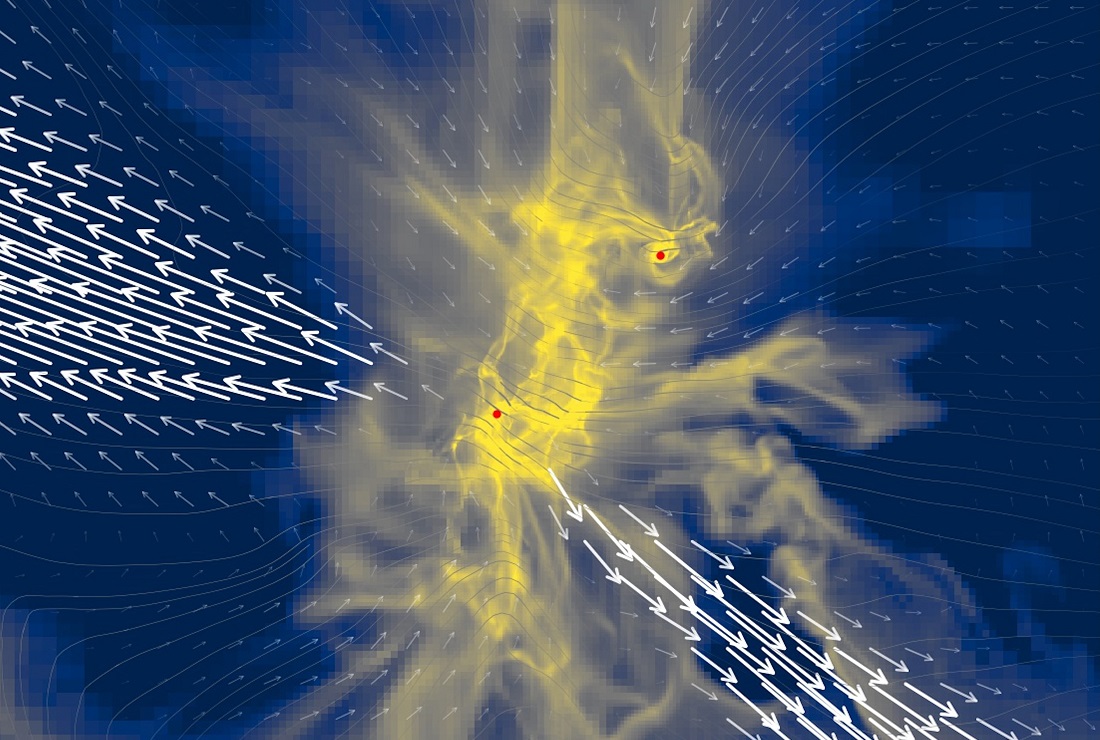
Simulation of binary star (from the scientific article by Jørgensen, Kuruwita et al.)

Nearly half of Sun-size stars are binary. According to University of Copenhagen research, planetary systems around binary stars may be very different from those around single stars. This points to new targets in the search for extraterrestrial life forms.

Since the only known planet with life, the Earth, orbits the Sun, planetary systems around stars of similar size are obvious targets for astronomers trying to locate extraterrestrial life. Nearly every second star in that category is a binary star.

“The result is exciting since the search for extraterrestrial life will be equipped with several new, extremely powerful instruments within the coming years...

Read More

Australian Telescope finds No Signs of Alien Technology in 10 Million Star Systems

Dipole antennas of the Murchison Widefield Array (MWA) radio telescope in Mid West Western Australia. Credit: Dragonfly Media.

A radio telescope in outback Western Australia has completed the deepest and broadest search at low frequencies for alien technologies, scanning a patch of sky known to include at least 10 million stars. Astronomers used the Murchison Widefield Array (MWA) telescope to explore hundreds of times more broadly than any previous search for extraterrestrial life.

The study, published today in Publications of the Astronomical Society of Australia, observed the sky around the Vela constellation. But in this part of the Universe at least, it appears other civilisations are elusive, if they exist.

The research was conducted by CSIRO astronomer Dr Chenoa Tremblay a...

Read More

Earth’s extremes point the way to extraterrestrial life

A giant of a moon appears before a giant of a planet undergoing seasonal changes in this natural color view of Titan and Saturn from NASA's Cassini spacecraft. Credit: NASA Jet Propulsion Laboratory

A giant of a moon appears before a giant of a planet undergoing seasonal changes in this natural color view of Titan and Saturn from NASA’s Cassini spacecraft. Credit: NASA Jet Propulsion Laboratory

Astrobiologists draw upon what is known about Earth’s most extreme lifeforms and the environments of Mars and Titan, Saturn’s moon, to paint a clearer picture of what life on other planets could be like. Some of the most unusual organisms found on Earth provide insights for Washington State University planetary scientist Dirk Schulze-Makuch to predict what life could be like elsewhere in the universe.

NASA’s discovery last month of 500 new planets near the constellations Lyra and Cygnus, in the Milky Way Galaxy, touched off a storm of speculation about alien life...

Read More
