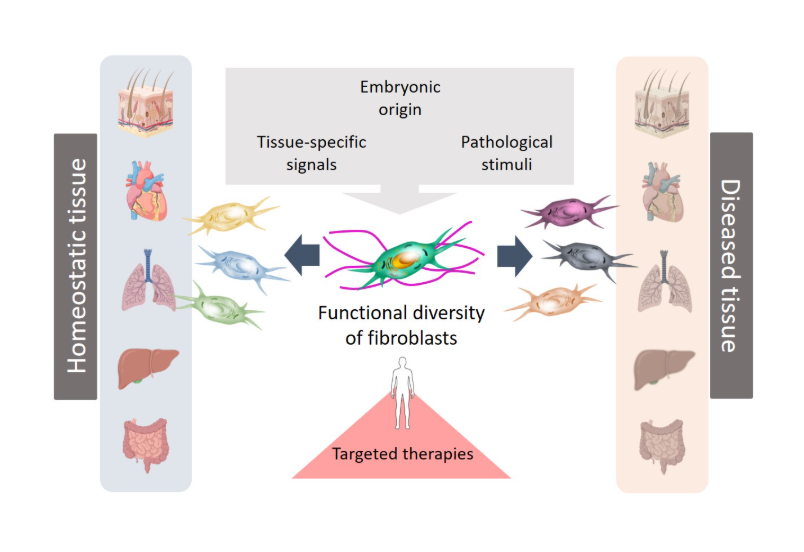
Human fibroblasts comprise diverse populations with specialized roles in tissue homeostasis and pathology that are controlled by developmental and environmental signals. Image: Professor Sandra Franz, Biorender.com
Fibroblasts are specialised connective tissue cells that play a key role in wound healing and tissue regeneration. The recent scientific publication from the University of Leipzig Medical Center shows that fibroblasts respond differently depending on the organ and disease context. Their functions are shaped by their embryonic origin, tissue-specific signals, and pathological stimuli...
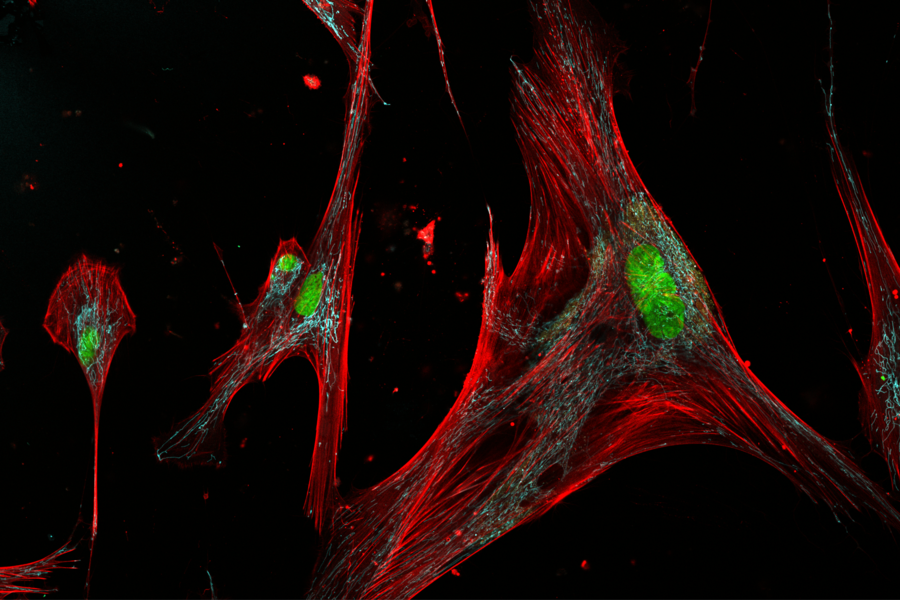
Researchers identified three types of zombie skin cells; only one gets worse with age. Researchers have identified three subtypes of senescent skin cells with distinct shapes, biomarkers, and functions – an advance that could equip scientists with the ability to target and kill the harmful types while leaving the helpful ones intact.
Senescent skin cells, often referred to as zombie cells because they have outlived their usefulness without ever quite dying, have existed in the human body as a seeming paradox, causing inflammation and promoting diseases while also helping the immune system to heal wounds.
New findings may explain why: Not all senescent skin cells are the same. They were published today in the journal Science Advances.
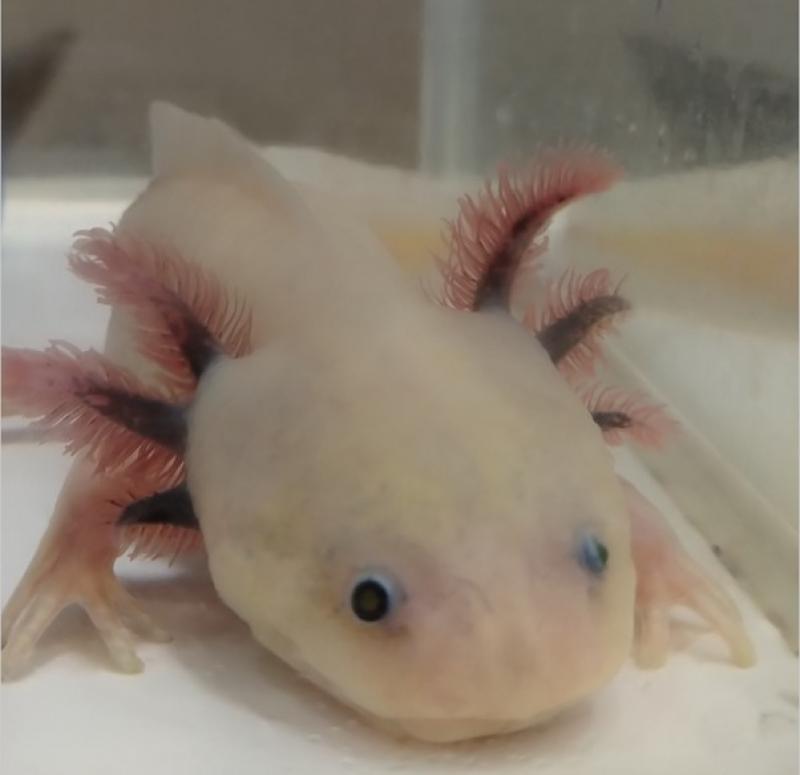
Keratinocytes produce collagen fibers, while deeper fibroblasts later modify the collagen fibers initially formed by keratinocytes. Challenging the long-standing belief that fibroblasts produce skin collagen, researchers at Okayama University have investigated collagen formation in the ‘glass-skinned’ amphibian axolotl and other vertebrates. They discovered that keratinocytes, the surface cells of the skin, are responsible for producing collagen, which is then transferred deeper to form the dermis. Later, fibroblasts migrate into this collagen layer, modifying and reinforcing its structure.
This diagram illustrates how the combination of fibroblast growth factor 4 and ascorbic acid activates the JAK2–STAT3 signaling pathway, promoting the maturation of induced cardiomyocytes (iCMs). This approach effectively reprograms fibroblasts into cardiomyocytes with improved structure and function, offering exciting possibilities for regenerative medicine. Credit: The author
Cardiovascular disease continues to lead as the primary cause of death across the globe, taking millions of lives every year. Damage caused by these diseases is particularly difficult to repair, since the heart has minimal ability to regenerate itself. But what if we could reprogram the body’s own cells to restore damaged tissue?
This question has been tackled by scientists at Korea University, led by Dr...







Recent Comments