
formation of planets tagged posts

Gigantic Jupiter-type Planet reveals Insights into how Planets Evolve

An image of the HD 106906 stellar debris disk, created by Erika Nesvold's simulation, showing the ring of rocky and icy planet-forming material rotating around the star. (The star is removed from the image, masked by the black circle.) The different hues represent gradients of brightness in the disk material; yellow is the brightest and blue the dimmest. Credit: Erika Nesvold/Carnegie Institution for Science

An image of the HD 106906 stellar debris disk, created by Erika Nesvold’s simulation, showing the ring of rocky and icy planet-forming material rotating around the star. (The star is removed from the image, masked by the black circle.) The different hues represent gradients of brightness in the disk material; yellow is the brightest and blue the dimmest. Credit: Erika Nesvold/Carnegie Institution for Science

Astrophysicists get rare peek at a baby solar system 300 light-years away. An enormous young planet ~300 light-years from Earth has given astrophysicists a rare glimpse into planetary evolution. The planet, known as HD 106906b, was discovered in 2014 by a team of scientists from the U.S., the Netherlands and Italy...

Read More
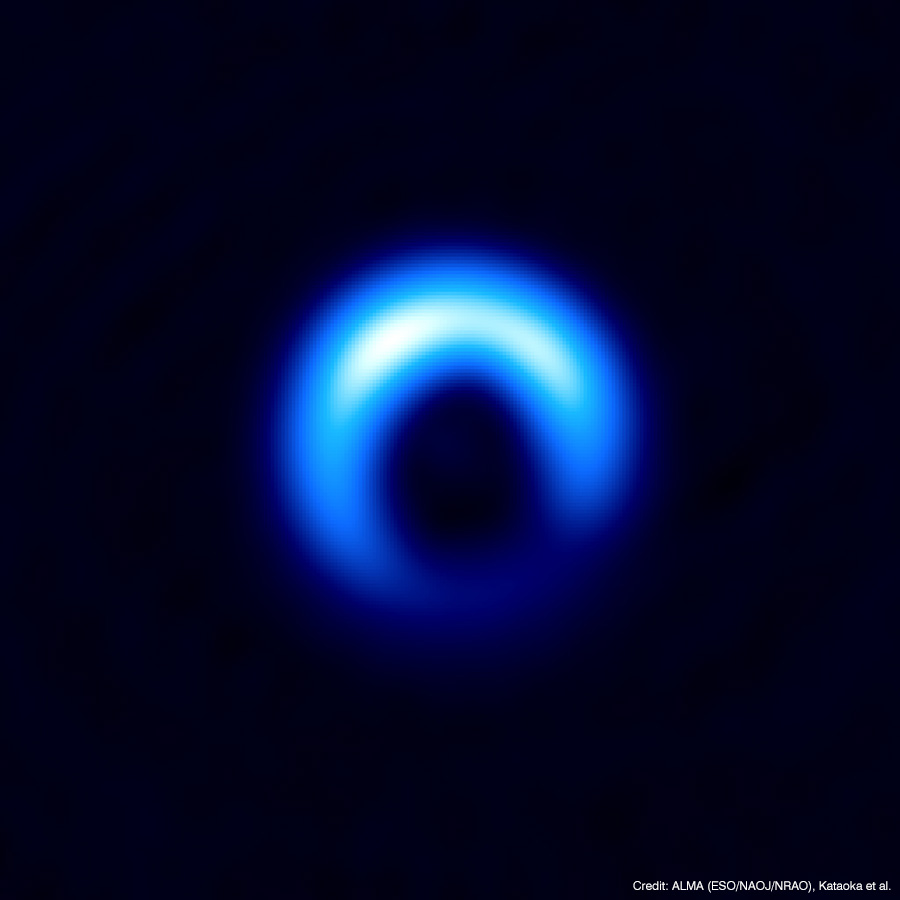
ALMA measures Size of Seeds of Planets

Dust disk around the young star HD 142527 observed with ALMA.

Dust disk around the young star HD 142527 observed with ALMA.

Researchers have for the first time, achieved a precise size measurement of small dust particles around a young star through radio-wave polarization. ALMA’s high sensitivity for detecting polarized radio waves made possible this important step in tracing the formation of planets around young stars. Astronomers have believed that planets are formed from gas and dust particles, although the details of the process have been veiled. One of the major enigmas is how dust particles as small as 1 micrometer aggregate to form a rocky planet with a diameter of 10,000 km. Difficulty in measuring the size of dust particles has prevented astronomers from tracing the process of dust growth.

Akimasa Kataoka and his collaborators have theoretic...

Read More
