This image combines 678 separate images taken by NSF–DOE Vera C. Rubin Observatory in just over seven hours of observing time. Combining many images in this way clearly reveals otherwise faint or invisible details, such as the clouds of gas and dust that comprise the Trifid nebula (top) and the Lagoon nebula, which are several thousand light-years away from Earth. More information about this image is available on RubinObservatory.org. Download Trifid and Lagoon at full resolution (24.14GB) Credit: NSF–DOE Vera C. Rubin Observatory
When you look up at the night sky, it appears unchanging. But if you look deep enough you will find that the sky is in fact constantly shifting. Satellites, asteroids and interstellar objects pass by...
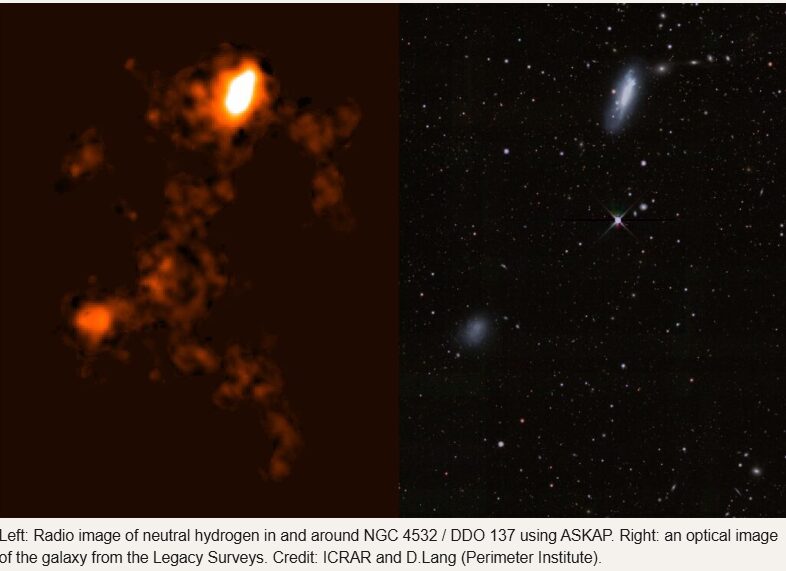
Astronomers have made a groundbreaking discovery of a colossal bridge of neutral hydrogen gas linking two dwarf galaxies. Scientists at The University of Western Australia’s node of the International Centre for Radio Astronomy Research (ICRAR) have made a remarkable discovery: a massive structure stretching about 185,000 light-years between two galaxies, NGC 4532 and DDO 137, located some 53 million light-years from Earth.
According to a study published in the Monthly Notices of the Royal Astronomical Society, the team also detected a huge tail of gas extending another 1.6 million light-years beyond the bridge, making it the largest feature of its kind ever recorded.
Lead researcher Professor Lister Staveley-Smith from ICRAR UWA explained that the finding provides an important n...
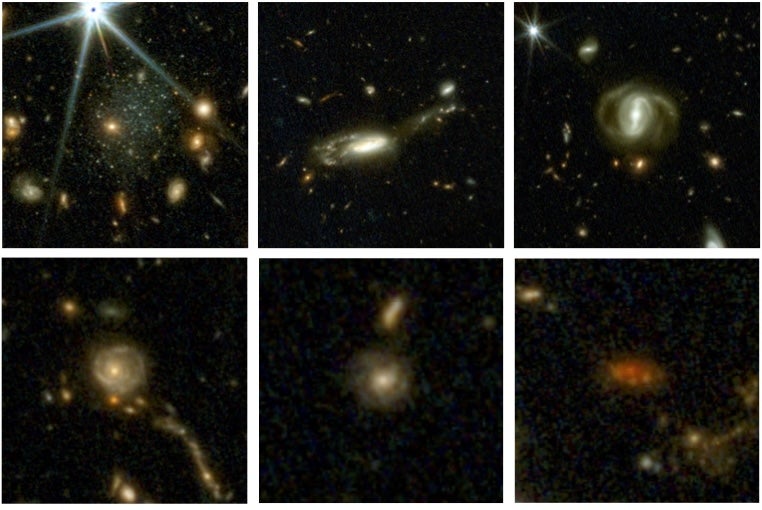
Photo Credit M. Franco / C. Casey / COSMOS-Web collaboration Six images of galaxies taken from nearly 800,000, from upper left to lower right: the present-day universe, and 3, 4, 8, 9 and 10 billion years ago
Largest map of the universe announced revealing 800,000 galaxies, challenging early cosmos theories
In the name of open science, the multinational scientific collaboration COSMOS on Thursday released the data behind the largest map of the universe. Called the COSMOS-Web field, the project, built with data collected by the James Webb Space Telescope (JWST), consists of all the imaging and a catalog of nearly 800,000 galaxies spanning nearly all of cosmic time. And it’s been challenging existing notions of the infant universe.
“Our goal was to construct this deep field of space ...






Recent Comments