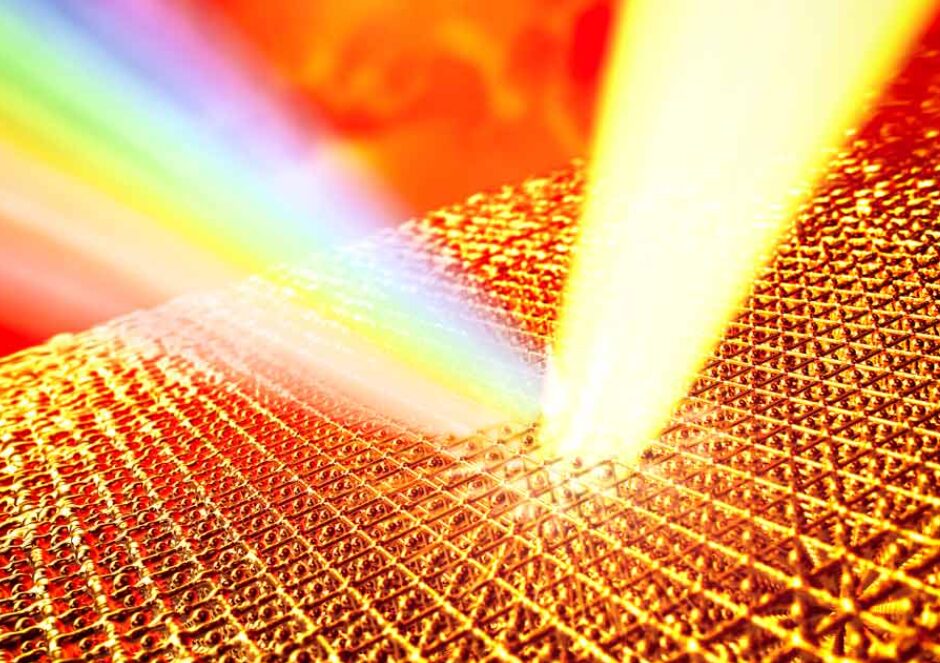
Researchers at SLAC’s Matter in Extreme Conditions (MEC) instrument used a laser to superheat a sample of gold. Then, they sent a pulse of ultrabright X-rays from the Linac Coherent Light Source (LCLS) through the sample to measure the speed, and thus the temperature, of the atoms vibrating in the sample. Graphic credit: Greg Stewart/SLAC National Accelerator Laboratory
Gold was superheated to 19,000 Kelvin without melting, defying physics and unlocking new possibilities in high-energy research. Physicists have heated gold to over 19,000 Kelvin, more than 14 times its melting point, without melting it, smashing the long-standing “entropy catastrophe” limit...
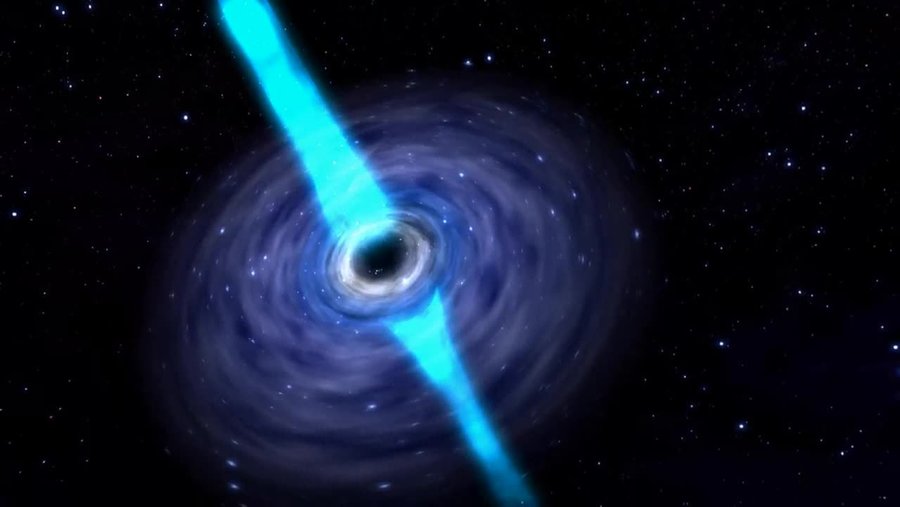
How are chemical elements produced in our Universe? Where do heavy elements like gold and uranium come from? Using computer simulations, a research team from the GSI Helmholtzzentrum für Schwerionenforschung in Darmstadt, together with colleagues from Belgium and Japan, shows that the synthesis of heavy elements is typical for certain black holes with orbiting matter accumulations, so-called accretion disks. The predicted abundance of the formed elements provides insight into which heavy elements need to be studied in future laboratories — such as the Facility for Antiproton and Ion Research (FAIR), which is currently under construction — to unravel the origin of heavy elements. The results are published in the journal Monthly Notices of the Royal Astronomical Society.
C. metallidurans can produce small gold nuggets. Credit: American Society for Microbiology
High concentrations of heavy metals, like copper and gold, are toxic for most living creatures. This is not the case for the bacterium C. metallidurans, which has found a way to extract valuable trace elements from a compound of heavy metals without poisoning itself. One interesting side-effect: the formation of tiny gold nuggets. A team of researchers from Martin Luther University Halle-Wittenberg (MLU), the Technical University of Munich (TUM) and the University of Adelaide in Australia has discovered the molecular processes that take place inside the bacteria.
The rod-shaped bacterium C. metallidurans primarily lives in soils that are enriched with numerous heavy metals...
1. The theory that primordial black holes collide with neutron stars to create heavy elements explains the lack of neutron stars in the center of the Milky Way galaxy, a long-standing mystery. Credit: University of California, Los Angeles 2. A black hole captured by a neutron star. Credit: Alexander Kusenko/UCLA
UCLA physicists have proposed new theories for how the universe’s first black holes might have formed and the role they might play in the production of heavy elements such as gold, platinum and uranium. A long-standing question in astrophysics is whether the universe’s very first black holes came into existence less than a second after the Big Bang or whether they formed only millions of years later during the deaths of the earliest stars.







Recent Comments