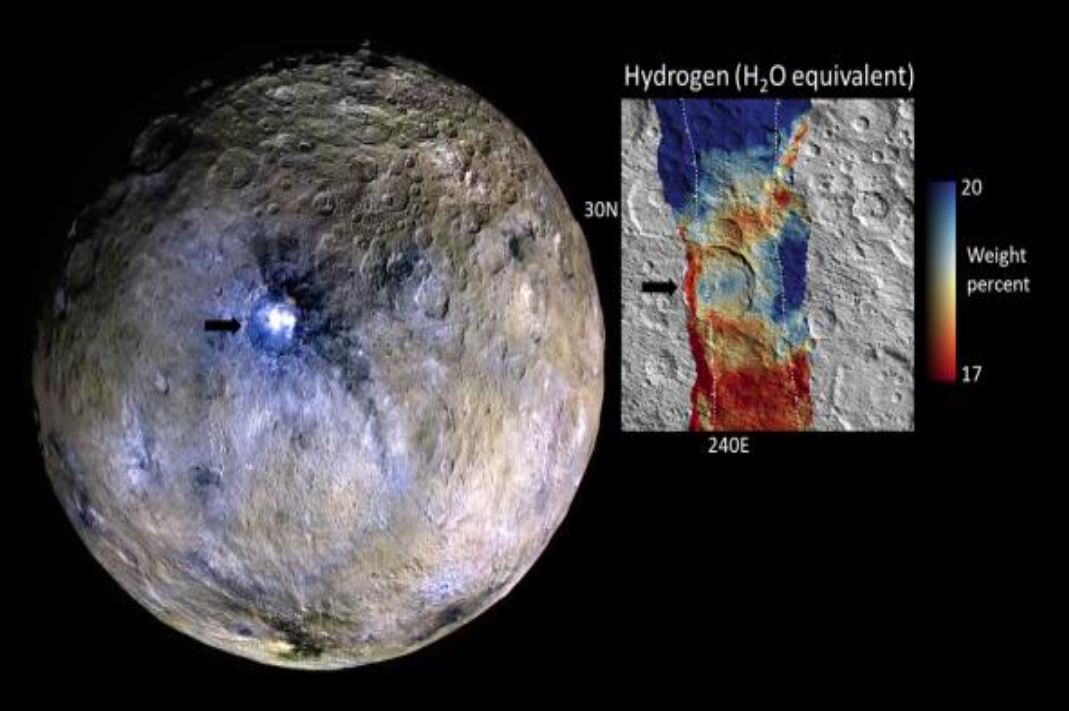
The study focused on Occator crater (left), which contains Ceres’ most prominent bright spots. The newly reported map (right) reveals higher concentrations of hydrogen than expected if the near sub-surface within Occator crater and its ejecta blanket was ice free. Results indicate that the crustal materials excavated by the crater-forming impact were rich in water ice. Image credits: NASA/JPL-CalTech/UCLA/MPS/DLR/IDA and Prettyman et al. (2021).
Anomalies in the distribution of hydrogen at Occator crater on the dwarf planet Ceres reveal an icy crust, says a new paper led by Tom Prettyman, a Senior Scientist at the Planetary Science Institute.
The evidence comes from data acquired by the Gamma Ray and Neutron Detector (GRaND) aboard NASA’s Dawn spacecraft...






Recent Comments