
Habitable-zone Planet Finder (HPF) tagged posts

Nearby super-Earth may be our best chance yet to find alien life

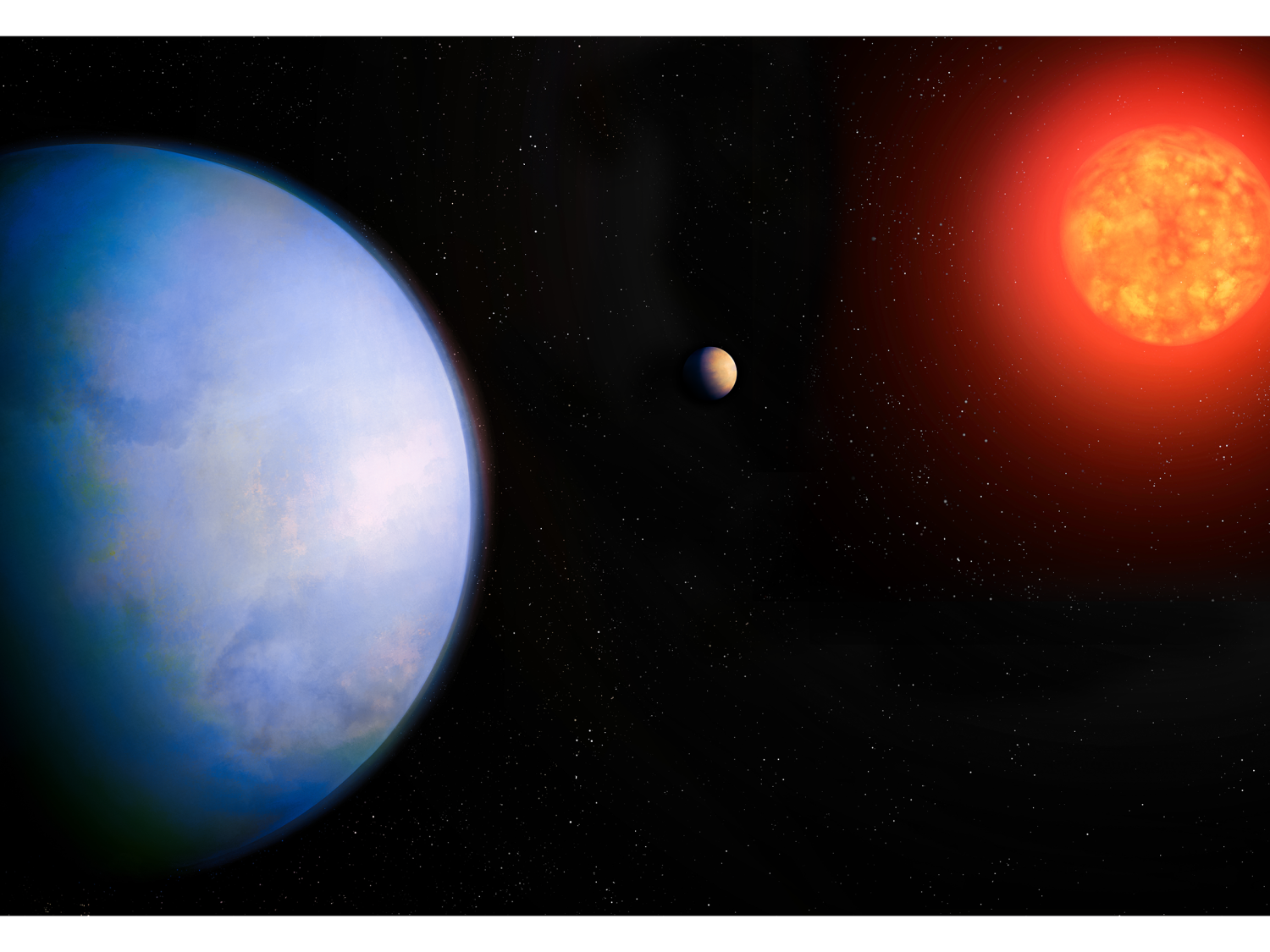
an illustration of a planet and a star
An international team of scientists, including researchers at Penn State, dubbed the exoplanet, named GJ 251 c, a “super-Earth” as data suggest it has a rocky composition similar to Earth and is almost four times as massive.  Credit: Illustration by University of California Irvine . All Rights Reserved.

A nearby super-Earth may be one of the best chances yet to search for life beyond our solar system. A newly detected super-Earth just 20 light-years away is giving scientists one of the most promising chances yet to search for life beyond our solar system. The discovery of the exoplanet orbiting in the habitable zone of its star was made possible by advanced spectrographs designed at Penn State and by decades of observations from telescopes around the world.

A possible “supe...

Read More

Sub-Neptune sized planet validated with the Habitable-Zone Planet Finder

A signal originally detected by the Kepler spacecraft has been validated as an exoplanet using the Habitable-zone Planet Finder (HPF), an astronomical spectrograph built by a Penn State team and recently installed on the 10m Hobby-Eberly Telescope at McDonald Observatory in Texas. The HPF provides the highest precision measurements to date of infrared signals from nearby low-mass stars, and astronomers used it to validate the candidate planet by excluding all possibilities of contaminating signals to very high level of probability. The details of the findings appear in the Astronomical Journal.

The planet, called G 9-40b, is about twice the size of the Earth, but likely closer in size to Neptune, and orbits its low mass host star, an M dwarf star, only 100 light years from Earth...

Read More
