Holograms tagged posts

New technology turns paintings into holograms, bringing art to life

New technology turns paintings into holograms, bringing art to life

Artists are always looking for new ways to create and express themselves. A growing trend is the use of multiple layers of see-through materials, such as Plexiglas, to create paintings that have real depth, transforming two-dimensional images into three-dimensional illusions that feel more realistic and lifelike. But can these layered works be made even more immersive?

A new study, published in Royal Society Open Science, answers this question by demonstrating a novel process to transform a multilayer acrylic painting into a fullcolor, three-dimensional hologram. In addition to offering a striking way to experience art, this technique provides a novel method for preserving and reproducing valuable works.

The researchers used a painting of a tiger titled “Taxonomy Test 1” by reno...

Read More
Optoelectronics research could bring holograms to your smartphone and closer to everyday use

New research from the University of St Andrews paves the way for holographic technology, with the potential to transform smartdevices, communication, gaming and entertainment.

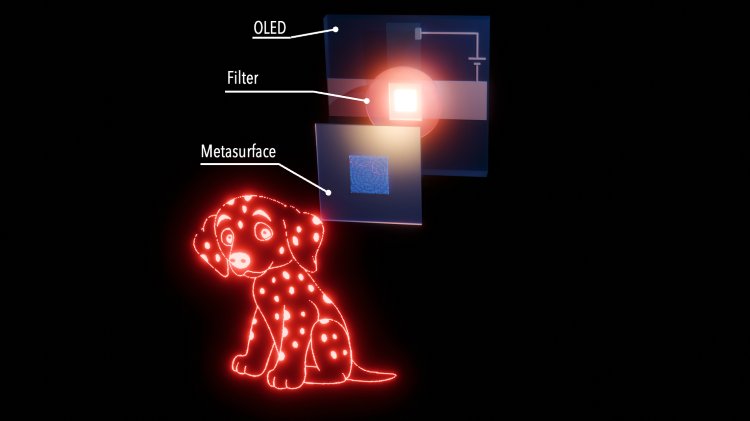
In a study published in Light: Science & Applications, researchers from the School of Physics and Astronomy created a new optoelectronic device from the combined use of holographic metasurfaces (HMs) and organic light-emitting diodes (OLEDs).

Until now, holograms have been created using lasers. However, researchers have found that using OLEDs and HMs gives a simpler and more compact approach that is potentially cheaper and easier to apply, overcoming the main barriers to hologram technology being used more widely.

Organic light-emitting diodes are thin film devices widely used to make the colored pixels...

Read More

Holograms with a twist: Entangling light and information

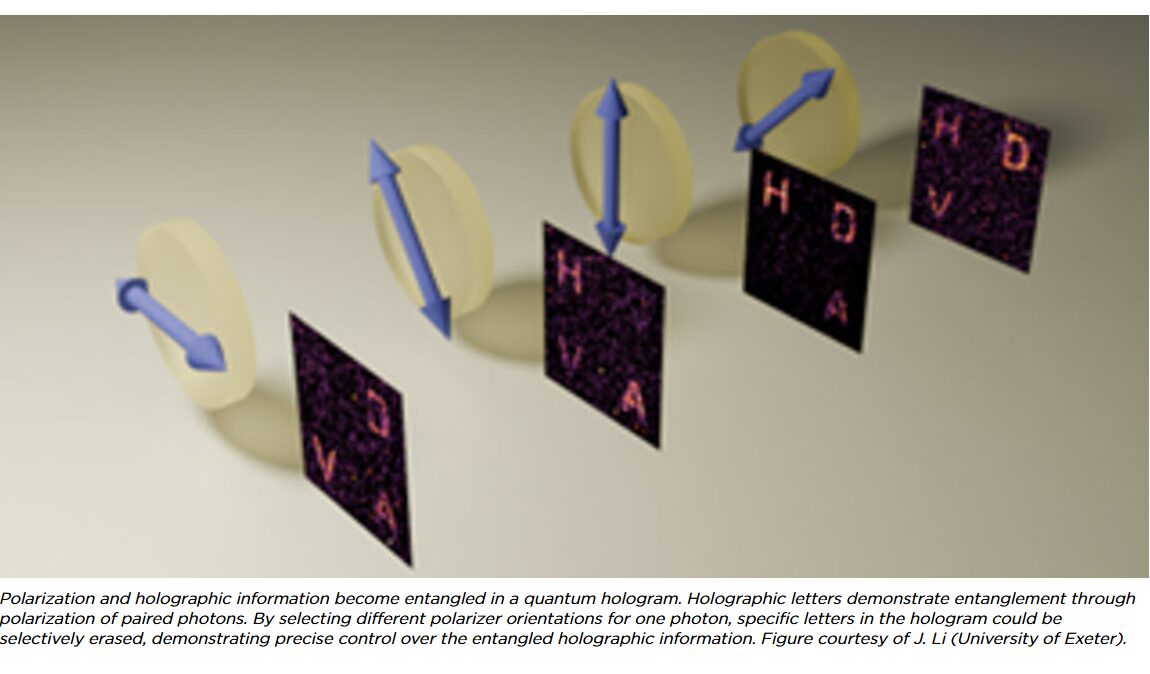
Quantum holograms using polarized light and metasurfaces enable precise control over entangled holographic information, advancing practical applications in quantum communication and anticounterfeiting technologies

Quantum entanglement is a fundamental phenomenon in nature and one of the most intriguing aspects of quantum mechanics. It describes a correlation between two particles, such that measuring the properties of one instantly reveals those of the other, no matter how far apart they are. This unique property has been harnessed in applications such as quantum computing and quantum communication.

A common method for generating entanglement is through a nonlinear crystal, which produces photon pairs with entangled polarizations via spontaneous parametric down-conversion (SPDC)...

Read More

Self-supervised AI Learns Physics to Reconstruct Microscopic Images from Holograms

GedankenNet 2
Ozcan Research Lab/UCLA
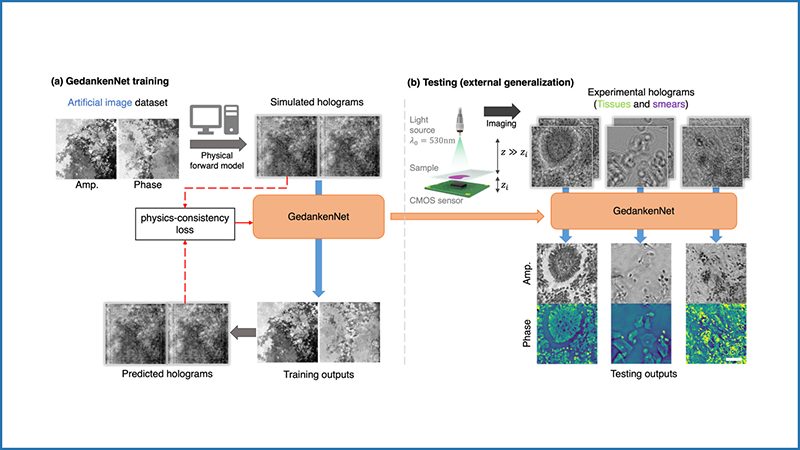
Images showing the training and testing of UCLA-developed AI-powered GedankenNet using simulated holograms generated from random images in reconstructing microscopic images of various human tissue sections and Pap smears. Scale bar: 50 μm (millionth of a meter)

Advance uses thought experiments, instead of real data, to expedite learning. Researchers from the UCLA Samueli School of Engineering have unveiled an artificial intelligence-based model for computational imaging and microscopy without training with experimental objects or real data.

In a recent paper published in Nature Machine Intelligence, UCLA’s Volgenau Professor for Engineering Innovation Aydogan Ozcan and his research team introduced a self-supervised AI model nicknamed GedankenNet that learns f...

Read More