The team obtained the thermal emission spectrum of WASP-18 b by measuring the amount of light it emits over the Webb Telescope’s NIRISS SOSS 0.85 – 2.8 micron wavelength range, capturing 65% of the total energy emitted by the planet. WASP-18 b is so hot on the day side of this tidally locked planet that water molecules would be vaporized. Webb directly observed water vapor on the planet in even relatively small amounts, indicating the sensitivity of the observatory. Credit: NASA/JPL-Caltech (R. Hurt/IPAC)
400 light-years out there is something that is so tantalizing that astronomers have been studying it since its discovery in 2009. One orbit for WASP-18 b around its star that is slightly larger than our sun takes just 23 hours. There is nothing like it in our solar system.
Courtesy of NASA/ESA/CSA/Alyssa Pagan (STScI)/Geronimo Villanueva (NASA-GSFC) SwRI contributed to new Cycle 1 JWST findings that show the plume of water escaping from Saturn’s moon Enceladus extends 6,000 miles or more than 40 times the moon’s size. In light of this discovery, SwRI’s Dr. Christopher Glein was awarded a NASA JWST Cycle 2 allocation to study the plume as well as the icy surface of Enceladus, to better understand the potential habitability of this ocean world.
Two Southwest Research Institute scientists were part of a James Webb Space Telescope (JWST) team that observed a towering plume of water vapor more than 6,000 miles long—roughly the distance from the U.S. to Japan—spewing from the surface of Saturn’s moon, Enceladus...
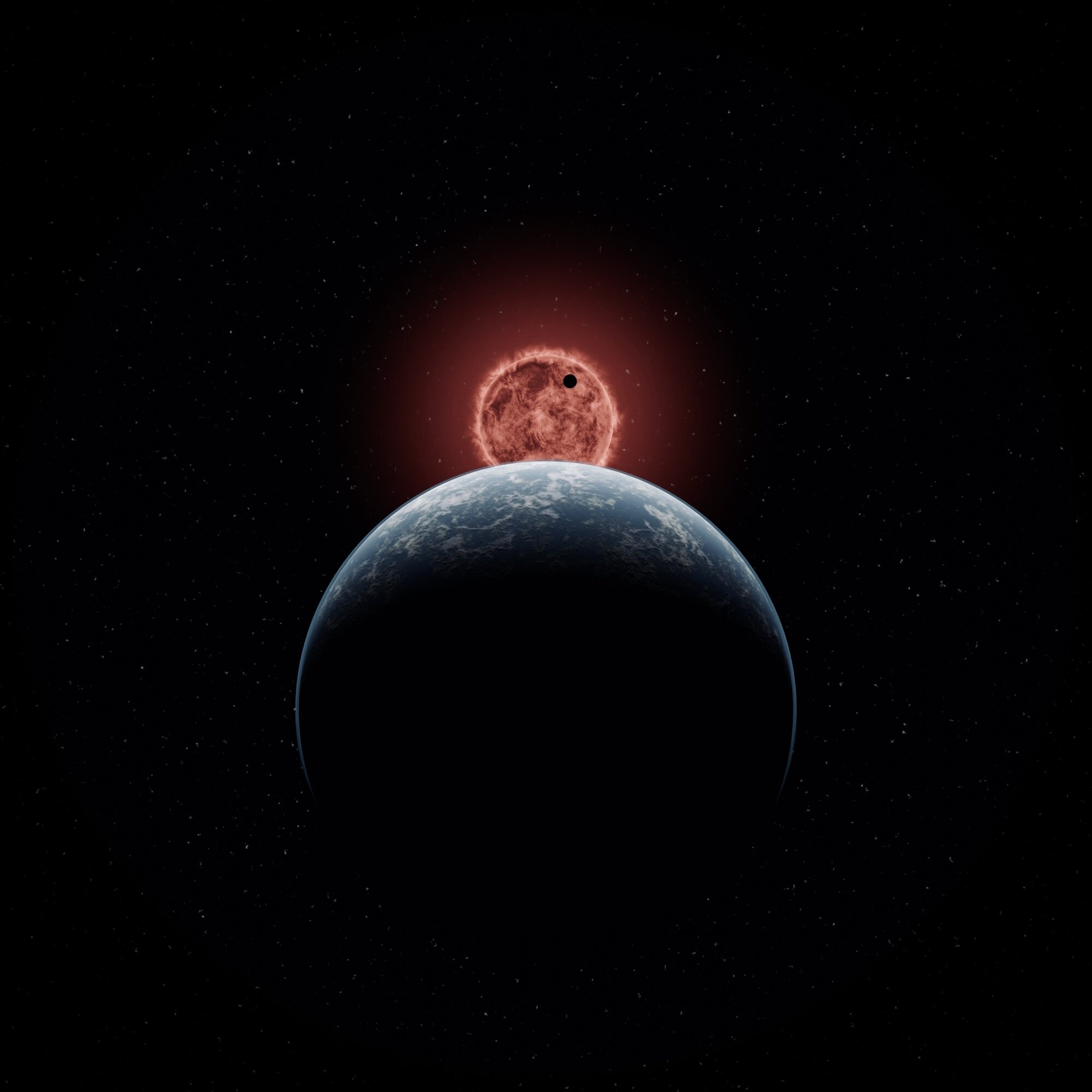
Artist’s view of the TOI-2096 system. Credit: Lionel J. Garcia / ULiège
A study led by researchers of the University of Liège and the CSIC—using observations from NASA’s TESS telescope—presents the detection of a system of two planets slightly larger than Earth orbiting a cold star in a synchronized dance. Named TOI-2096, the system is located 150 light-years from Earth.
The discovery is the result of a close collaboration between European and American universities and was made possible by the US space mission TESS (Transiting Exoplanet Survey Satellite), which aims to find planets orbiting nearby bright stars.
“TESS is conducting an all-sky survey using the transit method, that is, monitoring the stellar brightness of thousands of stars in the search for a slight dimming, ...
Images of six candidate massive galaxies, seen 500-800 million years after the Big Bang. Image credit: NASA/ESA/CSA/I. Labbe
Astronomers find that six of the earliest and most massive galaxy candidates observed by the James Webb Space Telescope so far appear to have converted nearly 100% of their available gas into stars, a finding at odds with the reigning model of cosmology.
The JWST appears to be finding multiple galaxies that grew too massive too soon after the Big Bang, if the standard model of cosmology is to be believed.
In a study published in Nature Astronomy, Mike Boylan-Kolchin, an associate professor of astronomy at The University of Texas at Austin, finds that six of the earliest and most massive galaxy candidates observed by JWST so far stand to contradict the preva...







Recent Comments