
JWST tagged posts

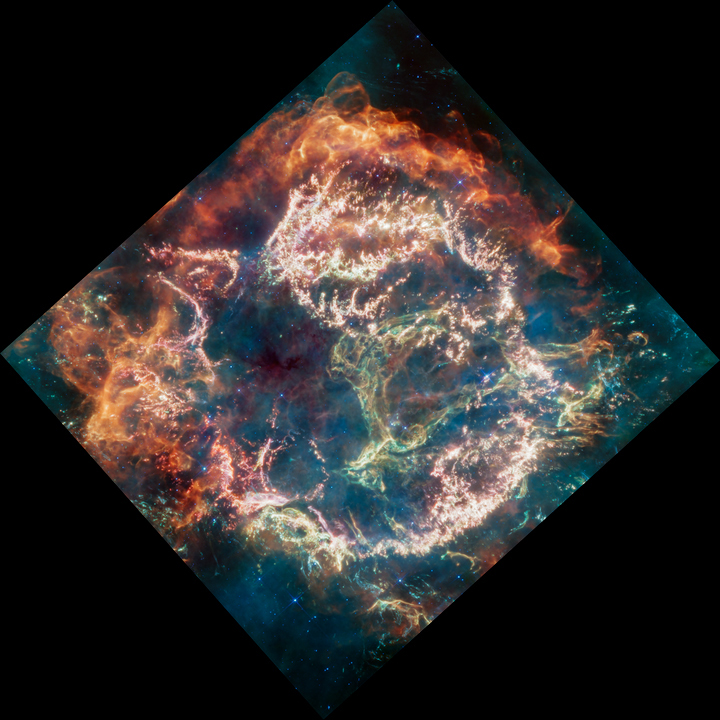
New Webb Telescope image reveals Wonders, Beauty, Secrets of Star Structure and Building Blocks of life

milisavljevic-cassiopeia
Danny Milisavljevic’s research on the James Webb Space Telescope led to his new detailed image of stellar remnant Cassiopeia A in which infrared light is translated into visible-light wavelengths. (NASA image)

To gaze at the stars is human. To be able to see them in 3D detail is very nearly divine.
Divine vision is what the James Webb Space Telescope has granted Earthbound scientists in a new near-infrared, detailed image of Cassiopeia A (Cas A), a stellar remnant—the clouds of gas, dust and other material left behind when a star dies. Danny Milisavljevic, assistant professor of physics and astronomy in Purdue University’s College of Science, studies supernova remnants and leads a year one research team on the JWST examining Cas A.

“I have spent 17 years studying stars and their ...

Read More
JWST confirms Giant Planet Atmospheres Vary Widely

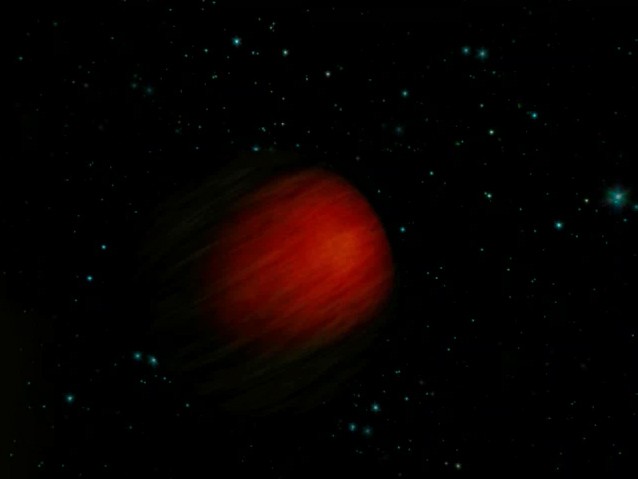
An international team of astronomers has found the atmospheric compositions of giant planets out in the galaxy do not fit our own solar system trend.

Using NASA’s James Webb Space Telescope (JWST), the researchers discovered that the atmosphere of exoplanet HD149026b, a ‘hot Jupiter’ orbiting a star comparable to our sun, is super-abundant in the heavier elements carbon and oxygen — far above what scientists would expect for a planet of its mass.

These findings, published in “High atmospheric metal enrichment for a Saturn-mass planet” in Nature on March 27, provide insight into planet formation.

“It appears that every giant planet is different, and we’re starting to see those differences thanks to JWST,” said Jonathan Lunine, professor in the physical sciences at Cornell Univ...

Read More

Researchers Capture Early Stages of Star Formation from JWST data

Galaxy captured by the James Webb Space Telescope
Researchers are getting their first glimpses inside distant spiral galaxies to see how stars formed and how they change over time, thanks to the James Webb Space Telescope’s ability to pierce the veil of dust and gas clouds. (Photo: NASA/Space Telescope Science Institute)

A team of researchers has been able to see inside faraway spiral galaxies for the first time to study how they formed and how they change over time, thanks to the powerful capabilities of the James Webb Space Telescope.

“We’re studying 19 of our closest analogs to our own galaxy. In our own galaxy we can’t make a lot of these discoveries because we’re stuck inside it,” says Erik Rosolowsky, professor in the Department of Physics and co-author on a recent paper analyzing data from the James Webb telescope.

Unli...

Read More

Were Galaxies much Different in the Early Universe?

The HERA radio telescope consists of 350 dishes pointed upward to detect 21-centimeter emissions from the early universe. It is located in a radio-quiet region of the arid Karoo in South Africa. (Photo credit: Dara Storer, 2022)

Newest data from HERA improves search for cosmic dawn radiation, tests theories of galaxy formation. An array of 350 radio telescopes in the Karoo desert of South Africa is getting closer to detecting “cosmic dawn” – the era after the Big Bang when stars first ignited and galaxies began to bloom.

In a paper accepted for publication in The Astrophysical Journal, the Hydrogen Epoch of Reionization Array (HERA) team reports that it has doubled the sensitivity of the array, which was already the most sensitive radio telescope in the world dedicated to exploring ...

Read More
