JWST tagged posts

Hubble Captures Largest Near-Infrared Image to find Universe’s Rarest Galaxies

""
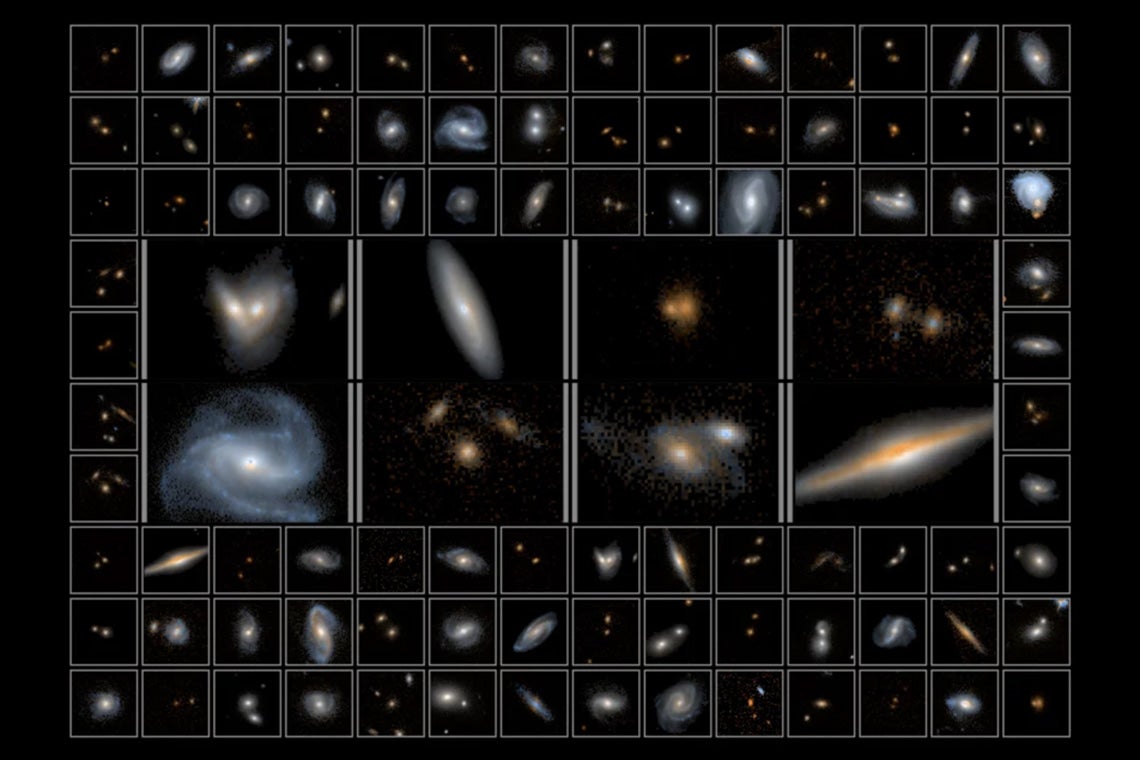
Galaxies from the last 10 billion years witnessed in the 3D-DASH program, created using 3D-DASH/F160W and ACS-COSMOS/F814W imaging (image by Lamiya Mowla)

An international team of scientists today released the largest near-infrared image ever taken by NASA’s Hubble Space Telescope, enabling astronomers to map the star-forming regions of the universe and learn how the earliest, most distant galaxies originated. Named 3D-DASH, this high-resolution survey will allow researchers to find rare objects and targets for follow-up observations with the recently launched James Webb Space Telescope (JWST) during its decades-long mission.

A preprint of the paper to be published in The Astrophysical Journal is available on arXiv.

“Since its launch more than 30 years ago, the Hubble Space Teles...

Read More
Neptune is Cooler than we thought: Study reveals unexpected Changes in Atmospheric Temperatures

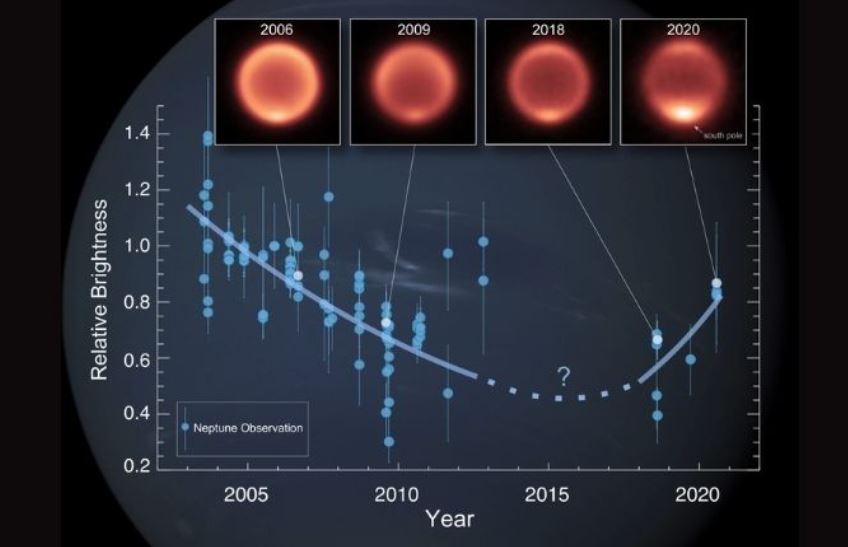
Observed changes in Neptune’s thermal-infrared brightness, a measure of temperature in Neptune’s atmosphere. The plot shows the relative change in the thermal-infrared brightness from Neptune’s stratosphere with time for all existing images taken by ground-based telescopes. Brighter images are interpreted as warmer. Corresponding thermal-infrared images (top) at wavelengths of ~12 µm show Neptune’s appearance in 2006, 2009, 2018 (observed by the European Southern Observatory’s Very Large Telescope’s VISIR instrument), and 2020 (observed by Subaru’s COMICS instrument). The south pole appears to have become dramatically warmer in just the past few years. Credit: Michael Roman/NASA/JPL/Voyager-ISS/Justin Cowart

New research led by space scientists at the University of Leice...

Read More

Eccentric Exoplanet discovered

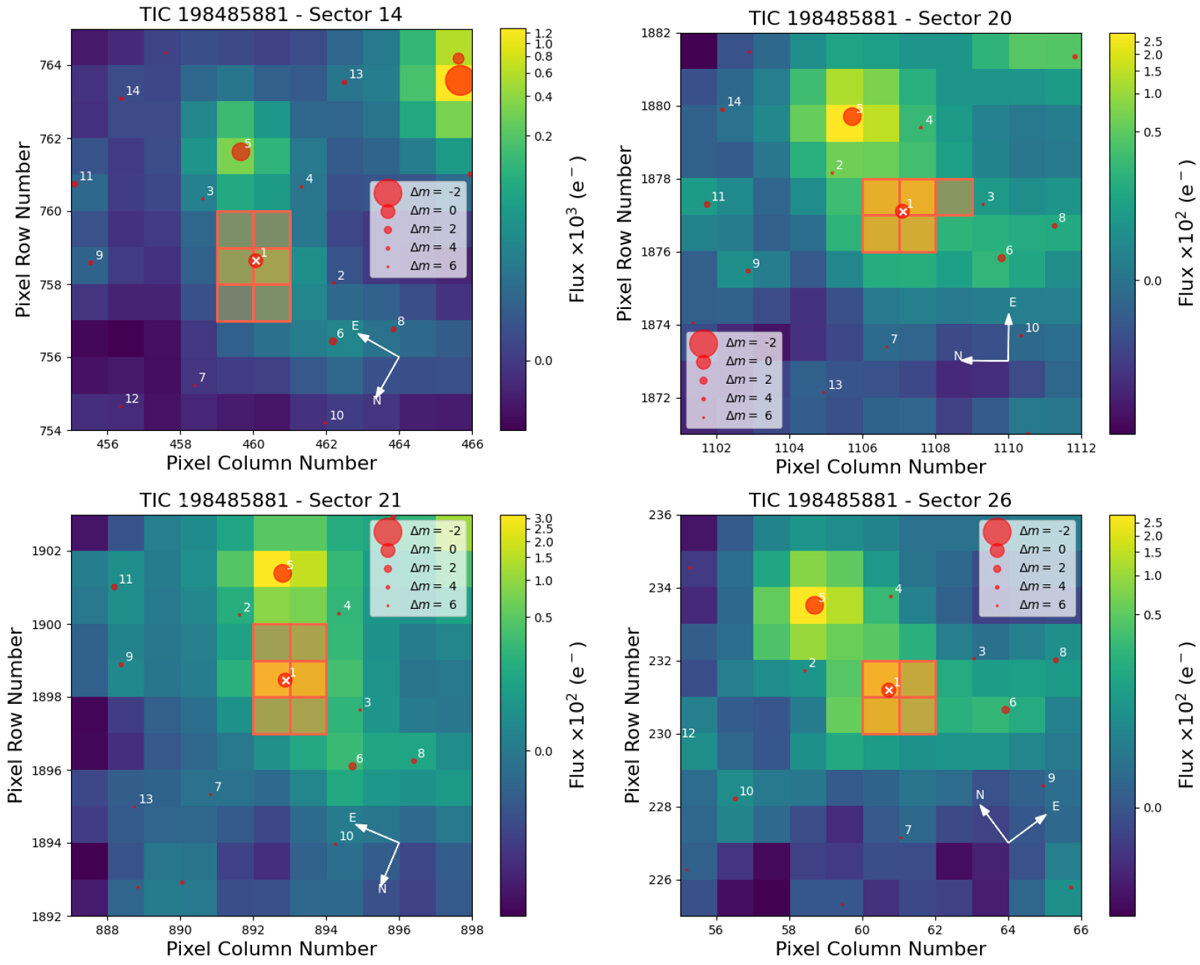
TESS target pixel files of Sectors 14, 20, 21, and 26 that observed TOI-2257, generated by means of tpfplotter (Aller et al. 2020). The apertures used to extract the photometry by the SPOC pipeline are shown as red shaded regions. The Gaia DR2 catalog (Gaia Collaboration 2018) is over-plotted, with all sources of up to 6 magnitudes in contrast with TOI-2257 shown as red circles. We note that the symbol size scales with the magnitude contrast. While the star is relatively isolated, there is a small amount of contamination from outside sources, ranging from 2–5% of the total flux. Credit: DOI: 10.1051/0004-6361/202142280

Eccentric exoplanet discovered Led by the University of Bern, an international research team has discovered a sub-Neptune exoplanet orbiting a red dwarf star...

Read More

Ocean World: Rocky Exoplanet has just Half the Mass of Venus

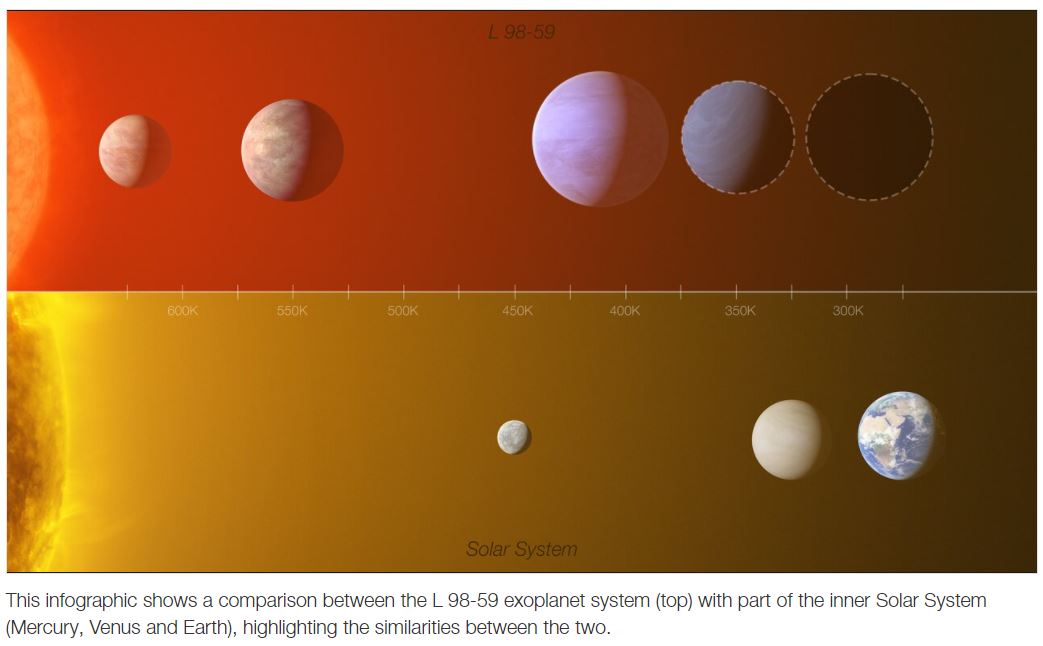
A team of astronomers have used the European Southern Observatory’s Very Large Telescope (ESO’s VLT) in Chile to shed new light on planets around a nearby star, L98-59, that resemble those in the inner Solar System. Amongst the findings are a planet with half the mass of Venus — the lightest exoplanet ever to be measured using the radial velocity technique — an ocean world, and a possible planet in the habitable zone.

“The planet in the habitable zone may have an atmosphere that could protect and support life,” says María Rosa Zapatero Osorio, an astronomer at the Centre for Astrobiology in Madrid, Spain, and one of the authors of the study published today in Astronomy & Astrophysics.

The results are an important step in the quest to find life on Earth-sized planets outside the...

Read More