
JWST tagged posts

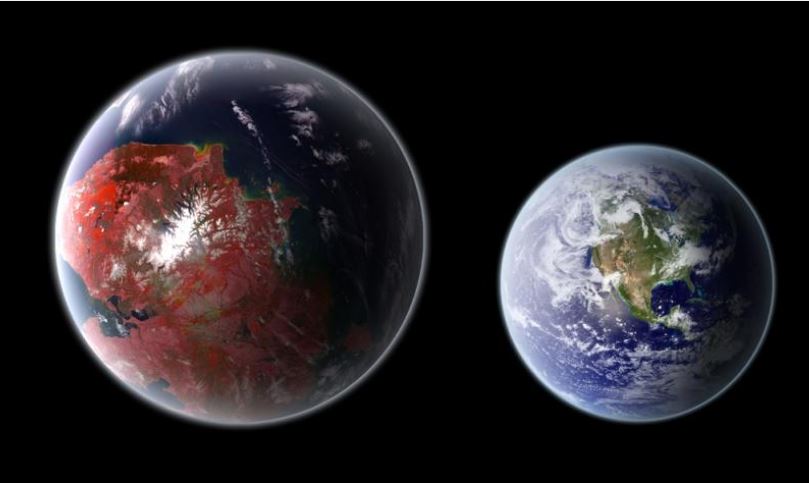
Earth-like Biospheres on other Planets may be Rare

An artistic representation of the potentially habitable planet Kepler 422-b (left), compared with Earth (right).
Credit
Ph03nix1986 / Wikimedia Commons
Licence type
Attribution-ShareAlike (CC BY-SA 4.0)

A new analysis of known exoplanets has revealed that Earth-like conditions on potentially habitable planets may be much rarer than previously thought. The work focuses on the conditions required for oxygen-based photosynthesis to develop on a planet, which would enable complex biospheres of the type found on Earth. The study is published today in Monthly Notices of the Royal Astronomical Society.

The number of confirmed planets in our own Milky Way galaxy now numbers into the thousands...

Read More

‘Twins’ of Superstar Eta Carinae found in Other Galaxies

Location of Eta twins in galaxies M51, M101, NGC 6946, and M83. Individual Image Credits: M51: NASA/ESA/Hubble Heritage Team (STScI/AURA); M101:NASA/ESA/K. Kuntz (JHU), F. Bresolin (U. Hawaii), J. Trauger (Jet Propulsion Lab), J. Mould (NOAO), Y.-H. Chu (U. Illinois, Urbana), Canada-France-Hawaii Telescope/ J.-C. Cuillandre/Coelum/, Jacoby, B. Bohannan, and M. Hanna/ NOAO/AURA/NSF; NGC 6946: NASA/ESA/STScI/R. Gendler/Subaru Telescope (NAOJ); M83: NASA/ESA/Hubble Heritage Team (STScI/AURA) Credit: NASA, ESA and R. Khan (GSFC and ORAU)

Location of Eta twins in galaxies M51, M101, NGC 6946, and M83. Individual Image Credits: M51: NASA/ESA/Hubble Heritage Team (STScI/AURA); M101:NASA/ESA/K. Kuntz (JHU), F. Bresolin (U. Hawaii), J. Trauger (Jet Propulsion Lab), J. Mould (NOAO), Y.-H. Chu (U. Illinois, Urbana), Canada-France-Hawaii Telescope/ J.-C. Cuillandre/Coelum/, Jacoby, B. Bohannan, and M. Hanna/ NOAO/AURA/NSF; NGC 6946: NASA/ESA/STScI/R. Gendler/Subaru Telescope (NAOJ); M83: NASA/ESA/Hubble Heritage Team (STScI/AURA) Credit: NASA, ESA and R. Khan (GSFC and ORAU)

Eta Carinae, the most luminous and massive stellar system within 10,000 light-yrs, is best known for an enormous eruption seen in the mid-19th century that hurled an amount of material at least 10X the sun’s mass into space...

Read More
