lactate tagged posts

How a Waste Product of Exercise Protects Neurons from Trauma Damage

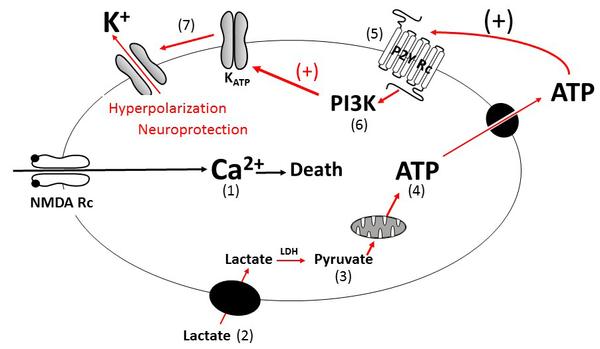
(1) Excessive glutamate activity triggers a strong influx of calcium (Ca2+) into the neuron through NMDA receptors, which leads to cell death. (2) Lactate is transported into the neuron and (3) converted to pyruvate by the enzyme lactate dehydrogenase (LDH). (4) Pyruvate is then transported into mitochondria by the mitochondrial pyruvate carrier (MPC) where it generates ATP. (5) ATP is then released through pannexins and activates the receptor P2Y, which (6) activates the PI3K pathway. (7) This triggers the opening of potassium channels (K+), which causes the neuron to hyperpolarize, decreasing the neuron's excitability, and thus protecting it from excitotoxic damage.

(1) Excessive glutamate activity triggers a strong influx of calcium (Ca2+) into the neuron through NMDA receptors, which leads to cell death. (2) Lactate is transported into the neuron and (3) converted to pyruvate by the enzyme lactate dehydrogenase (LDH). (4) Pyruvate is then transported into mitochondria by the mitochondrial pyruvate carrier (MPC) where it generates ATP. (5) ATP is then released through pannexins and activates the receptor P2Y, which (6) activates the PI3K pathway. (7) This triggers the opening of potassium channels (K+), which causes the neuron to hyperpolarize, decreasing the neuron’s excitability, and thus protecting it from excitotoxic damage.

Researchers led by EPFL have found how lactate, a waste product of glucose metabolism can protect neurons from damage follo...

Read More

Nerve cells cover their High Energy demand with Glucose and Lactate, scientists confirm

In comparison to other organs, the human brain has the highest energy requirements. Credit: Image courtesy of University of Zurich

In comparison to other organs, the human brain has the highest energy requirements. Credit: Image courtesy of University of Zurich

They show for the 1st time in the intact mouse brain evidence for an exchange of lactate between different brain cells. With this study they were able to confirm a 20-year old hypothesis. In comparison to other organs, the human brain has the highest energy requirements. A hypothesis from the 1990’s postulates, that a well-orchestrated collaboration between astrocytes and neurons, is the basis of brain energy metabolism.

Astrocytes produce lactate, which flows to neurons to cover their high energy needs. Due to a lack of experimental techniques, it remained unclear whether an exchange of lactate existed between astrocytes and neurons...

Read More