
Lithium-Sulfur Batteries tagged posts

From 0 to 100 in 12 minutes—roadmap for lithium–sulfur batteries

From 0 to 100 in 12 minutes—roadmap for lithium-sulfur batteries
Key challenges (red background) and potential solutions (green background) for fast-charging LSBs. Credit: Advanced Energy Materials (2025). DOI: 10.1002/aenm.202404383

Grab a coffee and your car is fully charged—this is how many people envision the future of mobility. But today’s batteries still fall short of this ideal. While modern lithium–ion batteries can charge from 20% to 80% in about 20 to 30 minutes, a full charge takes considerably longer—and fast charging puts significant stress on the cells.

A new international review study published in the journal Advanced Energy Materials now shows how lithium–sulfur batteries (LSBs) could overcome these limitations.

Researchers from Germany, India, and Taiwan—coordinated by Dr...

Read More
Chemists Decipher Reaction Process that could Improve Lithium-Sulfur Batteries

Electric battery
Research by UCLA chemists on the sulfur reduction reaction in lithium-sulfur batteries could lead to crucial advancements in battery capacity, speed and life span.

A combination of battery technology and catalysis opens new avenues for cheap, high-capacity batteries. Lithium-sulfur batteries can potentially store five to 10 times more energy than current state-of-the-art lithium-ion batteries at much lower cost. Current lithium-ion batteries use cobalt oxide as the cathode, an expensive mineral mined in ways that harm people and the environment. Lithium-sulfur batteries replace cobalt oxide with sulfur, which is abundant and cheap, costing less than one-hundredth the price of cobalt.

But there’s a catch: Chemical reactions, particularly the sulfur reduction reaction, are very comple...

Read More

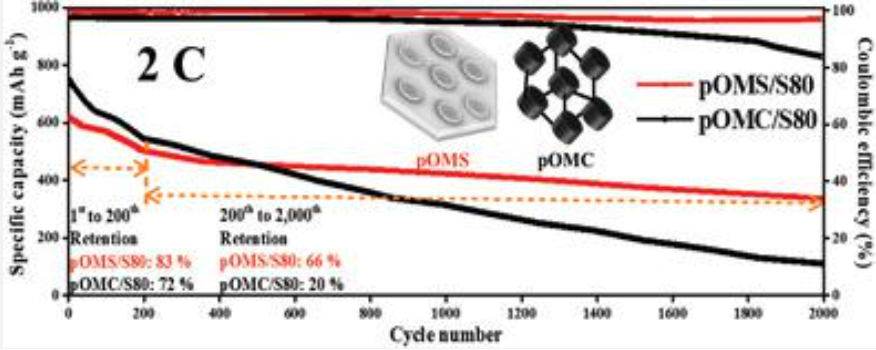
Breaking the mold: An unusual choice of Material yields incredibly Long-Lasting Batteries

This work has conducted an evaluation on the role of polarity over conductivity by using a polar but nonconductive platelet ordered mesoporous silica (pOMS) and its replica platelet ordered mesoporous carbon (pOMC), which is conductive but nonpolar. It is found that the polar pOMS/S cathode with a sulfur mass fraction of 80 wt% demonstrates outstanding long‐term cycle stability for 2000 cycles even at a high current density of 2C.

Non-conductive silica could be key to realizing next-generation lithium-sulfur batteries. Scientists have developed a novel silica-based cathode for lithium-sulfur batteries, thereby enabling the realization of batteries that can last for over 2000 charge/discharge cycles...

Read More

Coaxial Nanotubes used to Improve Performance of Lithium-Sulfur Batteries

Schematic illustration of polypyrrole-manganese dioxide (PPy-MnO2) coaxial nanotubes to accommodate sulfur for high-performance Li–S battery. Comparison of cyclic performance of S/PPy-MnO2 and S/PPy at 0.2C. (Reprinted with permission by American Chemical Society) (click on image to enlarge) Read more: Improving the performance of lithium-sulfur batteries with coaxial nanotubes

Schematic illustration of polypyrrole-manganese dioxide (PPy-MnO2) coaxial nanotubes to accommodate sulfur for high-performance Li–S battery. Comparison of cyclic performance of S/PPy-MnO2 and S/PPy at 0.2C. (Reprinted with permission by American Chemical Society) (click on image to enlarge) Read more: Improving the performance of lithium-sulfur batteries with coaxial nanotubes

University of Texas team has found that using coaxial nanotubes can improve the performance of lithium-sulfur batteries (Li-S).They used Polypyrrole-MnO2 coaxial nanotubes to overcome obstacles to using Li-S batteries in commercial products. Prior research has shown that Li-S batteries would offer users of electronics more energy storage—as much as 5X that of lithium-ion batteries...

Read More
