
living cells tagged posts

Soft, 3D transistors could host living cells for bioelectronics

Soft, 3D transistors may upend semiconductor device design, transform bioelectronics
From 2D rigid electronics to 3D soft electronics: Increasing the dimensionality of transistors with 3D hydrogel semiconductors. Credit: Shiming Zhang

New research from the WISE group (Wearable, Intelligent, Soft Electronics) at The University of Hong Kong (HKU-WISE) has addressed a long-standing bioelectronic challenge: the development of soft, 3D transistors.

This work introduces a new approach to semiconductor device design with transformative potential for bioelectronics. It is published in Science.

Led by Professor Shiming Zhang from the Department of Electrical and Electronic Engineering, Faculty of Engineering, the research team included senior researchers who joined HKU-WISE from the University of Cambridge and the University of Chicago, together with HKU Ph.D...

Read More
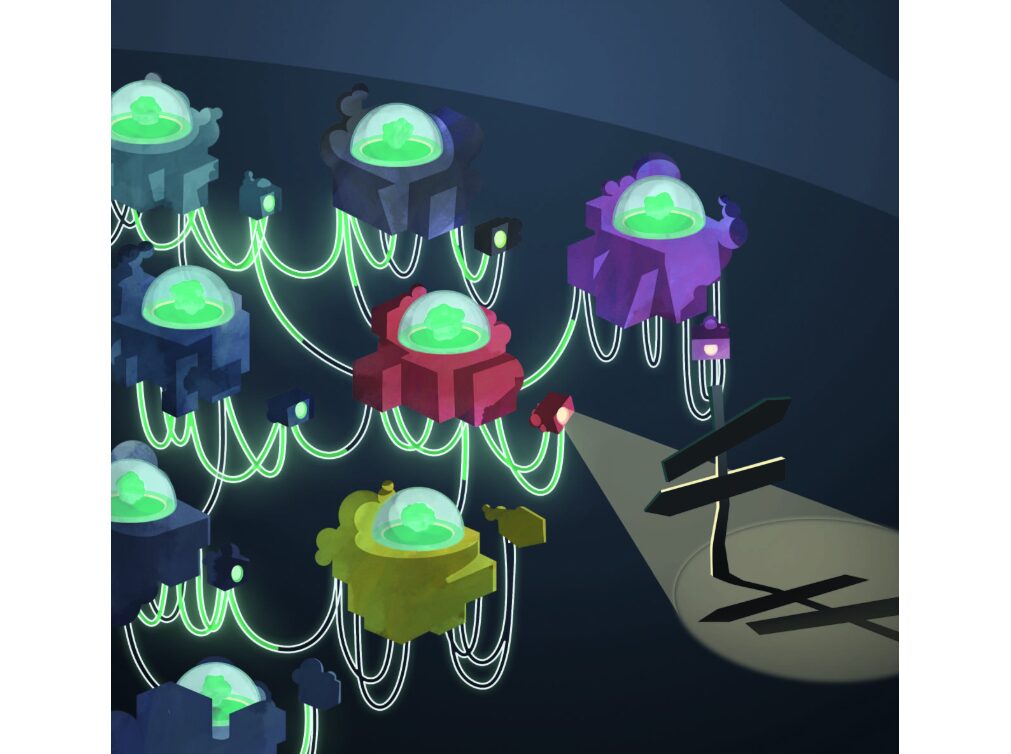
Introducing Perceptein, a Protein-based Artificial Neural Network in Living Cells

Here, each neuron is represented as spacecrafts, with their pilots in the cockpits depicted in the shape of protein 3D structures. These spacecrafts collectively process and transmit information to the final red neuron to make decisions on space navigation. The wires that connect the neurons, with the green substance inside, indicate the flow of biological information. Credit: Ehmad Chehre

Westlake University in China and the California Institute of Technology have designed a protein-based system inside living cells that can process multiple signals and make decisions based on them.

The researchers have also introduced a unique term, “perceptein,” as a combination of protein and perceptron...

Read More

Outsmarting the Biological Uncertainty Principle

This is a 3-D fluorescence microscopy image of a cell guidance receptor's (EphA2) signaling activity in a cryo-arrested cell. This receptor is overexpressed in melanomas and affects metastasis. From this image taken at subzero temperatures, one can see that it is transmitting its signals from small vesicles in the cell that get internalized from the plasma membrane. The color code indicates the signaling activity of the receptor. Credit: MPI f. Molecular Physiology

This is a 3-D fluorescence microscopy image of a cell guidance receptor’s (EphA2) signaling activity in a cryo-arrested cell. This receptor is overexpressed in melanomas and affects metastasis. From this image taken at subzero temperatures, one can see that it is transmitting its signals from small vesicles in the cell that get internalized from the plasma membrane. The color code indicates the signaling activity of the receptor. Credit: MPI f. Molecular Physiology

Pinpointing positions of individual molecules while also measuring their activity and interactions in the same living cell is now possible. A dedicated cooling protocol on a microscope allows to pause cellular life at subzero temperatures, to let it continue to live again after warming...

Read More
