
LOw Frequency ARray (LOFAR) tagged posts

Largest ever radio sky survey maps the universe in unprecedented detail

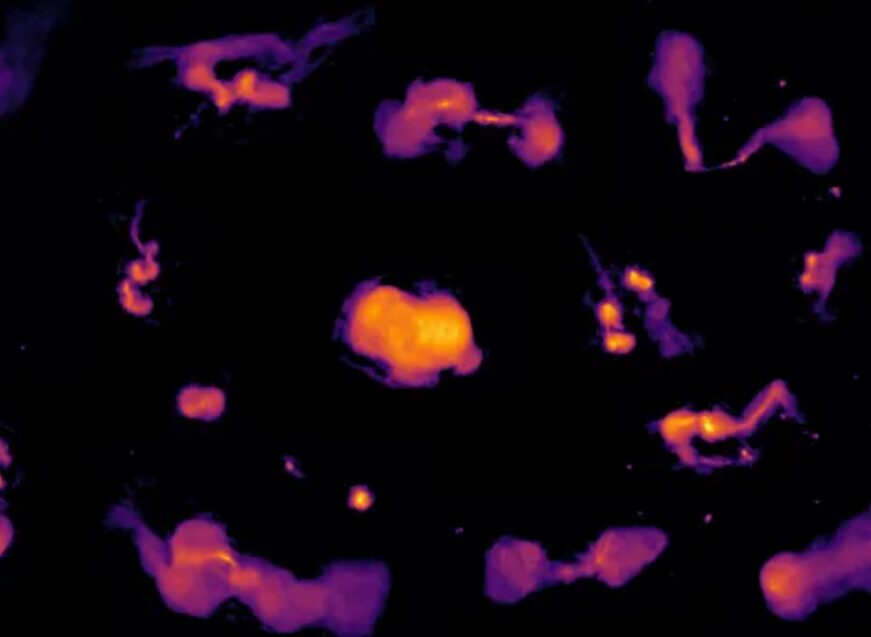
An international collaboration using the Low Frequency Array (LOFAR) has published an exceptionally detailed radio sky map, revealing 13.7 million cosmic sources and delivering the most complete census yet of actively growing supermassive black holes. It showcases an extraordinary variety of systems powered by these black holes, whose radio emission can extend for millions of light-years.

The newly released LOFAR Two-meter Sky Survey (LoTSS-DR3) marks a major milestone in radio astronomy and international scientific collaboration. The results will be published in Astronomy & Astrophysics.

By observing the sky at low radio frequencies, the survey reveals a dramatically different view of the universe than that seen at optical wavelengths...

Read More
European Astronomers Detect New Component of Radio Halo in a Nearby Galaxy Cluster

European astronomers detect new component of radio halo in a nearby galaxy cluster
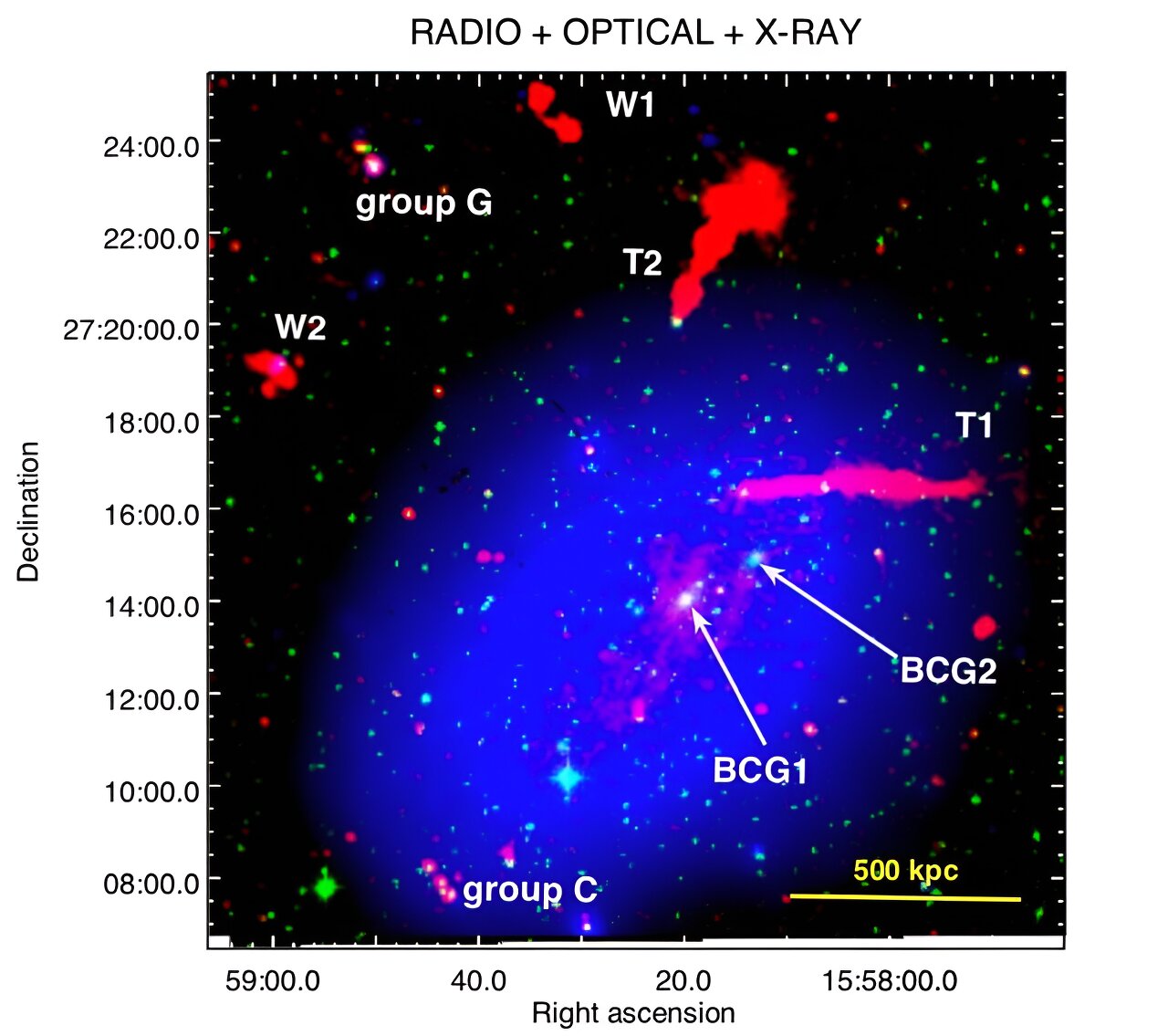
Composite RGB image of Abell 2142: radio (GMRT, 323 MHz) in red, optical (DSS-2, red filter) in green, and X-rays (XMM-Newton) in blue. Credit: Bruno et al., 2023.

Using the LOw Frequency ARray (LOFAR), astronomers from the University of Bologna, Italy and elsewhere, have conducted radio observations of the nearby galaxy cluster Abell 2142. In result, they detected a new component of the cluster’s giant radio halo. The finding was presented in a paper published August 15 on the pre-print server arXiv.

Galaxy clusters contain up to thousands of galaxies bound together by gravity. They are the largest known gravitationally bound structures in the universe, and could serve as excellent laboratories for studying galaxy evolution and cosmology.

Radio halos are enormous regions of diff...

Read More
